Does Medicare Cover Weight Loss Drugs Like Wegovy in 2026?
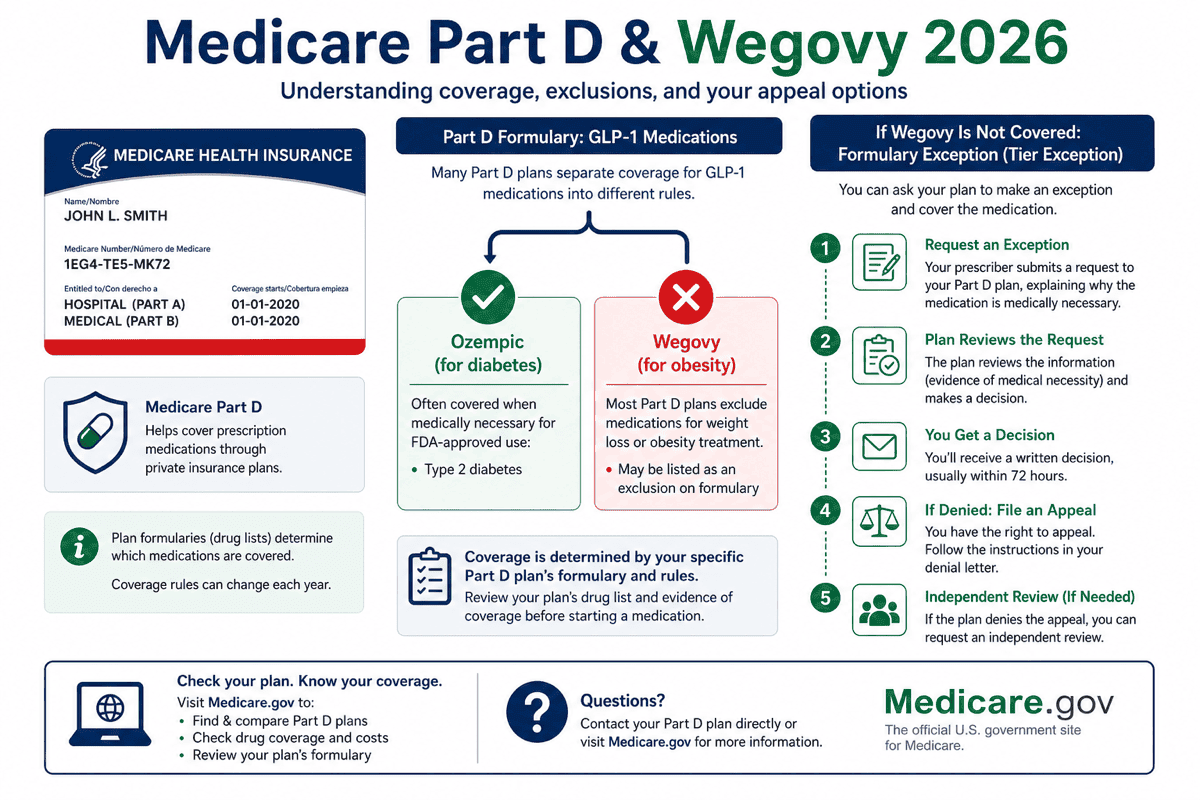
Medicare Part D Rules for Weight Loss Medications in 2026
Key Takeaway: Part D covers drugs for medically accepted indications — obesity drugs were excluded from Medicare coverage for decades. Wegovy's FDA approval for chronic weight management does not automatically add it to Part D formularies. Check your plan's drug list before assuming coverage.
When patients ask whether Medicare covers Wegovy, the answer depends on which Medicare benefit applies and what diagnosis the prescriber documents. Original Medicare (Part A/B) does not include outpatient prescription drug coverage — that comes through Part D or Medicare Advantage with drug coverage.
The statutory framework matters: Medicare Part D plans cannot cover drugs used for anorexia, weight gain, or weight loss under longstanding federal policy. Wegovy falls into this exclusion even though it treats obesity as a chronic disease. This is different from commercial employer plans, where obesity coverage varies by employer design.
- Part D standalone plans: Check formulary on Medicare.gov/plan-compare or your plan's member portal
- Medicare Advantage with Part D (MA-PD): Drug coverage follows the embedded Part D formulary, same obesity exclusion typically applies
- Part B medical benefit: Rarely covers GLP-1 injections except in specific clinical scenarios billed as physician-administered drugs
What Is the Medicare GLP-1 Bridge Program?
Key Takeaway: Medicare.gov describes a separate GLP-1 Bridge program for certain weight-management GLP-1 medications. It is not the same as standard Part D formulary coverage for Ozempic. Eligibility criteria on Medicare.gov are specific to that program.
Medicare.gov's weight-loss drugs page describes the Medicare GLP-1 Bridge, which lists Foundayo, Wegovy, and Zepbound KwikPen for eligible people with Part D. Ozempic is not on that Bridge drug list. People who already receive a GLP-1 through Part D, or who have type 2 diabetes, are directed to work with the Part D plan instead of the Bridge.
For commercial Ozempic rules, see does insurance cover Ozempic. For Wegovy appeal steps, see how to appeal a Wegovy insurance denial.
Wegovy vs. Ozempic: Why Medicare May Cover One but Not the Other
Key Takeaway: Same molecule (semaglutide) at different doses and FDA indications produces different Part D coverage outcomes. Diabetes indication (Ozempic, E11.x) routes through standard prior auth; obesity indication (Wegovy, E66.x) hits the weight-loss exclusion on most plans.
Ozempic and Wegovy both contain semaglutide but carry different FDA-approved uses and dosing schedules. See does insurance cover Ozempic for commercial plan rules and how to appeal a Wegovy insurance denial for appeal workflows.
| Drug | FDA Indication | Typical Part D Status |
|---|---|---|
| Ozempic | Type 2 diabetes (E11.x) | Often on formulary with prior auth and step therapy |
| Wegovy | Chronic weight management (E66.x) | Usually excluded, obesity drug exclusion applies |
| Mounjaro | Type 2 diabetes (E11.x) | Often on formulary with prior auth |
Prescribing Ozempic for a patient whose primary need is weight loss without documented type 2 diabetes creates audit risk for the prescriber and may result in claim denial or coverage investigation. Document clinical rationale honestly, appeals built on mismatched diagnoses fail more often than they succeed.
How to Request a Medicare Part D Formulary Exception for Wegovy
Key Takeaway: A formulary exception is your primary pathway when Wegovy is not on your Part D drug list. Submit a prescriber statement, clinical records, and evidence that covered alternatives are ineffective or intolerable. Expedited review is available when delay poses serious health risk.
- Confirm Wegovy is excluded. Search your plan formulary on Medicare.gov or your Part D plan portal. Note whether it is “not covered” vs. “requires prior authorization.”
- Get a prescriber statement of medical necessity. Must explain why Wegovy is required and why formulary alternatives fail. Include BMI, comorbidities, and failed prior therapies with dates.
- Submit the exception request. Call your Part D plan or use the plan's online portal. Request expedited review if your physician certifies urgency.
- Track the decision deadline. Expedited: 24–72 hours. Standard: 72 hours for exception requests. Document every call with representative name and reference number.
- If denied, file a Part D appeal. Redetermination → reconsideration → Independent Review Entity (IRE). Each level has a 60-day filing window from the prior denial.
Weak vs. Strong Medicare GLP-1 Appeal Language (Before & After)
Key Takeaway: Part D reviewers approve exceptions when clinical documentation matches plan criteria, not when patients express frustration. Replace emotional appeals with dated metrics, ICD-10 codes, and formulary alternative failure records.
| Weak statement | Strong statement |
|---|---|
| “I need Wegovy because Medicare should cover weight loss drugs now.” | “Beneficiary (BMI 36.1, ICD-10 E66.01) requests formulary exception for Wegovy after documented failure of metformin 1000mg BID × 90 days (<3% weight loss) and phentermine discontinuation due to tachycardia (HR 118 bpm). Covered alternatives are ineffective or intolerable per plan exception criteria.” |
| “My doctor says Ozempic and Wegovy are the same drug.” | “Prescriber (NPI documented) attests that semaglutide 2.4 mg (Wegovy) is required for obesity management at FDA-approved dose. Ozempic maximum dose (2 mg) produced subtherapeutic weight response (−4 lbs over 6 months) documented in attached visit notes dated [date].” |
| “Please approve my Wegovy, it is FDA approved.” | “I request expedited formulary exception under Part D appeal rights. Attached: prescriber statement, BMI records, HbA1c 6.4% (prediabetes E11.65), hypertension (I10), and step therapy documentation per denial rationale. Request 72-hour expedited decision.” |
Need a Medicare GLP-1 Appeal Letter?
AppealFlow's GLP-1 generator drafts formulary exception language citing FDA criteria, failed therapies, and Part D appeal rights from the facts you enter.
Submitting Through Medicare Part D Portals and PBMs
Key Takeaway: Part D plans contract with Pharmacy Benefit Managers for drug claims. Formulary exception requests go to your Part D plan first, not directly to CoverMyMeds or Express Scripts unless your plan routes through those platforms.
| Platform | Used By | How to Use for Part D |
|---|---|---|
| Medicare.gov Plan Compare | All Part D beneficiaries | Search formulary by drug name before enrolling or requesting exceptions |
| CoverMyMeds | Some Part D plans; prescriber-initiated PA | Prescriber submits via key code; attach exception documentation |
| Express Scripts | Many national Part D plans | Member portal → Pharmacy → Coverage Determination / Appeal |
| OptumRx | UnitedHealthcare Part D plans | OptumRx.com → Medicare member login → Formulary Exception Request |
Your Medicare card lists your Part D plan name and customer service number. Call that number to confirm the correct submission channel before your prescriber sends documentation to the wrong PBM portal.
Part D Appeal Levels After Formulary Exception Denial
Key Takeaway: Medicare Part D provides a structured five-level appeal process ending with federal court review. Most beneficiaries resolve cases at redetermination or Independent Review Entity (IRE) level when documentation is complete.
- Redetermination: Request from your Part D plan within 60 days of denial. Plan must respond within 7 days (expedited) or 45 days (standard).
- Reconsideration by Independent Review Entity: File within 60 days of redetermination denial. IRE is not employed by your plan.
- ALJ hearing: Available if IRE denies and the case meets the dollar threshold.
- Medicare Appeals Council review: Further federal review if ALJ decision is unfavorable.
- Federal district court: Final judicial option for unresolved Part D disputes.
What Timelines Apply to Medicare GLP-1 Appeals?
Key Takeaway: Plan for 7 to 45 days per Part D appeal level depending on whether you request expedited review. Formulary exceptions for obesity GLP-1s face the statutory weight-loss exclusion, so complete clinical documentation addressing plan criteria matters at every level.
Medicare's obesity drug exclusion is a structural barrier, not only a paperwork issue. A well-documented appeal letter helps when covered alternatives have failed, but it cannot override a plan that applies the exclusion consistently. Document why formulary alternatives are ineffective or intolerable and cite Part D exception criteria precisely.
Common myth: News coverage about GLP-1 popularity means Medicare automatically covers Wegovy. Part D formularies update annually, check your current plan's drug list every enrollment period. Patient assistance programs (Novo Nordisk Wegovy savings card) may help while appeals are pending for non-Medicare patients, but Medicare anti-kickback rules limit manufacturer subsidy options for beneficiaries.
Five Mistakes That Kill Medicare Wegovy Appeals
Key Takeaway: Resubmitting the same prior auth form is not a Part D appeal. Formulary exceptions and redeterminations are separate processes with different deadlines and legal protections.
- Assuming FDA approval equals Part D coverage. The exclusion applies regardless of FDA obesity indication.
- Missing the 60-day appeal deadline. Part D appeal rights expire, no exceptions for late filing.
- Generic prescriber letters. One-paragraph notes without failed therapy documentation rarely succeed.
- Wrong diagnosis coding. E66.x obesity codes trigger exclusion review; ensure clinical record supports the documented indication.
- Stopping after first denial. Independent Review Entity reconsideration is often the strongest remaining option. Many beneficiaries abandon the process too early.
Frequently Asked Questions
Answers to the most common Medicare Part D Wegovy coverage questions from beneficiaries and advocates.
Generate Your Free GLP-1 Appeal Letter
AppealFlow.net drafts a formal Part D formulary exception letter citing FDA indication criteria and your specific denial reason, edit live, then download as PDF or Word. No account required.
- 100% Free
- No Signup
- PDF & Word Export
Disclaimer: This article is for educational purposes only and does not constitute medical or legal advice. AppealFlow is not a healthcare provider or law firm. Plan formularies and Medicare rules change. Verify current criteria with Medicare.gov and your Part D plan before taking action. For medical emergencies, call 911. See our full disclaimer.