Can I Cancel My Medical Insurance?
Can You Cancel Medical Insurance Whenever You Want?
Key Takeaway: Cancellation eligibility is broad, you can end most medical insurance plans, but timing, notice requirements, and financial consequences vary sharply by plan type. Cancelling without replacement coverage exposes you to full medical costs and possible state mandate penalties.
Patients ask “can I cancel my medical insurance?” when they gain employer coverage, qualify for Medicare, move states, or simply want to stop paying premiums. The answer is usually yes, but the process is not identical across marketplace, employer, Medicare, and Medicaid plans.
This article focuses on eligibility and rules, when cancellation is permitted, what penalties apply, and what happens to pending claims. For step-by-step cancellation instructions, see our guide on how to cancel your health insurance.
Marketplace Medical Insurance Cancellation Rules
Key Takeaway: ACA marketplace plans can be cancelled at any time through Healthcare.gov. You choose your termination date, usually the last day of the month. Cancelling mid-month typically does not refund the current month's premium.
Marketplace cancellation is self-service. Log into Healthcare.gov, go to “My Plans and Programs,” select your plan, and choose “End (terminate) all coverage.” Save your confirmation screen and check for a termination email within 48 hours.
Common reasons that make marketplace cancellation appropriate:
- Gaining employer-sponsored coverage (qualifying life event)
- Qualifying for Medicare Part A and Part B through SSA.gov
- Becoming eligible for Medicaid in your state
- Moving abroad or to a state where you no longer need marketplace coverage
- Income changes that make premiums unaffordable without subsidy adjustment
Report income changes when you cancel if you are switching to Medicaid or employer coverage, failure to update can affect future subsidy eligibility or trigger IRS reconciliation on your tax return.
Employer Medical Insurance Cancellation Eligibility
Key Takeaway: You can cancel employer medical insurance mid-year only during open enrollment or after a qualifying life event. HR requires a waiver or termination form and may demand proof of other creditable coverage before allowing mid-year cancellation.
Section 125 cafeteria plan rules lock benefit elections for the plan year. Permitted mid-year cancellation events typically include:
- Gaining coverage through a spouse's employer plan
- Qualifying for Medicare Part A and Part B
- Enrolling in another group health plan
- Loss of dependent status (child no longer qualifies)
- Divorce or legal separation removing spousal coverage need
Contact HR to complete a waiver or termination form. Cancellation usually takes effect the first of the following month or the end of the current pay period. You cannot drop employer coverage outside permitted windows without a qualifying event, even if you want to stop paying premiums.
Some employers require proof of other coverage before processing mid-year cancellation. Save your new insurance card and coverage confirmation letter before submitting the waiver.
Medicare and Medicaid Cancellation Rules
Key Takeaway: Medicare Part B cancellation requires Form CMS-1763 submitted to SSA.gov or your local Social Security office. You need other creditable coverage to avoid late enrollment penalties if you re-enroll later. Medicaid cancellation is voluntary or triggered by income changes reported to your state agency.
To cancel Medicare Part B, submit Form CMS-1763. You must already have other creditable coverage, typically an employer plan or marketplace plan, to avoid a late enrollment penalty if you re-enroll Part B later. The penalty is 10% added to your premium for every 12-month period you were eligible but not enrolled.
Switching from Medicare Advantage to Original Medicare is not the same as cancelling all Medicare coverage. Use Medicare.gov during Annual Enrollment (October 15 – December 7) or during a Medicare Special Enrollment Period after moving or losing employer coverage.
Medicaid is income-based. You can voluntarily cancel by contacting your state Medicaid agency or reporting income changes through your state portal. If your income rises above eligibility limits, you must report it within 10 days in most states. Voluntary Medicaid cancellation may open a Special Enrollment Period on Healthcare.gov for marketplace coverage.
When Cancellation Triggers Penalties or Financial Risk
Key Takeaway: There is no federal penalty for cancelling health insurance since 2019, but five states impose individual mandate penalties for going uninsured. Going without coverage exposes you to full medical costs, a single ER visit can exceed $3,000.
States with individual mandate penalties for uninsured residents:
- California
- Massachusetts
- New Jersey
- Rhode Island
- District of Columbia
Cancelling without replacement coverage in those states may trigger a state tax penalty on your annual return. More importantly, uninsured gaps mean you pay full billed amounts for care, and providers may balance bill you directly.
Premium refunds after early cancellation are rare. If you cancel on the 5th of the month, you typically pay for the entire month on marketplace and employer plans. Budget for a full final month when planning cancellation.
Coverage gap warning: Never cancel existing medical insurance before confirming replacement coverage is active. Even a one-day gap can leave you uninsured for emergencies and may reset waiting periods on pre-existing condition protections on non-ACA plans.
Wrong vs. Correct Cancellation Approaches
Key Takeaway: Successful cancellations coordinate termination dates with new coverage start dates and preserve documentation. Failed cancellations create gaps, forfeit pending claims, or trigger Medicare late enrollment penalties.
| ❌ Wrong Approach | ✅ Correct Approach |
|---|---|
| Terminating marketplace coverage on Healthcare.gov before your employer plan start date, creating an uninsured gap. | Confirming employer coverage starts 07/01/2026, then terminating marketplace coverage effective 06/30/2026 through Healthcare.gov, saving the termination confirmation email. |
| Stopping Medicare Part B premium payments without submitting Form CMS-1763 to SSA.gov, risking collections and re-enrollment penalties. | Submitting Form CMS-1763 with proof of employer creditable coverage, receiving SSA confirmation, then enrolling in the employer plan with documented start date. |
| Cancelling employer coverage mid-year with no qualifying event because premiums are too high, HR denies the request. | Waiting for open enrollment to waive employer coverage after gaining spouse's plan, submitting waiver form with spouse's coverage confirmation within 30 days of the qualifying event. |
Pending Claim Denied Before You Cancel?
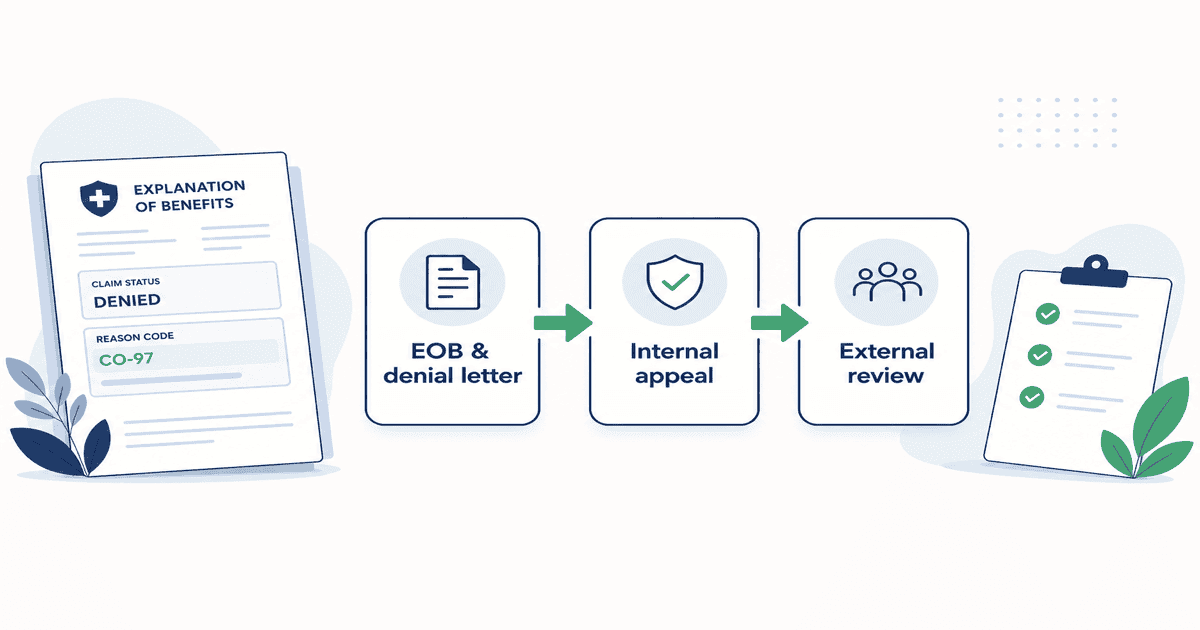
Continue pursuing appeals on your current plan. AppealFlow drafts a formal appeal letter with member ID, policy number, and denial details, ready to submit via Availity or your PBM portal.
What Happens to Pending Claims After Cancellation?
Key Takeaway: Claims for services received while coverage was active should still process, even if you cancel before the claim is paid. Claims for services after your termination date are not covered. Pending appeals continue in most cases because ERISA appeal rights attach to the denial.
Submit outstanding claims promptly with your member ID and dates of service during active coverage. If your pharmacy benefit manager, Express Scripts, OptumRx, or Caremark, denied a prior authorization, continue the appeal through the PBM portal or CoverMyMeds before your coverage ends. Appeals with complete documentation succeed roughly 40–55% of the time on first submission.
After cancellation, you lose portal access on Availity and insurer member sites within weeks. Download EOBs, denial letters, and appeal confirmation numbers before your termination date.
Portals for Cancelling Medical Insurance
Key Takeaway: Healthcare.gov handles marketplace termination. SSA.gov processes Medicare Part B cancellation. Medicare.gov manages Advantage plan switches. Availity confirms employer coverage termination propagated to your insurer.
| Portal | Plan Type | Cancellation Action |
|---|---|---|
| Healthcare.gov | ACA marketplace plans | My Plans → End coverage → select termination date → save confirmation |
| SSA.gov | Medicare Part B | Submit Form CMS-1763 with proof of other creditable coverage |
| Medicare.gov | Medicare Advantage & Part D | Switch or disenroll during AEP (Oct 15 – Dec 7) or Medicare SEP, not a full Medicare cancellation |
| Availity | Employer-sponsored plans (BCBS, Aetna, Humana) | Verify termination date updated after HR processes waiver, confirm before next claim |
COBRA vs. Cancelling When You Lose Employer Coverage
Key Takeaway: Losing employer coverage lets you choose COBRA continuation or cancel and enroll elsewhere. COBRA preserves your exact plan at full premium cost, often $600–$1,200 per month for family coverage. Marketplace SEP or Medicaid may cost less.
COBRA is not cancellation, it is continuation of the same employer plan for up to 18 months after job loss. You elect COBRA within 60 days of receiving the election notice. Premiums are typically 102% of the full plan cost with no employer subsidy.
Cancelling employer coverage and enrolling on Healthcare.gov during your 60-day SEP often costs less if you qualify for premium tax credits. Compare COBRA premium, marketplace subsidized premium, and Medicaid eligibility before deciding. If you elect COBRA, you can still switch to marketplace coverage during your SEP, but timing matters for avoiding gaps.
If you have pending claims or appeals on your employer plan, resolve them before COBRA ends or before cancelling. Download EOBs and denial letters from Availity while your portal access remains active.
State Mandate Penalties for Cancelling Without Replacement
Key Takeaway: Five states and DC impose tax penalties for residents who go uninsured. Cancelling medical insurance without replacement coverage in those states may increase your state tax liability, separate from any federal rules.
California, Massachusetts, New Jersey, Rhode Island, and the District of Columbia enforce individual mandate penalties on residents without minimum essential coverage. Penalty amounts vary by state and income. Some states offer exemptions for short gaps under three months.
Even in states without mandate penalties, going uninsured means paying full billed amounts for care. A single ER visit without coverage can exceed $3,000 before any negotiation. Short-term health plans in some states are not ACA-compliant and do not satisfy mandate requirements in penalty states.
Five Mistakes When Cancelling Medical Insurance
Key Takeaway: Most cancellation problems come from coverage gaps, missing HR documentation, stopping Medicare Part B without Form CMS-1763, and abandoning pending appeals before resolution.
- Cancelling before replacement coverage is confirmed. Overlap by one day if needed.
- Assuming premium refunds for partial months. Budget for a full final month on most plans.
- Stopping Medicare Part B payments without SSA paperwork. Use Form CMS-1763 through SSA.gov.
- Abandoning pending claim appeals. ERISA appeal rights attach to the denial, pursue them before losing portal access.
- Not reporting income changes on Healthcare.gov. Update your application when switching to Medicaid or employer coverage.
Frequently Asked Questions
Direct answers about whether you can cancel your medical insurance and what rules apply.
Generate Your Free Appeal Letter
AppealFlow.net drafts a formal appeal letter with fields for member ID, policy number, claim number, and denial details, edit it live, then download as PDF or Word. No account required.
- 100% Free
- No Signup
- PDF & Word Export
Disclaimer: This article is for educational purposes only and does not constitute medical or legal advice. AppealFlow.net is not a healthcare provider or law firm. Cancellation rules vary by state, employer, and plan type. Verify eligibility with Healthcare.gov, your HR department, SSA.gov, or Medicare.gov before cancelling coverage. For medical emergencies, call 911. See our full disclaimer.