Can I Switch My Health Insurance?
Can I Switch My Health Insurance at Any Time?
Key Takeaway: No, you cannot switch your health insurance whenever you want. Federal law and employer plan rules restrict switching to annual open enrollment or a Special Enrollment Period triggered by a qualifying life event. Being unhappy with premiums, networks, or claim denials does not open a mid-year switch on its own.
When patients ask “can I switch my health insurance?” they often mean right now, after a denied MRI, a pharmacy prior auth rejection routed through CoverMyMeds, or a doctor leaving their network. The answer depends on your plan type and whether something in your life recently changed. If nothing qualifies as a life event, your next opportunity is open enrollment.
Switching means ending one plan and enrolling in another. Your old coverage terminates when the new plan starts on the marketplace, you do not cancel separately on Healthcare.gov. Employer and Medicare switches follow different portals and deadlines. For eligibility rules framed around “changing” versus “switching,” see our companion guide on whether you can change your health insurance.
When Open Enrollment Lets You Switch Your Plan
Key Takeaway: Open enrollment is the yearly window when anyone can switch health insurance without a qualifying life event. ACA marketplace open enrollment runs November 1 through January 15 in most states. Employer open enrollment typically falls in October or November for a January 1 effective date.
During open enrollment, you can move between metal tiers, change carriers, add or remove dependents, and update your premium tax credit estimate on Healthcare.gov. Employer open enrollment lets you switch from an HMO to a PPO, move to a high-deductible health plan with an HSA, or change the tier your family is on, but only during the dates HR announces.
| Plan Type | Open Enrollment Window | New Coverage Starts |
|---|---|---|
| ACA marketplace (Healthcare.gov) | November 1 – January 15 | January 1 if enrolled by Dec 15; February 1 if enrolled Jan 1–15 |
| Employer-sponsored plans | Set by employer, usually October–November | January 1 of the following plan year |
| Medicare Advantage & Part D | October 15 – December 7 (Annual Enrollment Period) | January 1 |
| Medicaid & CHIP | Year-round enrollment in most states | Often retroactive to application date |
Mark your calendar the day open enrollment opens. Plans, networks, and formularies change every year. The carrier you liked last January may have shifted prescription tiers on Express Scripts, OptumRx, or Caremark , compare the full package, not just the monthly premium.
Qualifying Events That Let You Switch Mid-Year
Key Takeaway: Qualifying life events open a Special Enrollment Period, typically 60 days on the marketplace and 30 days on employer plans from the event date. Marriage, divorce, birth, job loss, moving to a new coverage area, and aging off a parent's plan at 26 are the most common triggers.
Each event has documentation requirements and a hard deadline. Miss the window and you wait until the next open enrollment, often 10–12 months away on employer plans.
- Marriage or divorce. Add or remove a spouse from marketplace or employer coverage. SEP clock starts on the wedding or divorce decree date.
- Birth, adoption, or foster placement. Add the child to existing coverage or enroll in a new plan. Employer plans may retroactively cover a newborn if you enroll within 30 days.
- Job loss or reduction in hours. Losing employer-sponsored coverage, including voluntary departure, triggers a marketplace SEP. COBRA is an alternative, but subsidies may cost less.
- Moving to a new ZIP code. You must move to an area where different health plans are available. A move within the same metro with identical carrier options may not qualify.
- Aging off a parent's plan at 26. You have a 60-day SEP starting 60 days before and ending 60 days after your 26th birthday.
- Loss of Medicaid or CHIP. Income changes or aging out of CHIP open a marketplace SEP on Healthcare.gov.
Pregnancy alone does not open a marketplace SEP, birth does. If you are pregnant and uninsured, check Medicaid eligibility in your state before assuming you must wait for open enrollment.
How to Switch Your Health Insurance on the Marketplace
Key Takeaway: Log into Healthcare.gov during open enrollment or within 60 days of a qualifying event. Report the life change, compare plans, enroll, and pay your first premium before the deadline. Your old marketplace plan terminates automatically when the new plan starts.
- Log into Healthcare.gov and update your application with current household size and income.
- Report a qualifying life event if switching mid-year, select the event type and enter the date it occurred.
- Compare plans by premium, deductible, out-of-pocket maximum, provider network, and prescription formulary tier for your medications.
- Enroll and pay your first premium before the SEP or open enrollment deadline. Coverage does not start until payment is received.
- Upload documentation if requested, marriage certificate, birth certificate, termination letter, or lease showing your new address within 30 days of enrollment.
- Save your enrollment confirmation number and check for your new insurance card before your next appointment.
Timing tip: On the marketplace, new coverage typically starts the first of the month after enrollment if you sign up by the 15th. Enroll on the 16th and you may wait an extra month, plan your switch accordingly.
Switching Employer-Sponsored Health Insurance
Key Takeaway: Employer plans restrict mid-year switches to qualifying life events defined in your Summary Plan Description. Notify HR within 30 days of the event, complete a change-of-status form, and confirm the update appears in Availity or your insurer's member portal before your next claim.
Section 125 cafeteria plan rules lock your benefit elections for the plan year unless a permitted status change occurs. Permitted changes mirror ACA qualifying events: marriage, divorce, birth, death of a dependent, loss or gain of other coverage, and employment status changes affecting eligibility.
Contact HR immediately after the event. Most employers require written notice and supporting documents within 30 days. Some changes, adding a newborn, can be retroactive to the birth date. Others, switching from PPO to HMO after marriage, take effect on the first of the month following enrollment.
After HR processes your switch, log into Availity or your carrier portal and verify your new member ID, plan tier, and effective date. Providers bill using information on file, if HR updated but the insurer system lags, claims can deny as inactive coverage.
Switching Medicare and Medicaid Coverage
Key Takeaway: Medicare Annual Enrollment Period runs October 15 through December 7 for switching Advantage or Part D plans. Initial Enrollment around age 65 is a one-time window through SSA.gov. Medicaid accepts applications year-round in most states when income qualifies.
Medicare rules are separate from ACA marketplace rules. Key windows for switching your Medicare coverage:
- Initial Enrollment Period (IEP): Seven-month window around your 65th birthday. Enroll in Part A, Part B, and optionally Part D or Medicare Advantage through SSA.gov.
- Annual Enrollment Period (AEP): October 15 – December 7. Switch Medicare Advantage plans, change Part D plans, or return to Original Medicare. Compare at Medicare.gov.
- Medicare Advantage Open Enrollment: January 1 – March 31. Switch to another MA plan or return to Original Medicare with a Part D add-on.
- Medicare Special Enrollment Periods: Moving out of your plan's service area, losing employer coverage, or qualifying for Extra Help open limited switching windows.
Missing Part B enrollment without qualifying coverage triggers a late enrollment penalty, 10% added to your premium for every 12-month period you were eligible but not enrolled. If you delayed Part B because you had employer coverage, you have 8 months after that coverage ends to enroll through SSA.gov without penalty.
When You Cannot Switch Your Health Insurance Mid-Year
Key Takeaway: Claim denials, premium increases, out-of-network doctors, and general plan dissatisfaction are not qualifying life events. You must appeal the denial on your current plan or wait for open enrollment to switch.
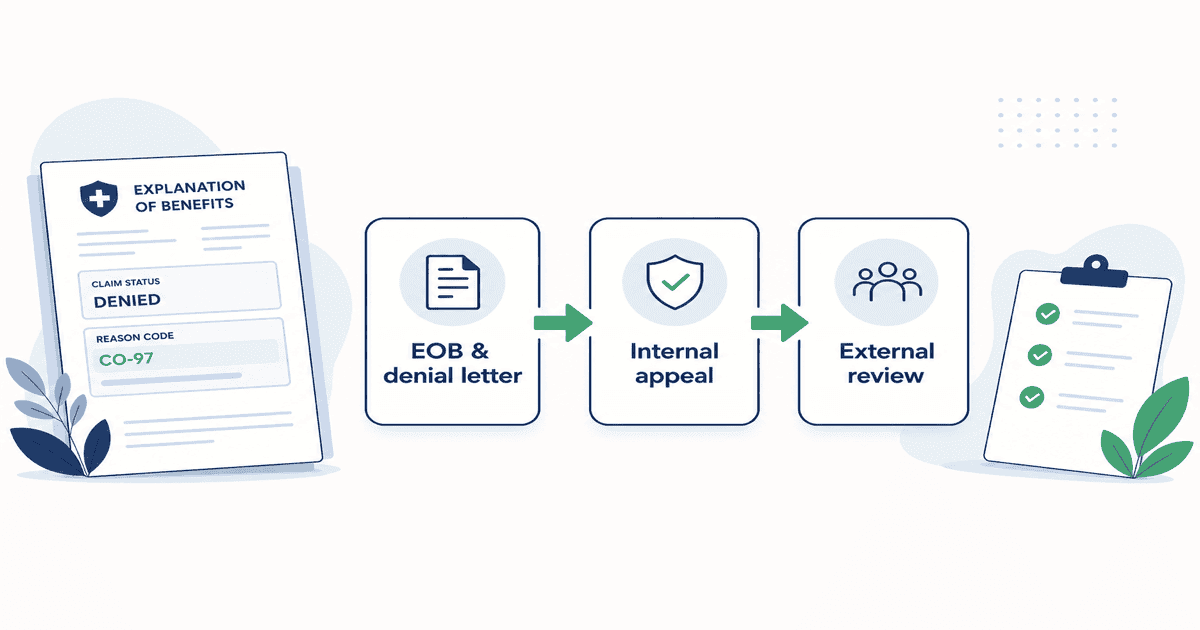
If your insurer denied a prior authorization through Express Scripts, OptumRx, or Caremark, switching plans mid-year will not retroactively cover that service. File an internal appeal first. Appeals with complete clinical documentation succeed roughly 40–55% of the time on first submission. Use Availity or your PBM portal and include your member ID, policy number, and denial reason code on every document.
Short-term limited-duration insurance is available in some states outside open enrollment, but these plans are not ACA-compliant. They can exclude pre-existing conditions, cap benefits, and do not count as minimum essential coverage in mandate states like California and Massachusetts.
Wrong vs. Correct Ways to Switch Your Health Insurance
Key Takeaway: Successful mid-year switches tie back to a documented qualifying event and meet the enrollment deadline. Requests based on plan dissatisfaction alone get denied every time.
| ❌ Wrong Approach | ✅ Correct Approach |
|---|---|
| Calling your insurer in March to switch plans because your GLP-1 was denied on CoverMyMeds, with no qualifying life event. | Filing a formal appeal on your current plan via Availity or your PBM portal with denial code, physician letter, and clinical records, then comparing plans during November open enrollment if you still want different coverage. |
| Cancelling your marketplace plan on Healthcare.gov before confirming your new employer coverage start date, creating a coverage gap. | Enrolling in employer coverage with a start date of 07/01/2026, then allowing marketplace coverage to terminate automatically on 06/30/2026, saving the termination confirmation email from Healthcare.gov. |
| Emailing HR: “I want to switch from PPO to HDHP because my deductible is too high”, with no qualifying event. | After marriage on 03/15/2026: submitting a change-of-status form to HR within 30 days, requesting mid-year enrollment to add your spouse to the PPO, effective 04/01/2026, with marriage certificate attached. |
Denied a Claim While Waiting to Switch?
You do not need to wait for open enrollment to fight a denial. AppealFlow drafts a formal appeal letter with your member ID, policy number, and denial details, ready to submit in under 60 seconds.
Portals for Switching Your Health Insurance
Key Takeaway: Healthcare.gov handles marketplace enrollment and SEP reporting. SSA.gov manages Original Medicare and Part B. Medicare.gov compares Advantage and Part D plans. Availity confirms employer enrollment changes propagated to your insurer before you file claims.
| Portal | Use For | Switch Action |
|---|---|---|
| Healthcare.gov | ACA marketplace enrollment and SEP | Report qualifying life event → compare plans → enroll → upload documentation within 30 days |
| Availity | Employer plan eligibility for BCBS, Aetna, Humana, and others | Verify HR enrollment changes updated your member profile before filing claims or appeals |
| Medicare.gov | Medicare Advantage and Part D plan comparison | Compare plans during AEP (Oct 15 – Dec 7) or after a Medicare SEP event |
| SSA.gov | Medicare Part A and Part B enrollment | Apply for Part B after employer coverage ends (8-month SEP) or during Initial Enrollment at age 65 |
After any switch, give your doctor and pharmacy your new member ID and insurance card. Pharmacy benefits often route through a different PBM, Express Scripts, OptumRx, or Caremark, even when your medical carrier stays the same. Confirm formulary coverage for ongoing prescriptions before your first refill on the new plan.
Five Mistakes When Switching Your Health Insurance
Key Takeaway: Most switch failures come from missed SEP deadlines, coverage gaps, assuming claim denials qualify as life events, and forgetting that deductibles reset when you change plans mid-year.
- Missing the 60-day marketplace SEP or 30-day employer window. Set a calendar reminder on the event date, not when you start shopping.
- Creating a coverage gap. Never cancel existing coverage before confirming your new plan is active. Overlap by one day if needed.
- Switching only because of a denied claim. Appeal first on your current plan. Switch during open enrollment if you still want different coverage.
- Ignoring deductible reset. When you switch mid-year, your new plan's deductible starts at zero, even if you already met your old plan's deductible.
- Not updating providers and pharmacies. Out-of-network denials spike after switches when doctors still bill under your old member ID.
Frequently Asked Questions
Direct answers to the most common questions about whether you can switch your health insurance.
Generate Your Free Appeal Letter
AppealFlow.net drafts a formal appeal letter with fields for member ID, policy number, claim number, and denial details, edit it live, then download as PDF or Word. No account required.
- 100% Free
- No Signup
- PDF & Word Export
Disclaimer: This article is for educational purposes only and does not constitute medical or legal advice. AppealFlow.net is not a healthcare provider or law firm. Enrollment rules vary by state, employer, and plan type. Verify your eligibility for a Special Enrollment Period with Healthcare.gov, your HR department, or Medicare.gov before making coverage changes. For medical emergencies, call 911. See our full disclaimer.