Can You Be Dropped From Health Insurance?
What Does Being Dropped From Health Insurance Mean?
Key Takeaway: Being dropped means your insurer or employer terminates your coverage before the plan year ends. This is different from voluntarily cancelling your policy. Involuntary termination can trigger appeal rights, COBRA eligibility, and a 60-day marketplace Special Enrollment Period.
Patients use “dropped” and “cancelled” interchangeably, but the distinction matters for your rights. When an insurer drops you, they end active coverage mid-term, sometimes with retroactive effective dates in nonpayment cases. When you cancel voluntarily, you control the end date and typically receive no appeal rights because you initiated the termination.
Three plan categories determine how much protection you have: ACA-compliant marketplace and small-group plans, grandfathered plans purchased before March 23, 2010, and short-term limited-duration plans. Know which category your plan falls into before assuming the ACA shields you from termination.
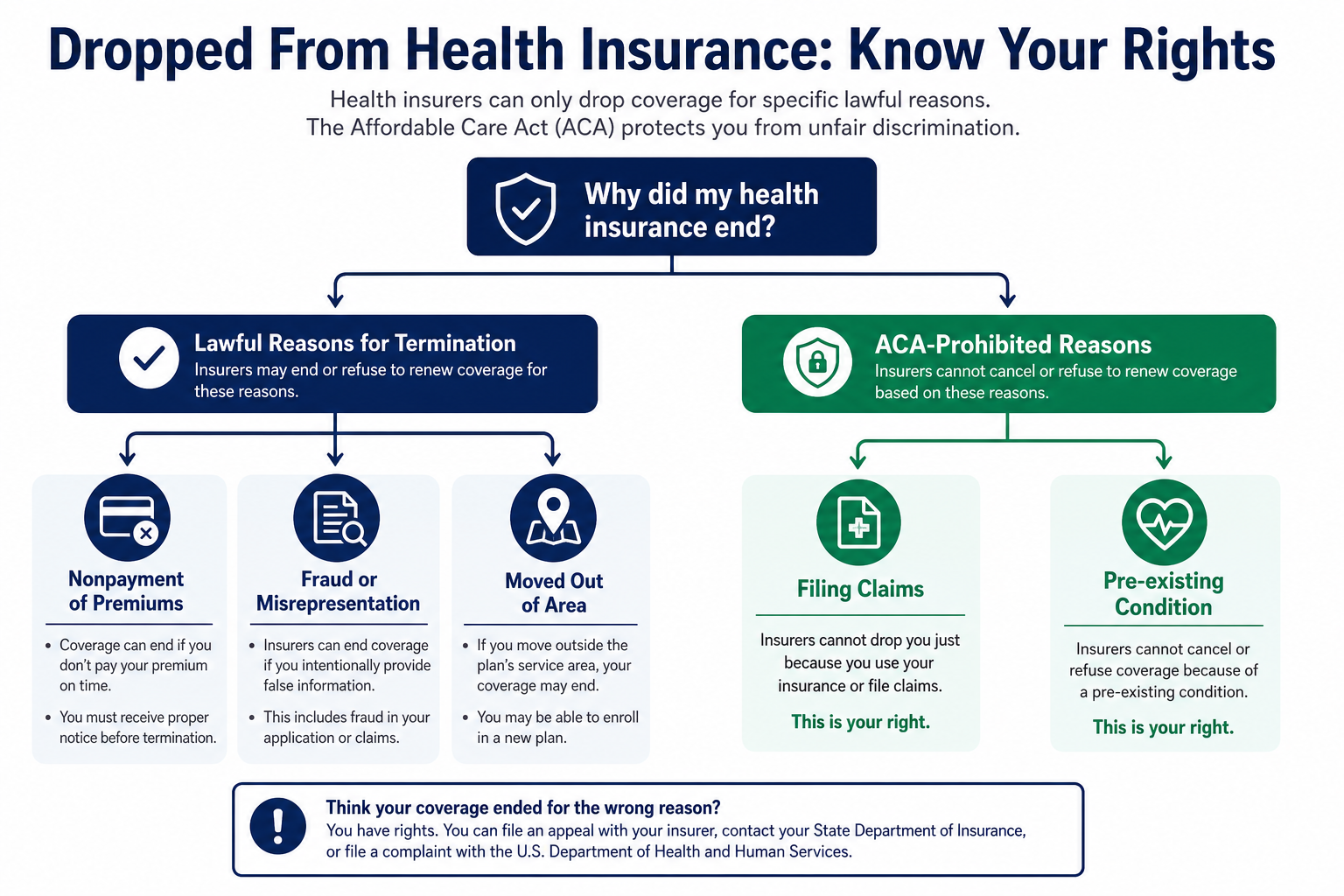
What Are Lawful Reasons Insurers Can Drop You?
Key Takeaway: Common lawful termination triggers include premium nonpayment, application fraud or material misrepresentation, moving outside the plan service area, employer plan termination, and insurer market exit. Each trigger carries specific notice requirements under federal and state law.
| Reason | Notice pattern | Your options |
|---|---|---|
| Nonpayment of premiums | Grace period rules vary; marketplace plans with subsidies often use a 90-day grace period | Pay arrears during grace period; appeal if dropped in error |
| Fraud or misrepresentation | Written notice with explanation required | Appeal through marketplace or state insurance commissioner |
| Moved out of service area | Varies by plan; often end of month after move | 60-day Special Enrollment Period on Healthcare.gov |
| Employer stops offering plan | COBRA election notice within 14 days of qualifying event | COBRA or marketplace Special Enrollment Period |
| Insurer exits market | Advance notice before plan year end | Choose replacement coverage during open enrollment or SEP |
What insurers cannot do on ACA-compliant plans: drop you because you were diagnosed with a serious condition, filed an expensive claim, or developed a chronic illness. If your termination notice cites medical claims or pre-existing conditions as the reason, request written explanation and appeal if it appears retaliatory.
What ACA Protections Apply When Coverage Ends?
Key Takeaway: The Affordable Care Act prohibits insurers from dropping ACA-compliant coverage because you got sick, filed expensive claims, or developed a pre-existing condition. These protections apply to individual, marketplace, and small-group plans purchased after March 23, 2010.
Before the ACA, insurers sometimes rescinded policies after patients were diagnosed with costly conditions. Congress largely ended that practice for ACA-compliant plans. Today, your insurer cannot drop you mid-policy-year simply because you used your benefits.
The ACA does not protect against nonpayment after the grace period, intentional fraud on your enrollment application, moving outside your plan service area, or your employer discontinuing the group health plan. Grandfathered and short-term plans have fewer drop protections. Check your certificate of coverage.
What Happens If You Are Dropped for Nonpayment?
Key Takeaway: Marketplace enrollees receiving advance premium tax credits typically get a grace period when premiums go unpaid. Coverage may continue during part of that period, then terminate retroactively if payment is not received. Loss of coverage opens a 60-day Special Enrollment Period on Healthcare.gov.
If you believe the drop was in error, gather bank records or payment confirmations and file an appeal immediately through Healthcare.gov or your state marketplace. Screenshot your payment confirmation and the insurer member portal showing any balance discrepancy.
For grace period rules and notice requirements, see Healthcare.gov coverage loss guidance and your termination letter.
Weak vs. Strong Language When Disputing a Drop
Key Takeaway: Insurers respond to specific documentation, payment records, enrollment confirmations, and policy citations. Frame your dispute around factual errors and the appeal rights on your termination notice.
| Weak statement | Strong statement |
|---|---|
| “I paid my bill. Please don't drop my insurance.” | “Premium payment of $387.00 was submitted via ACH on 04/12/2026 (confirmation #ACH-9921043). Termination effective 05/01/2026 is erroneous. I request reinstatement per the internal appeal rights on my termination notice. Attached: bank statement and payment receipt.” |
| “You can't drop me. I have a serious medical condition.” | “Termination notice dated 06/08/2026 cites application misrepresentation regarding 2025 income. My reported household income matches my 2025 Form 1040 (attached). I request written specification of the alleged material misrepresentation.” |
| “I need my insurance back. This isn't fair.” | “I invoke my right to an internal appeal under the process described on my termination notice. Coverage ended 07/01/2026 without the advance written notice required for my plan type. Attached: enrollment confirmation and correspondence log.” |
Wrongfully Dropped From Your Health Plan?
AppealFlow drafts formal appeal letters citing policy errors and termination notice rights. Edit live, then download as PDF or Word.
How Do You Appeal Being Dropped From Health Insurance?
Key Takeaway: File your internal appeal within the window on your termination notice. Request all documents the insurer used to make the decision. Enroll in replacement coverage during your Special Enrollment Period even while you appeal.
- Request a written explanation. Ask the insurer to cite the specific policy provision and evidence supporting the termination.
- Gather documentation. Payment records, bank statements, enrollment confirmations, and all correspondence with the insurer or marketplace.
- File an internal appeal. Submit through your insurer member portal or Healthcare.gov for marketplace plans. Include your member ID and termination reference number.
- Request expedited review if needed. If you have active medical treatment, ask for urgent appeal processing when your plan allows it.
- File with your state insurance commissioner. If the internal appeal fails, your state Department of Insurance can investigate wrongful termination on many fully insured plans.
- Enroll in replacement coverage. Do not wait for the appeal outcome. Loss of coverage triggers a 60-day Special Enrollment Period on Healthcare.gov.
What If Your Employer Plan Ends Your Coverage?
Key Takeaway: When employer coverage ends from job loss, hour reduction, or plan discontinuation, you receive COBRA rights and a 60-day marketplace Special Enrollment Period. Compare COBRA against marketplace subsidies before you elect continuation coverage.
Your employer must provide a COBRA election notice within 14 days of the qualifying event. You have 60 days to elect COBRA, and coverage is retroactive to the date employer coverage ended. Employers cannot selectively remove individual employees from a group plan for discriminatory reasons while keeping others enrolled.
Common mistake: Assuming being dropped from an employer plan means you have no options. You may have COBRA and a marketplace Special Enrollment Period. Enroll within 60 days to avoid a coverage gap.
Frequently Asked Questions
Common questions about whether you can be dropped from health insurance and what appeal rights apply.
Generate Your Free Insurance Appeal Letter
AppealFlow drafts formal appeal letters for wrongful terminations and claim denials. Edit live, download as PDF or Word. No account required.
- 100% Free
- No Signup
- PDF & Word Export
Disclaimer: This article is for educational purposes only and does not constitute legal advice. AppealFlow is not a law firm. Termination rules vary by plan type and state. Verify current requirements with your insurer or state insurance commissioner. For medical emergencies, call 911. See our full disclaimer.