What Does Out of Network Mean for Insurance?
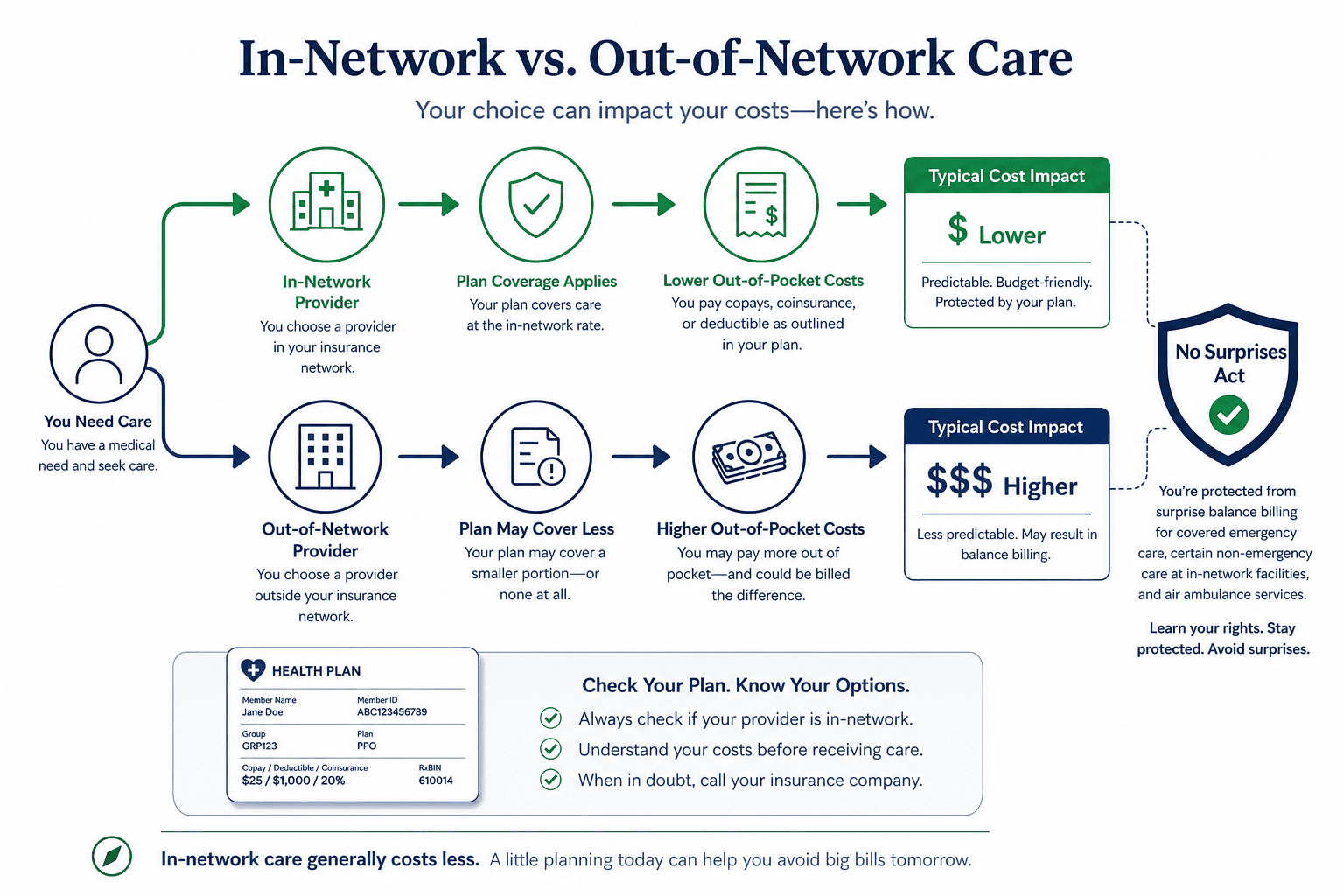
What Is Out-of-Network Care in Health Insurance?
Key Takeaway: In-network providers sign contracts with your insurer accepting negotiated rates. Out-of-network providers have no such contract, your plan pays less (or nothing), and you absorb the difference through higher cost-sharing and potential balance bills.
Health insurance networks exist because insurers negotiate discounted rates with groups of providers. When you see an in-network doctor, the insurer and provider have already agreed on a maximum allowed charge. Your plan pays its share, and you pay your copay, coinsurance, or deductible portion.
Out-of-network care breaks that arrangement. The provider bills their full charge, often 2–5 times the negotiated in-network rate. Your insurer may apply a lower reimbursement percentage or deny the claim entirely, leaving you responsible for the gap.
Plan types handle out-of-network care differently:
- HMO: No out-of-network coverage except emergencies. Non-emergency out-of-network care is 100% your responsibility.
- EPO: Similar to HMO, no out-of-network benefits outside emergencies.
- PPO: Covers out-of-network care at reduced rates (often 50–70% of allowed amount) with a separate, higher deductible.
- POS: Requires referrals for in-network specialists; out-of-network coverage available at higher cost-sharing.
How Much More Does Out-of-Network Care Cost?
Key Takeaway: A $200 in-network specialist visit can become a $600–$1,200 out-of-network bill for the same service. Separate out-of-network deductibles and coinsurance rates amplify the cost gap.
Here is a realistic comparison for a PPO plan with a $1,500 in-network deductible and $3,000 out-of-network deductible:
| Cost Component | In-Network | Out-of-Network |
|---|---|---|
| Specialist visit (billed $350) | $40 copay | 50% of $280 allowed = $140 + possible balance bill |
| MRI (billed $2,800) | 20% coinsurance after deductible ≈ $400 | 50% of $1,400 allowed = $700 + balance bill up to $1,400 |
| Annual deductible | $1,500 | $3,000 (separate track) |
Out-of-network spending typically does not count toward your in-network out-of-pocket maximum. You could hit $3,000 in out-of-network costs and still owe your full in-network deductible for the rest of the year.
Balance Billing: The Hidden Out-of-Network Cost
Key Takeaway: Balance billing is when a provider charges you the difference between their full price and what insurance paid. The No Surprises Act bans balance billing for emergencies and certain in-facility care, but not for elective out-of-network visits you chose.
If an out-of-network surgeon charges $8,000 and your plan's allowed amount is $3,200 (paying 50% = $1,600), you owe $1,600 in coinsurance plus a potential $4,800 balance bill. That balance bill is legal for elective care but prohibited under the No Surprises Act for:
- Emergency department services at any hospital
- Air ambulance transport
- Non-emergency services at in-network facilities where an out-of-network clinician treats you
For protected services, you owe only your in-network cost-sharing. If you receive a balance bill for emergency care, dispute it immediately. See our guide on disputing out-of-network ER bills under the No Surprises Act.
How Do I Verify Whether a Provider Is In Network?
Key Takeaway: Never rely on a single source. Confirm network status through your insurer's directory, member services, and the provider's billing office, and screenshot everything before your appointment.
- Search your insurer's online provider directory. Enter the provider's name, NPI number, and your specific plan, not just the parent brand (e.g., “BCBS PPO Gold” not just “Blue Cross”).
- Call member services. Use the number on your insurance card. Ask: “Is Dr. [Name], NPI [number], in-network for my plan [plan ID] on [date of service]?” Get a reference number.
- Call the provider's billing office. Ask which insurance plans they participate in and whether they are in-network for your specific plan ID.
- Screenshot directory results. Provider directory errors are a recognized appeal ground. If a doctor was listed as in-network but your claim processed as out-of-network, you have a strong dispute case.
Hospital-based physicians (anesthesiologists, radiologists, pathologists, assistant surgeons) often do not participate in the same networks as the hospital itself. Even at an in-network hospital, individual clinicians may be out-of-network, which is exactly what the No Surprises Act addresses.
Weak vs. Strong Language When Disputing Out-of-Network Bills
Key Takeaway: Effective disputes cite specific plan language, federal law, and documented network verification, not frustration. Replace emotional appeals with dated evidence and legal rights.
| ❌ Weak Statement | ✅ Strong Statement |
|---|---|
| “I didn't know the doctor was out of network. Please fix this.” | “Per your provider directory (screenshot dated 3/15/2026), Dr. Smith was listed as in-network for Plan ID ABC123. Claim #456789 processed as out-of-network on 4/2/2026. I request reprocessing at in-network rates per ACA network adequacy standards.” |
| “The ER bill is too high. I was having a heart attack.” | “This emergency department visit on 5/10/2026 qualifies for No Surprises Act protections (Pub. L. 116-260). I invoke my right to in-network cost-sharing only. Attached: EOB showing $4,200 balance bill, ER admission records, and member ID.” |
| “Can you make an exception and cover this?” | “I request a single-case agreement (SCA) for out-of-network specialist Dr. Jones (NPI 9876543210), the only board-certified provider within 50 miles per your directory search. Attached: referral from PCP, clinical records, and network adequacy documentation.” |
Received a Surprise Out-of-Network Bill?
AppealFlow's No Surprises Act generator drafts a federal-law dispute letter citing your in-network cost-sharing rights, ready in under 60 seconds.
How to Appeal an Out-of-Network Claim Denial
Key Takeaway: File a formal internal appeal before your deadline (180 days for ERISA plans). Document directory errors, invoke No Surprises Act protections, or request a single-case agreement for network inadequacy.
- Identify your appeal ground. Directory error, surprise billing at in-network facility, emergency care, network inadequacy, or continuity-of-care exception.
- Gather evidence. Directory screenshots, call logs with member services, EOB, itemized bill, clinical records, and any prior authorization or referral documentation.
- Write your appeal letter. Cite the specific denial reason code, applicable federal law (No Surprises Act, ACA §2719), and your requested remedy (reprocess at in-network rates, SCA, or full coverage).
- Submit through the correct portal. Use your insurer's member portal, Availity, or the address on your denial letter. Confirm receipt.
- Follow up at 14 and 30 days. Insurers must respond within 30 days for standard appeals. Document every interaction.
- Request external review if denied. An independent reviewer evaluates your case when your plan notice lists that option after internal denial.
Submitting Disputes Through Insurer Portals
Key Takeaway: Most commercial plans require portal submission for appeals, not just phone calls. Submitting through the wrong channel is a common reason disputes get lost.
| Platform | Used By | Appeal Submission |
|---|---|---|
| Availity | Aetna, Anthem, BCBS, Humana, many regional plans | Member login → Claims → File Appeal; attach supporting documents |
| Express Scripts | Cigna, some BCBS pharmacy benefits | Member portal → Coverage & Claims → Appeal a Decision |
| OptumRx | UnitedHealthcare, employer plans | OptumRx.com → Prior Authorization → File Appeal |
| Medicare.gov | Original Medicare, Medicare Advantage appeals | Medicare.gov account → Claims & appeals → Start a new appeal |
Five Mistakes That Lead to Out-of-Network Bills
Key Takeaway: Most surprise out-of-network bills are preventable. The top mistakes: trusting outdated directories, assuming hospital network status covers all physicians, and paying balance bills without disputing.
- Not verifying network status before the appointment. Directories update frequently. Confirm within 48 hours of your visit.
- Assuming in-network hospital = in-network doctors. Hospital-based specialists often bill separately and may not participate in your plan's network.
- Paying balance bills without disputing. Protected services under the No Surprises Act should never result in balance billing. Dispute before paying.
- Using out-of-network labs or imaging centers. Your in-network doctor may refer you to an out-of-network facility. Always ask where labs and imaging will be processed.
- Missing the appeal deadline. Calendar the date the moment you receive an out-of-network denial. Deadlines are non-negotiable.
Important: Ground ambulance services are not fully covered under the No Surprises Act in most states. Verify your plan's ambulance coverage before an emergency occurs, and know your state's balance billing protections.
What Timelines Apply to Out-of-Network Appeals?
Key Takeaway: No Surprises Act disputes follow the process named on your bill. Directory error appeals need dated screenshots and call logs showing you verified network status before the visit.
Not every out-of-network bill can be overturned. If you knowingly chose an out-of-network provider for elective care, your appeal options are limited to single-case agreements or network inadequacy arguments. For surprise bills, directory errors, and emergency care, federal and state protections may give you additional grounds.
- No Surprises Act dispute: Provider must respond within 30 days; IDR available if unresolved
- Directory error appeal: 30 days for standard internal review
- Single-case agreement request: 14–30 days; expedite if treatment is time-sensitive
- External review: 45–60 days after internal denial
Frequently Asked Questions
Answers to the most common questions about what out of network means for insurance.
Generate Your Free Appeal Letter
AppealFlow.net drafts formal dispute letters citing No Surprises Act protections, network adequacy rights, and your specific denial reason, edit live, then download as PDF or Word. No account required.
- 100% Free
- No Signup
- PDF & Word Export
Disclaimer: This article is for educational purposes only and does not constitute medical or legal advice. AppealFlow.net is not a healthcare provider or law firm. Success rates cited are estimates based on industry advocacy data and vary by plan. Always review appeal letters with your provider before submission. For medical emergencies, call 911. See our full disclaimer.