Aetna Appeal Process
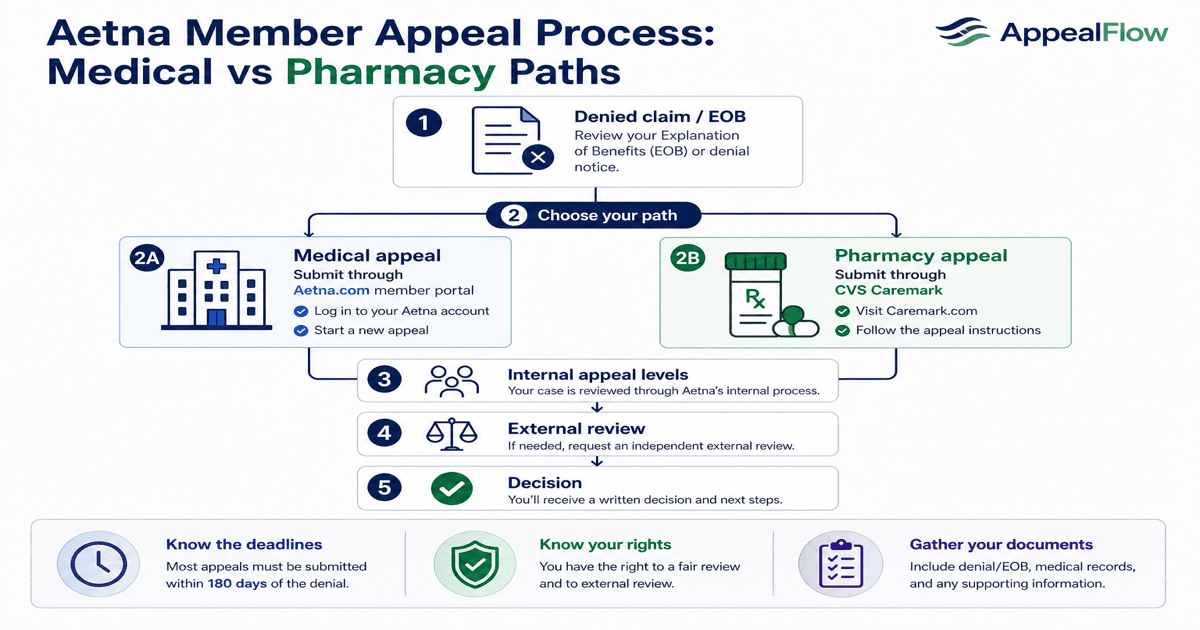
What Is the Aetna Appeal Process After a Denied Claim?
Key Takeaway: An Aetna denial is an adverse benefit determination. You have the right to ask the plan to reconsider its decision through internal appeals before independent external review is available on qualifying cases.
Aetna, now part of CVS Health, processes medical claims under Aetna policies and most pharmacy claims through CVS Caremark. When your plan refuses to pay all or part of a service, your Explanation of Benefits should explain why and how to appeal. According to Aetna claim denial resources for members, you can start an appeal by phone or mail and may authorize someone else to appeal on your behalf.
The process differs from provider billing disputes filed through Availity. If your doctor or hospital is appealing on the back end, see our guide on the Aetna appeal form for providers. Member appeals address coverage decisions that affect your benefits and out-of-pocket costs. For payer-specific filing paths, CPB citations, and escalation after internal review, see our Aetna appeal guide.
How Do Aetna Internal Appeal Levels Work?
Key Takeaway: Timing depends on your plan's number of appeal levels and whether the denial is pre-service or post-service. Read your appeal decision letter for the next step and deadline rather than assuming one national rule.
Aetna's member materials describe internal review as the first step when you disagree with a coverage decision. Many commercial plans include a second internal appeal if the first upholds the denial. Aetna states it will decide many post-service appeals within 30 days and pre-service appeals within 15 days when care has not yet been provided.
| Appeal stage | Who reviews | Typical member action |
|---|---|---|
| Level 1 internal appeal | Aetna appeals unit not involved in the initial denial | Submit letter or member appeal form with EOB, claim number, and clinical records |
| Level 2 internal appeal | Higher internal review when your plan offers two appeals | Request second review within 60 days of the Level 1 decision letter per Aetna member guidance |
| External review | Independent physician reviewer outside Aetna | File after internal appeals are exhausted when eligibility criteria on your notice are met |
Employer self-funded plans administered by Aetna follow ERISA claims procedures with clocks printed on your adverse benefit determination. Medicare Advantage members use Medicare organization determination and reconsideration rules on Medicare.gov, not commercial Aetna timelines.
Where Do You File an Aetna Appeal Online or by Mail?
Key Takeaway: Use the channel on your EOB. The Aetna member portal works for many medical claim appeals, but pharmacy denials often need a CVS Caremark path instead of the medical claims mailbox.
Sign in at aetna.com and follow the appeals workflow for your plan, or call Member Services at the number on your ID card. For mail, use the address on your EOB or print Aetna's member appeal form from the same claim denial page. Keep certified mail receipts or portal confirmation numbers because appeal rights are tied to timely filing.
Before you upload, draft your argument with AppealFlow's free health insurance appeal letter generator or review our health insurance appeal letter sample for enclosure formatting. Ask your treating provider to review clinical facts before you submit.
How Does the Aetna Pharmacy Appeal Path Differ From Medical Appeals?
Key Takeaway: CVS Health owns Aetna and administers most Aetna pharmacy benefits through CVS Caremark. The entity named on your denial letter tells you which portal, phone line, and criteria apply.
Retail, mail-order, and many specialty drug denials cite CVS Caremark formulary rules, step therapy, or prior authorization requirements. Your prescriber usually starts with a formulary exception or prior authorization request through CVS Caremark prior authorization channels. For step therapy and formulary denials, the step therapy appeal generator drafts a prescriber-ready exception letter. Medical benefit denials for infusions, Part B office-administered drugs, imaging, surgery, and facility care follow Aetna clinical policy bulletins and member medical appeals.
| Denial type | Typical reviewing entity | First action |
|---|---|---|
| Formulary or step therapy | CVS Caremark pharmacy benefit | Prescriber submits exception with failed drug trials and contraindications documented |
| Medical necessity (service) | Aetna medical management | Member appeal through Aetna with physician letter and records tied to cited clinical policy |
| Prior authorization | Aetna or CVS Caremark depending on benefit | Request retroactive authorization or appeal with urgency documentation. See how to appeal a prior authorization denial or use the prior authorization appeal generator |
| Part B drug in physician office | Aetna medical benefit | Appeal as a medical claim even when the drug also appears on the pharmacy formulary |
How Long Do You Have to Appeal an Aetna Denial?
Key Takeaway: Aetna lists 180 days from notice of denial for many commercial internal appeals unless your plan documents allow more time. Missing the internal window can block external review on ACA and state-regulated plans.
Aetna's member claim denial page states you have 180 days to appeal from when you receive notice unless your plan brochure or Summary Plan Description gives you a longer period. Plans with two appeal levels generally allow 60 days from the first appeal decision to request the second review. ACA marketplace plans must disclose internal and external review rights on your notice under Healthcare.gov appeal rules.
What Documents Should You Attach to an Aetna Appeal?
Key Takeaway: Aetna asks for identifying information plus any records that answer the specific denial reason. Incomplete packets trigger delay letters while the clock on urgent care keeps running.
- Aetna denial letter, EOB, member ID, and group or employer name
- Itemized bill and claim number for each disputed service line
- Physician letter or letter of medical necessity tied to the clinical policy Aetna cited
- Office notes, imaging, labs, and operative reports for medical necessity denials
- Prior authorization reference numbers and pharmacy claims history for step therapy appeals
- Plan booklet sections that support coverage when the denial cites plan exclusion language
Weak vs. Strong Aetna Appeal Language
Key Takeaway: Aetna reviewers look for member ID, claim numbers, cited policy sections, and numbered enclosures. Vague requests to reprocess without new clinical facts rarely change a medical necessity outcome.
| Weak statement | Strong statement |
|---|---|
| “Please overturn my Aetna denial. My doctor says I need this.” | “Member ID [number], claim [number], denial dated [date]. I request Level 1 internal appeal for medical necessity denial. Attached: physician letter, six weeks of conservative therapy notes, and clinical policy section [X] showing criteria met.” |
| “I sent this to Aetna headquarters.” | “Submitted through aetna.com on [date], confirmation [number], to the appeals address listed on my Explanation of Benefits for group [name].” |
| “CVS should cover my prescription because it is standard care.” | “CVS Caremark denial #[number] cites step therapy for [drug]. Attached: prescriber attestation of intolerance to [generic], pharmacy claims for failed trials from [dates], and formulary exception request dated [date].” |
Need an Aetna Appeal Letter Draft?
AppealFlow builds a regulation-informed draft from your denial reason, Aetna claim details, and plan type. Edit live, then download PDF or Word.
What If Aetna Denies Your Internal Appeal?
Key Takeaway: Read your appeal decision letter for the next level, deadline, and whether external review is offered. Aetna external review applies to certain medical necessity denials after internal appeals are exhausted.
When internal review upholds the denial, Aetna's external review program may be available if the denial involves medical necessity or experimental status and the amount you would owe exceeds plan thresholds stated on your notice. The independent reviewer's decision is binding on Aetna and the plan sponsor for eligible cases.
ACA marketplace and many fully insured plans must also offer state external review at no cost under Healthcare.gov external review rules. For general next steps after any carrier denies twice, see what to do when an insurance claim is denied.
Frequently Asked Questions
Common questions about the Aetna appeal process, member portal filing, pharmacy vs medical paths, and external review.
Generate Your Free Aetna Appeal Letter
AppealFlow drafts formal appeal letters for Aetna denials and other carriers. Enter your denial details, edit the letter for your plan type, and export PDF or Word. No account required.
- 100% Free
- No Signup
- PDF & Word Export
Disclaimer: This article is for educational purposes only and does not constitute medical or legal advice. AppealFlow is not an insurance company or law firm. Aetna appeal deadlines, portal paths, and coverage rules vary by product, contract year, and whether your pharmacy benefit is administered by CVS Caremark. Review your denial notice and plan documents, and consult a licensed professional when appropriate. For emergencies, call 911. See our full disclaimer.