Balance Billing Dispute Letter for Hospital Billing
When Do You Need a Balance Billing Dispute Letter?
Key Takeaway: Send a dispute letter when a hospital or out-of-network clinician bills you more than your in-network copay, deductible, and coinsurance for care the No Surprises Act may protect. Balance billing means billing you for the difference between the provider charge and what insurance paid.
A written dispute creates a paper trail before collection calls start. It is not a lawsuit and not the same as federal Independent Dispute Resolution between the provider and your plan. Your letter challenges your patient responsibility on the hospital statement.
Common hospital billing scenarios that trigger a dispute letter:
- Out-of-network ER physician bill after an in-network hospital visit
- Separate radiology or anesthesiology bill from an out-of-network group
- Hospital facility fee above in-network cost-sharing for emergency care
- Air ambulance balance bill where federal surprise billing rules apply
- Post-stabilization services at an in-network facility before safe transfer
For a full ER workflow, see our guide on No Surprises Act dispute resolution for out-of-network ER bills. For bills that are high but not surprise bills, read how to negotiate medical bills.
What Does the No Surprises Act Cover?
Key Takeaway: Federal surprise billing rules generally apply to group and individual commercial plans, not Original Medicare, Medicaid, or CHIP. They limit balance billing for qualifying emergency services, air ambulance, and certain facility-based care when you did not receive a valid notice-and-consent waiver.
CMS No Surprises Act consumer guidance describes which services federal law protects. Your dispute letter should name the specific service, whether the facility was in-network, and why you believe balance billing is prohibited for that visit.
| Situation | Typical next step |
|---|---|
| Emergency care at in-network hospital | Patient-provider dispute citing NSA emergency services rules |
| Elective OON care with valid waiver signed | Negotiate bill or insurer appeal; NSA caps may not apply |
| Ground ambulance | Check state law; federal NSA rules differ from air ambulance |
| Original Medicare or Medicaid | Follow program appeal instructions on your notice |
For a plain-language overview of balance billing rights, read what balance billing federal law protects.
How Do You Write a Hospital Balance Billing Dispute Letter?
Key Takeaway: Include patient identifiers, service details, a No Surprises Act citation, the dollar amount disputed, a request for corrected billing, and a numbered attachment list. Keep the tone factual and tie every dollar to your EOB.
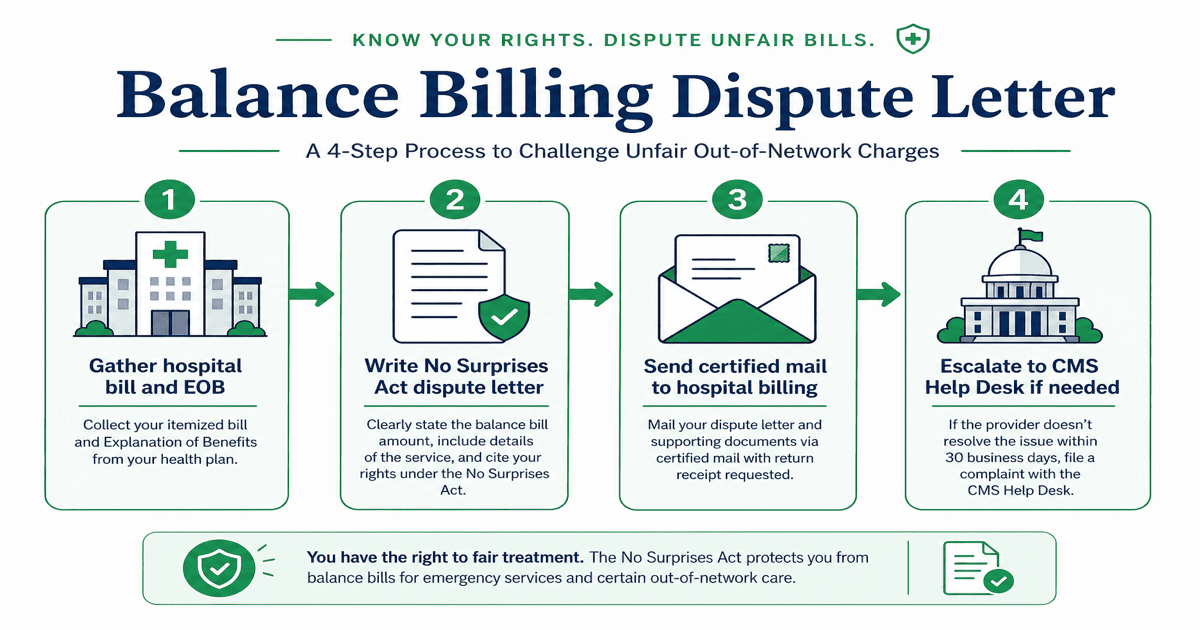
- Gather documents. Hospital bill, Explanation of Benefits, insurance card, and any prior correspondence from billing staff.
- Calculate correct patient responsibility. Your in-network copay plus deductible portion plus coinsurance equals the maximum you may owe when NSA protections apply.
- Identify the billing violation. Note whether the provider is out-of-network at an in-network facility, whether the service was emergency care, and the excess amount billed.
- Write the letter using the structure below. Cite the No Surprises Act and request corrected billing.
- Send by certified mail with return receipt. Send copies to hospital billing, any third-party billing company, and your insurer.
- Follow up if you receive no response. Contact the CMS No Surprises Help Desk and your state insurance department when appropriate.
CMS emergency services guidance confirms that out-of-network clinicians at in-network emergency facilities generally cannot balance bill you for emergency services.
What Documents Should You Attach?
Key Takeaway: Number each enclosure on your dispute letter so hospital billing can match your account quickly. Without EOB math, billing staff have no reference for how much you believe you owe.
- Itemized hospital bill with account number and date of service
- Explanation of Benefits showing in-network cost-sharing
- Insurance card copy and member ID
- Discharge summary or ER note when emergency status is disputed
- Certified mail receipt or portal upload confirmation
Use this header structure in your letter:
- Header: Your name, address, phone, email, account number, date of service, claim number
- Recipient: Hospital billing department and any third-party biller on the statement
- Re line: Formal dispute of balance bill under the No Surprises Act
- Body: Service, provider name, facility name, and network status on the date of care
- Amount disputed: Bill amount minus correct in-network cost-sharing from your EOB
- Request: Corrected statement reflecting only in-network patient responsibility
Weak vs. Strong Balance Billing Dispute Language
Key Takeaway: Hospital billing departments process disputes that cite federal law and dollar amounts. Replace frustration with EOB math and No Surprises Act citations.
| Weak statement | Strong statement |
|---|---|
| “This bill is unfair and I cannot afford to pay $4,200 for the ER doctor.” | “I dispute the $4,200 balance bill from [Out-of-Network ER Physician Group] for emergency services on [date] at [In-Network Hospital]. Under the No Surprises Act, my patient responsibility is limited to in-network cost-sharing: $350 copay per attached EOB. I owe $0 beyond that amount.” |
| “The hospital said the doctor is out of network so I have to pay.” | “Federal surprise billing rules prohibit balance billing for out-of-network emergency physicians at in-network facilities. Facility was in-network per attached EOB. Provider balance bill of $2,850 exceeds my in-network coinsurance of $412. I dispute $2,438.” |
| “Please remove this charge from my account.” | “I request corrected billing within 30 days reflecting only my in-network cost-sharing of $412. If uncorrected, I will file with the CMS No Surprises Help Desk at 1-800-985-3059 and notify [State] Department of Insurance. Copy sent to [Insurer] member services [date].” |
Draft Your Balance Billing Dispute Letter
AppealFlow's No Surprises Act dispute generator builds a patient-provider dispute letter from your EOB and billing details. Edit live, then download PDF or Word.
Where Should You Send the Letter and How Do You Escalate?
Key Takeaway: Send the dispute letter to hospital billing by certified mail. Escalate to the CMS No Surprises Help Desk and your state insurance commissioner if the provider does not correct billing after a reasonable period.
| Channel | When to use | How to access |
|---|---|---|
| Hospital billing (certified mail) | First step for every disputed balance bill | Address on your hospital bill; request return receipt |
| CMS No Surprises Help Desk | Provider refuses correction after your written dispute | cms.gov/nosurprises or 1-800-985-3059 |
| State insurance commissioner | State-regulated plan or provider violation | Your state DOI consumer complaint portal |
| Insurer member services | EOB shows wrong patient responsibility | Phone number on insurance card; reference EOB claim number |
What If Hospital Billing Ignores Your Dispute?
Key Takeaway: If a collection agency contacts you about a disputed balance bill, respond in writing within 30 days citing your original dispute date and federal surprise billing rules. Do not ignore collection notices.
Send the collection agency a copy of your original dispute letter with a cover note stating the debt is disputed under the No Surprises Act. Under the Fair Debt Collection Practices Act, collectors must pause certain collection activity while investigating a written dispute. Keep certified mail receipts so you can prove when you disputed the charge.
Check your notice: Paying a partial amount to appear cooperative does not protect you. Partial payment can be treated as acknowledgment of the full debt. Dispute the entire excess amount in writing before you pay above your in-network cost-sharing.
Federal IDR between the provider and your plan does not replace your patient dispute. When NSA protections apply, your cost-sharing should stay at the in-network level while the parties resolve payment. You do not file IDR yourself in most cases.
Five Mistakes That Weaken Balance Billing Disputes
Key Takeaway: Verbal phone disputes without written follow-up are hard to enforce. Always send a written dispute letter with EOB math and proof of delivery.
- Disputing by phone only. No paper trail for CMS or state complaints.
- Not attaching the EOB. Without in-network cost-sharing math, billing staff lack a correction target.
- Missing the collection agency response window. FDCPA dispute rights have deadlines.
- Paying the full bill to avoid collections. Overpayment is difficult to recover.
- Confusing patient dispute with provider IDR. IDR is between provider and insurer. Your letter disputes your patient responsibility.
Frequently Asked Questions
Answers to common balance billing dispute letter questions under the No Surprises Act.
Generate Your Balance Billing Dispute Letter
Use AppealFlow to draft a No Surprises Act dispute letter for hospital balance bills. Edit live, then download PDF or Word. No account required.
- 100% Free
- No Signup
- PDF & Word Export
Disclaimer: This article is for educational purposes only and does not constitute medical or legal advice. AppealFlow is not a healthcare provider or law firm. Deadlines and rights depend on your plan type and the notices you received. For medical emergencies, call 911. See our full disclaimer.