How to Negotiate Medical Bills
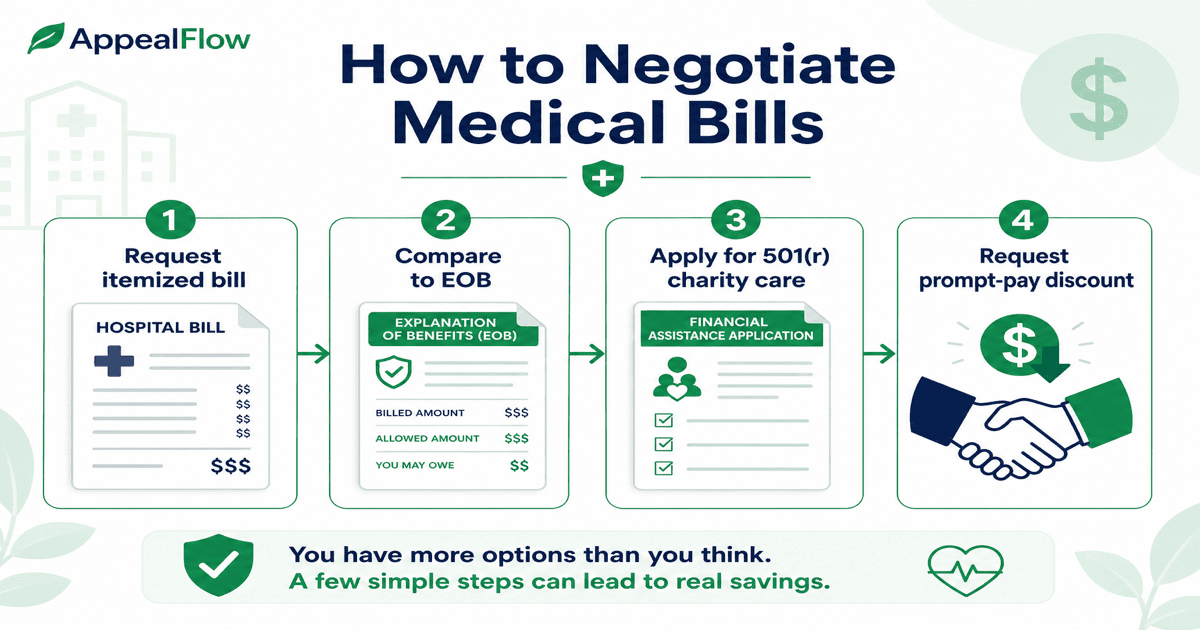
Step 1: Get an Itemized Bill and Your Explanation of Benefits
Key Takeaway: The one-page summary statement is not the same as an itemized bill. An itemized bill lists every charge with its CPT or revenue code. Comparing it to your Explanation of Benefits (EOB) is the fastest way to find billing errors, duplicate charges, and services you did not receive.
Call or write to the hospital billing department and specifically request an itemized bill. Use those words. Providers sometimes provide a summary statement instead. You are entitled to an itemized bill under state hospital billing statutes and, for most hospital outpatient and emergency services, hospitals are already required to provide good faith estimates to uninsured patients under the CMS No Surprises Act good faith estimate rules.
Your insurer sends an Explanation of Benefits (EOB) after a claim is processed. The EOB shows the billed amount, the plan-negotiated rate, what the insurer paid, and what you owe as patient responsibility. Compare every line of the itemized bill to the EOB. Common discrepancies include:
- Duplicate charges for the same service on the same date
- Charges for services or supplies not documented in your medical record
- Upcoded procedure codes that do not match the complexity of the visit
- Room charges for days already covered by discharge or transfer
- Insurance adjustments not applied: you owe the contractual rate, not the billed chargemaster rate
If you find discrepancies, dispute them in writing to the billing department, referencing the CPT code, date of service, and the reason for the dispute. Keep copies of all correspondence. If an insurer processed a claim incorrectly, file a formal internal appeal with your plan rather than only contacting the provider.
Step 2: Check Whether the No Surprises Act Limits Your Bill
Key Takeaway: The No Surprises Act limits out-of-network cost-sharing for emergency services at any hospital and for non-emergency facility-based services when you did not have a meaningful choice of provider. The law applies to most private insurance plans. It does not generally apply to Original Medicare or Medicaid.
Under the No Surprises Act (effective January 2022), if you receive emergency care at any hospital, even one not in your plan's network, your insurer must pay the out-of-network provider and you owe no more than your in-network cost-sharing amount. Providers may not balance-bill you for the difference above your plan's in-network rate.
The same protection applies to non-emergency services at in-network facilities when you receive care from an out-of-network provider and did not receive and sign a valid notice-and-consent form acknowledging the out-of-network status and estimated cost. Common examples: an out-of-network anesthesiologist during an in-network surgery, or an out-of-network radiologist reading your in-network MRI.
If you believe you were billed in violation of these rules, use the CMS patient-provider dispute resolution process or the No Surprises Act appeal generator to draft a formal dispute. For balance billing dispute letter templates, see our guide on balance billing dispute letters.
Step 3: Apply for Financial Assistance Under IRS Section 501(r) Before Paying
Key Takeaway: Nonprofit hospitals must offer financial assistance under IRS Section 501(r). Eligible patients may receive free or substantially discounted care. Apply before setting up a payment plan. Payment agreements can foreclose retroactive charity care discounts at some institutions.
If your provider is a tax-exempt nonprofit hospital, IRS Section 501(r) requires it to maintain a written financial assistance policy, accept applications, and limit charges for eligible patients to no more than amounts generally billed to insured patients under Section 501(r)(5). This is a federal tax requirement, not a voluntary program.
Financial assistance policies typically use federal poverty level (FPL) percentages to set discount tiers. Many hospitals offer free care for households below 200%–250% of FPL and partial discounts through 400% of FPL. Thresholds and discount levels vary by institution. Download the specific policy from the hospital's website or request it at the billing office.
Gather these documents before submitting:
- Most recent federal tax return (Form 1040)
- Two to three recent pay stubs for all household earners
- Documentation of unemployment benefits, Social Security, or other income
- Completed financial assistance application (available on the hospital website)
Under Section 501(r)(6), the hospital must halt extraordinary collection actions (wage garnishment, lawsuits, credit reporting) while your financial assistance application is under review. Request a billing hold in writing when you submit the application and keep the confirmation.
Note: Section 501(r) applies to nonprofit hospital facilities, not necessarily to every physician group, emergency medicine group, or laboratory that bills separately. Ask each billing entity whether it participates in the hospital financial assistance program or has its own policy.
If your income is too high for charity care, consider whether you qualify for other programs. For patients without insurance, see our guide on what to do if you can't afford health insurance.
Step 4: Request a Prompt-Pay or Cash-Pay Discount
Key Takeaway: After confirming you do not qualify for financial assistance (or after charity care is applied to the remaining balance), ask directly for a prompt-pay or cash-pay discount. These are not advertised and require a direct request. Get the offered amount in writing before paying.
Many hospitals, physician groups, and imaging centers offer voluntary discounts when patients pay a negotiated lump sum quickly. These discounts are not federally required and vary significantly. A self-pay patient negotiating directly may reach a different arrangement than a patient with insurance.
Ask the billing department: “What is your prompt-pay or cash-pay rate if I resolve this balance today or within 30 days?” Have a specific number in mind. If the offered discount is modest, ask whether a supervisor or patient financial services manager can authorize a larger reduction.
Before accepting a lump-sum offer, verify in writing: the exact dollar amount being forgiven, that the account will be marked “paid in full” rather than “settled,” and that no balance will be sent to collections after payment. Get this confirmation by email or certified letter.
Weak vs. Strong Negotiation Language
Key Takeaway: Billing departments process hundreds of requests. Specific, documented requests citing your legal rights move faster than general pleas. The table below shows the difference between language that stalls and language that advances your negotiation.
| ❌ Weak Request | ✓ Strong Request |
|---|---|
| “The bill seems too high. Can you lower it?” | “I am requesting an itemized bill with CPT codes for date of service [date]. Please compare to EOB #[number]; lines 4 and 7 appear duplicated. Please provide a corrected statement before I submit payment.” |
| “I don't have insurance. Do I get a discount?” | “I am submitting a financial assistance application under your IRS Section 501(r) policy. My household income is approximately [X]% of FPL. Attached: completed application, 2025 tax return, and two pay stubs. I request a billing hold on this account under Section 501(r)(6) while my application is reviewed.” |
| “Can I pay less than the full amount?” | “I would like to resolve the remaining balance of $[X] today with a prompt-pay settlement. I am prepared to pay $[Y] by [date] if you can confirm in writing that the account will be marked paid in full and no balance will be referred to collections.” |
| “This bill is from an out-of-network doctor. I think the law covers this.” | “This is an emergency service provided at [Hospital Name] on [date]. Under the No Surprises Act, my cost-sharing is limited to my in-network amount. The provider has not submitted a valid notice-and-consent form. I am disputing the balance above my plan's in-network cost-sharing amount and will submit a patient-provider dispute resolution request to CMS if the charge is not corrected.” |
Payment Plans: What to Know After Exhausting Other Options
Key Takeaway: Payment plans should be the last step, not the first call you make. Entering a payment plan before applying for charity care may waive your right to retroactive discounts at some hospitals. Understand what you are agreeing to before signing, including whether interest accrues and whether the plan affects collection hold status.
If charity care, discounts, and billing corrections still leave a balance you cannot pay in full, contact the billing department about an interest-free payment plan. Many nonprofit hospitals are required by state law or their own financial assistance policies to offer payment plans without interest for qualifying patients. Ask explicitly whether the plan carries interest.
Before signing a payment agreement, confirm:
- Whether charitable care or financial assistance applications can still be submitted or are foreclosed by the agreement
- The exact monthly amount, start date, and total number of payments
- Whether missing a payment immediately triggers collection referral or gives a grace period
- Whether the plan is interest-free or accrues interest, and at what rate
Avoid medical credit cards (such as CareCredit) before fully exploring hospital payment plans. Deferred-interest promotions on medical credit cards can result in full retroactive interest charges if the balance is not paid before the promotional period ends.
Insurance Denied the Claim Behind This Bill?
AppealFlow drafts regulation-informed appeal letters for insurance denials, citing ACA §2719, ERISA §503, and your specific denial reason. Ready to submit in under 60 seconds.
Negotiation Checklist: Documents and Steps
Key Takeaway: A structured approach produces better outcomes than repeated calls without documentation. Work through this checklist in order. Each step builds on the previous one and some steps (like charity care) must precede others (like payment plans).
| Step | Action | What to Ask / Submit |
|---|---|---|
| 1 | Request itemized bill | Call billing, request itemized statement with CPT/revenue codes |
| 2 | Compare to EOB | Match each line; dispute duplicates and errors in writing |
| 3 | Check No Surprises Act | For emergency or facility-based OON services; dispute if violated |
| 4 | Apply for charity care (501(r)) | Submit financial assistance application with income docs; request billing hold |
| 5 | Request prompt-pay discount | Ask for cash/prompt-pay rate on remaining balance; get offer in writing |
| 6 | Set up interest-free payment plan | Ask about interest rate, payment terms, and collection hold provisions |
For related guides, see what happens if you don't pay medical bills and what to do if you can't afford health insurance.
Frequently Asked Questions
Common questions about negotiating hospital bills, itemized statements, charity care, and the No Surprises Act.
Generate Your Free Appeal Letter
AppealFlow.net drafts formal appeal letters for insurance denials and billing disputes, citing ACA §2719, ERISA §503, and your specific denial reason. Edit live, download as PDF or Word. No account required.
- 100% Free
- No Signup
- PDF & Word Export
Disclaimer: This article is for educational purposes only and does not constitute medical, legal, or financial advice. AppealFlow.net is not a healthcare provider, insurance broker, or law firm. Hospital financial assistance policies, state collection laws, and federal billing rules change. Verify current requirements with the billing department, your insurer, or CMS.gov before taking action. For medical emergencies, call 911. See our full disclaimer.