What Happens If You Don't Pay Medical Bills?
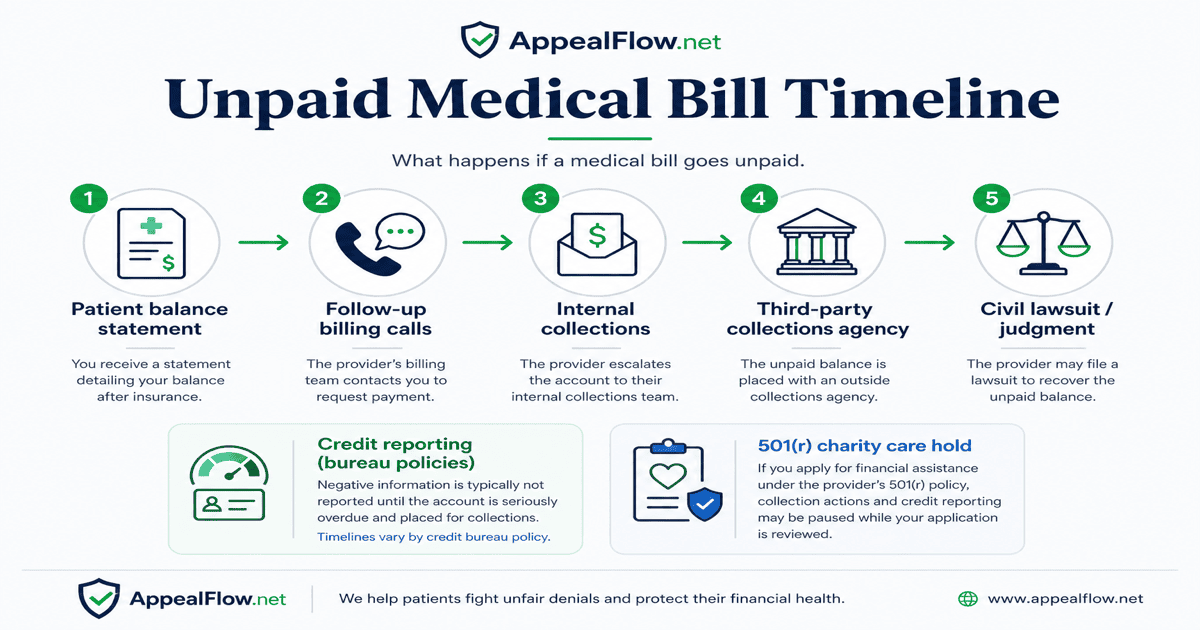
What Happens First When You Miss a Medical Bill Payment?
Key Takeaway: There is no single federally mandated waiting period before a medical bill can go to collections. Most large hospital systems send multiple statements over 60–180 days. Physician groups and specialty labs may move faster. The earlier you contact the billing department, the more options you have.
After a service, the provider submits a claim to your insurer if you have one. Once the claim is processed, you receive an Explanation of Benefits (EOB) from the insurer and a patient balance statement from the provider. If insured, the balance reflects what remains after your plan paid its portion. If uninsured, the statement reflects the provider's billed charge unless a discount was applied.
When the balance goes unpaid, most providers follow a sequence like the one below. Exact timelines vary by institution and state:
| Approximate timeframe | What typically happens | Your options |
|---|---|---|
| Days 1–30 | First patient balance statement sent | Request itemized bill; check for errors; apply for financial assistance |
| Days 30–90 | Follow-up statements; provider may call | Submit charity care application; request billing hold; negotiate prompt-pay discount |
| Days 90–180+ | Account may move to internal collections or a pre-collections unit | Financial assistance may still be available; set up payment plan; confirm 501(r) billing hold if pending |
| 180+ days (varies widely) | Account may be sold or referred to a third-party collections agency | Request debt validation within 30 days of the collector's first contact; negotiate settlement |
| After civil judgment (if sued) | Creditor may pursue wage garnishment, bank levies, or property liens under state law | Respond to any lawsuit notice; seek legal aid; explore state exemption protections |
State law can shorten or lengthen these steps. Some states require hospitals to screen for financial assistance eligibility before referring accounts to collections. Check your state attorney general's consumer protection office for state-specific rules.
Can Unpaid Medical Bills Hurt Your Credit Score?
Key Takeaway: A hospital statement sitting in patient financial services is not automatically a credit-report entry. Equifax, Experian, and TransUnion describe voluntary medical-collection policies: paid medical collections are not included; unpaid medical collections under $500 are not included; and larger unpaid medical collections generally wait about a year before appearing. Those practices can change. They are not a federal ban.
Equifax's NCRA medical-collections explainer states that, as of April 1, 2023, unpaid medical collection debt with an initial reported balance under $500 is no longer included on consumer credit reports; that paid medical collection debt is no longer included; and that the waiting period before unpaid medical collection debt appears increased to about one year.
For a deeper breakdown of bureau policies and how to check your own files, see do medical bills go on your credit report. This page does not estimate how many credit-score points a medical collection costs. Scoring models differ, and the bureaus themselves say individual score impacts vary.
Do not assume medical debt is invisible on credit reports. Unpaid balances above $500 in collections may still appear after the bureaus' waiting period. Paying, settling, or qualifying for charity care that eliminates the balance is the most reliable way to prevent a reporting entry.
What Is the Status of the 2025 CFPB Medical-Debt Rule?
Key Takeaway: On July 11, 2025, the U.S. District Court for the Eastern District of Texas vacated the CFPB's Regulation V medical-information rule. The Bureau's own page says the website materials are for reference only. Do not plan as if a nationwide CFPB ban on medical-debt reporting were in force.
The CFPB medical-information rule page documents the vacated January 2025 rule. Bureau voluntary policies and state statutes may still limit some reporting or collection activity, but there is no active nationwide CFPB prohibition you can rely on when a collector threatens credit reporting.
What Restrictions Apply at Nonprofit Hospitals Under IRS 501(r)?
Key Takeaway: Tax-exempt hospitals cannot take extraordinary collection actions against patients whose financial assistance applications are still under review. Applying for charity care triggers these protections in writing.
IRS Section 501(r)(6) requires tax-exempt nonprofit hospitals to make reasonable efforts to determine financial assistance eligibility before taking extraordinary collection actions (ECAs). ECAs include reporting to consumer credit agencies, wage garnishment, liens on property, seizing bank accounts, and selling debt to third-party collectors.
If you have submitted a financial assistance application, the hospital must halt ECAs while the application is under review. Notify the billing department in writing that you have applied, and request written confirmation of the billing hold. The hospital's financial assistance policy, required to be publicly available under Section 501(r)(4), sets the income thresholds and discount tiers.
Section 501(r) applies to the nonprofit hospital facility. It does not automatically apply to physician groups, anesthesiology practices, pathology labs, or air ambulance services that bill separately, even if they provided care at the same nonprofit hospital. Ask each billing entity whether it has its own financial assistance policy. For application steps, see our medical bill negotiation guide and hospital charity care guide.
What Can Medical Debt Collectors Do Under the FDCPA?
Key Takeaway: The Fair Debt Collection Practices Act regulates third-party collectors. If a collections agency contacts you about medical debt, you have specific rights to validation, dispute, and communication limits.
When a third-party debt collector contacts you, the FDCPA (15 U.S.C. § 1692 et seq.) gives you the following rights:
- Debt validation: Within 30 days of the collector's first written contact, send a written debt validation request. The collector must pause collection activity until they provide verification of the debt.
- Call time limits: Collectors cannot call before 8 a.m. or after 9 p.m. in your local time zone.
- No threats of arrest: Collectors cannot threaten criminal prosecution, arrest, or imprisonment for civil debt, including medical debt.
- No false representations: Collectors cannot misrepresent the amount owed, claim to be attorneys or government agencies, or threaten legal actions they cannot or do not intend to take.
- Cease communication: You can send a written cease-communication request. The collector must stop contacting you except to notify you of specific actions such as a lawsuit.
The FDCPA applies to third-party collectors, not to the original provider collecting its own debt. Some states extend similar protections to original creditors. Report FDCPA violations to the CFPB at consumerfinance.gov/complaint and to your state attorney general.
Can You Go to Jail for Not Paying a Medical Bill?
Key Takeaway: No. Unpaid medical bills are civil debts in the United States. You cannot be arrested or imprisoned for failing to pay a medical bill. Debt collectors who threaten arrest for medical debt are violating the FDCPA.
Medical debt is a civil matter. The consequence of unpaid medical debt is a civil lawsuit, not criminal prosecution. A civil judgment may result in wage garnishment or bank levies through the court system, but only after the creditor obtains a judgment in a case where you have the right to appear and respond.
For a detailed myth-by-myth breakdown, see our companion article: can you go to jail for not paying medical bills?
Was the Underlying Claim Denied by Insurance?
Unpaid bills often trace back to a denied claim. AppealFlow drafts regulation-informed appeal letters citing your specific denial reason and applicable federal protections.
What Should You Do Instead of Ignoring the Bill?
Key Takeaway: Ignoring a medical bill does not make it disappear. It narrows your options over time. Taking action early gives you access to financial assistance, dispute rights, and negotiation leverage that diminish once accounts reach collections.
If you cannot pay a medical bill, prioritize these steps in this order:
- 1Check whether the underlying claim was denied. If insurance denied the claim that generated this bill, file an internal appeal before paying anything. A successful appeal shifts the obligation back to the insurer.
- 2Request an itemized bill and check for errors. Billing errors are common. Disputing them in writing costs nothing and can reduce the balance.
- 3Apply for charity care. If the provider is a nonprofit hospital, the financial assistance application under IRS Section 501(r) is free and triggers collection holds while under review.
- 4Negotiate a reduced balance or payment plan. See our medical bill negotiation guide for specific language and steps.
- 5If uninsured, apply for coverage. Qualifying for Medicaid or marketplace insurance may help with future bills. See what to do if you can't afford health insurance.
Frequently Asked Questions
Common questions about collections timelines, credit reporting, FDCPA rights, and 501(r) restrictions on hospital collection actions.
Generate Your Free Appeal Letter
AppealFlow.net drafts formal appeal letters for insurance denials and billing disputes, citing ACA §2719, ERISA §503, and your specific denial reason. Edit live, download as PDF or Word. No account required.
- 100% Free
- No Signup
- PDF & Word Export
Disclaimer: This article is for educational purposes only and does not constitute legal, financial, or medical advice. AppealFlow.net is not a law firm, insurance broker, or financial advisor. Credit reporting rules, state collection statutes, and CFPB regulations change. Verify current requirements at consumerfinance.gov or your state attorney general's office before taking action. For medical emergencies, call 911. See our full disclaimer.