Can You Go to Jail for Not Paying Medical Bills?
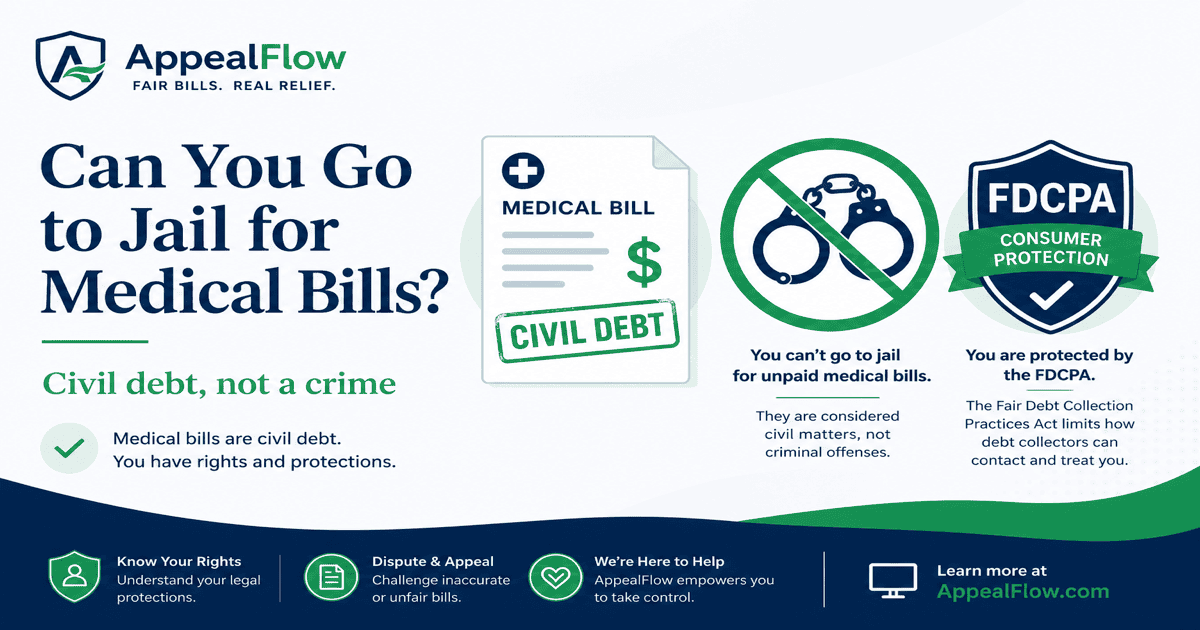
Is Medical Debt Civil or Criminal?
Key Takeaway: No U.S. federal or state statute makes ordinary failure to pay a medical bill a crime. Inability to pay a debt is a civil matter — enforceable through civil courts, not criminal prosecution. This has been the legal framework since the abolition of debtors' prisons in the United States.
People in financial distress sometimes receive phone calls from debt collectors implying they could be arrested. These threats are false and illegal. Under the Fair Debt Collection Practices Act (FDCPA), 15 U.S.C. § 1692e, debt collectors are prohibited from threatening any action they cannot legally take — including threatening criminal arrest for a civil debt.
The distinction between civil and criminal debt matters practically:
| Category | Civil Debt (Medical Bills) | Criminal Charge |
|---|---|---|
| Who enforces it | Creditor or collections agency through civil court | Government (prosecutor) on behalf of the public |
| Consequence of non-payment | Civil judgment, wage garnishment, liens, governed by state law | Fines, probation, or incarceration, only for defined criminal acts |
| Arrest possible? | No, not for the debt itself | Yes, if convicted of a criminal offense |
| What medical debt is | Civil, a contractual obligation to pay for services received | N/A, ordinary inability to pay is not a crime |
The Narrow Situation Where Jail Can Occur: Civil Contempt
Key Takeaway: Jail related to medical debt is legally possible only in a narrow scenario: a court holds someone in civil contempt for ignoring a specific court order, not for owing the debt. This is distinct from being jailed for the debt itself, and it requires a judge's finding after proper notice and a hearing.
Here is how the narrow scenario works: A hospital or collections agency sues you and obtains a civil judgment. After judgment, the creditor may request a court-ordered debtor's examination, a hearing at which you must answer questions about your assets and income under oath. If you receive proper notice of this hearing and willfully ignore it, a judge can issue a bench warrant for civil contempt for ignoring the court order, not for the underlying debt.
This is exceedingly different from being jailed for owing money. The jail risk, when it arises, is for ignoring a court order, and it can be avoided by responding to lawsuit notices, attending hearings, or seeking legal aid assistance.
Never ignore a lawsuit or court notice. If you receive a summons or complaint related to a medical debt, respond in writing by the deadline stated in the paperwork, typically 20–30 days depending on your state. Contact a legal aid organization in your area if you need assistance. Ignoring court documents is the single most avoidable path to escalating legal consequences.
Medical billing fraud, deliberately providing false information to obtain care, submitting false insurance claims, or identity theft, is a different matter entirely and can carry criminal penalties. Ordinary inability to pay a genuine medical bill is categorically different from fraud.
What Can Actually Happen: Civil Lawsuits and Wage Garnishment
Key Takeaway: A hospital or collections agency that wins a civil judgment may pursue wage garnishment, bank account levies, or property liens, all through the civil court system, all governed by state-specific rules that limit which income and assets are exempt.
The actual consequences of not paying medical bills escalate in this order, none of which involves criminal law:
- 1Repeated billing statements and calls from the original provider.
- 2Referral to internal collections, the provider's own collections department contacts you.
- 3Sale or referral to a third-party collections agency, now subject to FDCPA rules.
- 4Credit reporting, unpaid collections above $500 may appear on your credit report (subject to current CFPB/bureau rules).
- 5Civil lawsuit, creditor files in civil court; you have the right to respond and appear.
- 6Civil judgment, if creditor wins (or you default by not responding), allows wage garnishment or liens under state law.
State law governs which wages, bank accounts, and assets are exempt from garnishment. Social Security benefits are generally exempt from garnishment by private creditors under federal law. Many states protect a portion of wages or the primary residence. Check your state's debt collection exemption rules or consult legal aid.
Nonprofit Hospital Collection Restrictions Under IRS 501(r)
Key Takeaway: Tax-exempt hospitals must evaluate financial assistance eligibility before filing lawsuits, garnishing wages, or sending accounts to collections. Submitting a charity care application halts extraordinary collection actions while the application is under review.
Not all medical debt holders face identical collection risks. If your debt is owed to a tax-exempt nonprofit hospital, IRS Section 501(r)(6) restricts the hospital from taking extraordinary collection actions (ECAs), including filing lawsuits and wage garnishment, against patients who have not been evaluated for financial assistance.
If you apply for financial assistance, the hospital must pause ECAs while your application is reviewed. Keep written documentation of every application submission and every billing-hold request. For the steps to apply and the language to use, see our guide to negotiating medical bills.
FDCPA: Illegal Collector Threats You Can Report
Key Takeaway: If a debt collector threatens arrest, criminal prosecution, or imprisonment for a medical bill, that is an FDCPA violation. Document the threat and report it to the CFPB. You may also have a private right of action against the collector.
The FDCPA (15 U.S.C. § 1692 et seq.) prohibits debt collectors from:
- Threatening arrest or criminal prosecution for a civil debt
- Misrepresenting the amount owed or the legal status of the debt
- Claiming to be a government agency, law enforcement, or attorney when they are not
- Contacting you before 8 a.m. or after 9 p.m. in your local time zone
- Continuing to contact you after you send a written cease-communication request
Report violations to the CFPB at consumerfinance.gov/complaint and to your state attorney general's office. The FDCPA also provides a private right of action, you may be able to sue a collector who violates the Act in federal or state court. Consult an attorney or legal aid organization for guidance on whether a lawsuit is appropriate in your situation.
Was a Claim Denied Behind This Bill?
Many large medical bills start with a denied insurance claim. AppealFlow drafts formal appeal letters citing your specific denial reason and applicable regulations, ready in under 60 seconds.
What to Do Instead of Worrying About Jail
Key Takeaway: The risk of arrest is not real for ordinary medical debt, but ignoring bills can lead to civil judgments and wage garnishment that could have been avoided. Early action keeps more options open.
If you are facing an unpaid medical bill, shift focus from fear to action:
- Request an itemized bill and check for billing errors before paying anything
- Apply for hospital financial assistance (charity care) if the provider is a nonprofit
- Negotiate a reduced balance or interest-free payment plan
- If a collection lawsuit arrives, respond by the deadline, never ignore it
- Report illegal debt collector threats to the CFPB and your state attorney general
For a full breakdown of collections timelines, credit reporting impacts, and next steps, see what happens if you don't pay medical bills. For negotiation steps and language, see how to negotiate medical bills.
Frequently Asked Questions
Common questions about medical debt, jail risk, civil contempt, FDCPA protections, and what actually happens when bills go unpaid.
Generate Your Free Appeal Letter
AppealFlow.net drafts formal appeal letters for insurance denials and billing disputes, citing ACA §2719, ERISA §503, and your specific denial reason. Edit live, download as PDF or Word. No account required.
- 100% Free
- No Signup
- PDF & Word Export
Disclaimer: This article is for educational purposes only and does not constitute legal, financial, or medical advice. AppealFlow.net is not a law firm or financial advisor. Debt collection laws, credit reporting rules, state exemption statutes, and CFPB regulations change, verify current requirements at consumerfinance.gov or your state attorney general's office. If you have received a lawsuit, consult a qualified attorney or local legal aid organization. For medical emergencies, call 911. See our full disclaimer.