How to Apply for Hospital Charity Care
What Is Hospital Charity Care Under IRS Section 501(r)?
Key Takeaway: Charity care is not a single federal program with one income limit. It is each nonprofit hospital's written financial assistance policy, required as a condition of tax exemption under IRS section 501(r). Eligible patients may receive free or discounted emergency and medically necessary care.
The Affordable Care Act added section 501(r) to the Internal Revenue Code. Tax-exempt hospital organizations must maintain a financial assistance policy (FAP), limit charges for eligible patients, and follow rules on billing and collections. The IRS summarizes these requirements on its section 501(r) requirements page.
Many hospitals express discount tiers as a percentage of the HHS federal poverty guidelines. A common pattern is full charity care below 200%–250% of FPL and partial discounts through 400% of FPL. Each hospital chooses its own multiples, asset tests, and covered services. Download the specific policy rather than assuming a national cutoff applies.
Who Must Offer a Written Financial Assistance Policy?
Key Takeaway: IRS section 501(r) is a tax-exemption condition for 501(c)(3) hospital facilities. It is not a voluntary courtesy, and it does not automatically cover every doctor who billed you from the same campus.
The IRS summarizes 501(r) hospital requirements, including the financial assistance policy and emergency medical care policy under section 501(r)(4). The FAP must apply to emergency and other medically necessary care provided by the hospital facility. Treasury regulations at 26 CFR 1.501(r)-4 spell out what the written policy has to contain: eligibility criteria, how amounts charged are calculated, how to apply, and how the policy is publicized.
For-profit hospitals are not bound by 501(r). Independent emergency-medicine groups, radiologists, and labs often bill separately even when the hospital is a nonprofit. Ask each entity whether it uses the hospital FAP.
How Do I Find the Hospital's Financial Assistance Policy?
Key Takeaway: Search the hospital website for “financial assistance,” “charity care,” or “FAP.” Section 501(r) requires the policy to be widely publicized. If the PDF is missing, request it in writing from patient financial services and keep that request.
Download the full policy, the plain-language summary if one is posted, and the application form. Note the income measure the hospital uses and whether assets count toward eligibility. Those details are in the FAP, not on a generic charity-care flyer.
If you received care without reviewing the policy first, you can still apply retroactively at many hospitals. The FAP should state whether discounts apply to past balances and how far back. See our guide on how to get an itemized hospital bill so you know exactly which charges the application will cover.
Step-by-Step: Apply Before You Sign a Payment Plan
Key Takeaway: Submit a complete application, request a billing hold, and keep proof of delivery. Signing a payment plan first can block retroactive FAP discounts at some hospitals.
- Confirm the facility type. Nonprofit hospital facility versus for-profit hospital versus a separate physician group.
- Download the FAP and application. Use the hospital's current-year documents, not a copy from a friend's admission.
- Assemble income proof using the checklist below. Follow the FAP's household definition.
- Submit the packet the way the FAP allows (portal, mail, or in person). Get a date-stamped copy or certified-mail receipt.
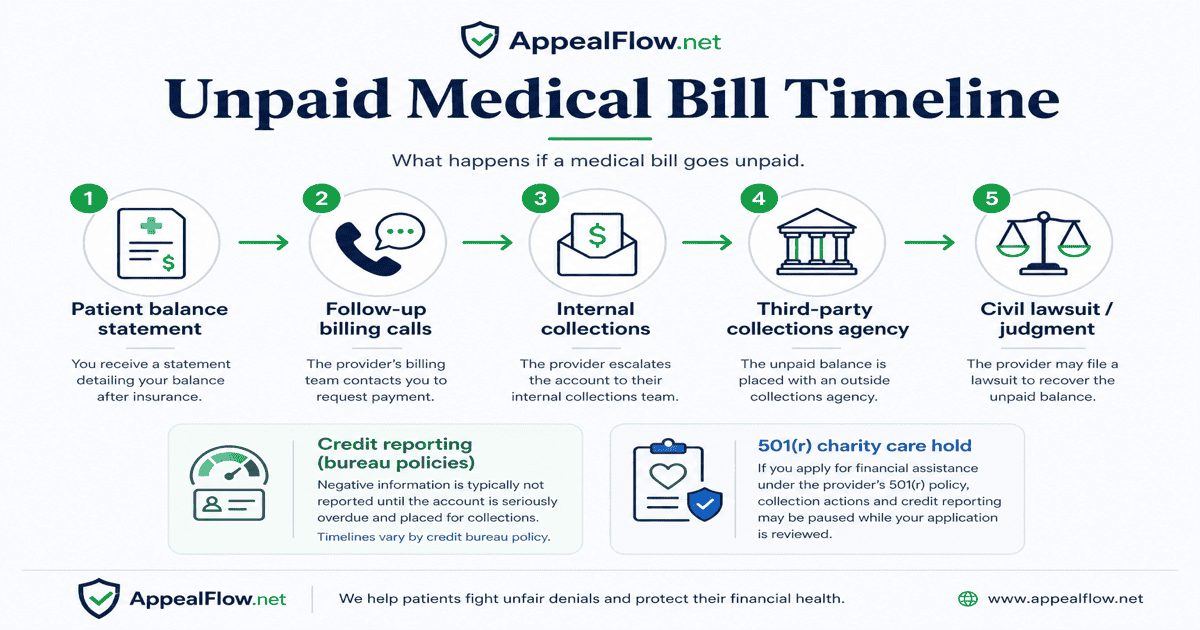
- Request a written billing hold while the application is pending. Under 501(r)(6), the hospital must make reasonable efforts to determine FAP eligibility before extraordinary collection actions.
- Calendar the decision window listed in the FAP. If you are denied, use any appeal or incomplete-application process the policy describes.
After assistance is applied, remaining balances may still be negotiated. See how to negotiate medical bills. If you also need coverage going forward, see what to do if you cannot afford health insurance. Community health centers use sliding-fee schedules that are separate from hospital 501(r) programs.
Document Checklist
Key Takeaway: Send what that hospital's FAP lists. Extra documents help only if the policy asks for them; missing required items is a common reason applications are returned as incomplete.
- Completed FAP application signed by the patient or guarantor
- Most recent federal tax return (Form 1040) if the FAP requests it
- Recent pay stubs for household earners named in the FAP
- Proof of unemployment, SSI/SSDI, child support, or a written zero-income statement if required
- Itemized hospital bill and insurance EOB or denial, if you have coverage
- Your copy of the submission and any billing-hold confirmation
Insurance Denied the Claim Behind This Hospital Bill?
Charity care does not replace an insurance appeal. AppealFlow drafts letters for denials and for surprise-bill disputes that can sit alongside a FAP application.
Weak vs. Strong Charity-Care Application Language
Key Takeaway: Cite the FAP, household income relative to the policy's FPL multiple, the account numbers, and the 501(r) billing-hold request. A vague plea that the bill is unaffordable is not an application.
| ❌ Weak Request | ✓ Strong Request |
|---|---|
| “I can't pay this. Can you help?” | “I am applying under [Hospital]'s financial assistance policy dated [year] for account(s) [numbers], date of service [date]. Attached: completed application, 2025 Form 1040, and two pay stubs. Household size is [n]; income is approximately [X]% of the current HHS poverty guideline as used in your FAP. Please confirm receipt and place a billing hold under section 501(r)(6) while you determine eligibility.” |
| “Just put me on a payment plan.” | “Please do not convert this account to a payment plan until the FAP application filed on [date] is decided. I request written confirmation that a payment agreement will not waive retroactive charity-care discounts listed in your policy.” |
| “A collector called. I guess I missed charity care.” | “FAP application submitted [date], receipt attached. Extraordinary collection actions before a determination may conflict with 501(r)(6). Please recall the account from collections and complete the eligibility review.” |
What If the Hospital Is For-Profit?
Key Takeaway: Section 501(r) does not require a for-profit hospital to maintain this FAP. Ask for any voluntary financial-aid policy, prompt-pay discount, and whether surprise-bill rules apply if you have private insurance.
Some states impose their own charity-care or fair-billing rules on additional facilities. Those statutes are not the same as IRS 501(r). Read the state hospital association materials or the bill's letterhead. Uninsured patients can still request an itemized bill and a cash-pay rate; insured patients should still match invoices to the EOB.
Do not skip insurance appeals. If a plan denied the stay, file the plan appeal on the notice's deadline and apply for FAP in parallel. One process does not complete the other.
Does the No Surprises Act Replace Charity Care?
Key Takeaway: No. The No Surprises Act limits certain out-of-network emergency and facility bills for people with private insurance. Charity care is a hospital income-based write-off or discount. You can need both.
Use the No Surprises Act dispute generator when the fact pattern is a surprise out-of-network balance. Keep the FAP application for the hospital facility charges that remain after insurance, including uninsured care that NSA does not address. Original Medicare and Medicaid generally sit outside NSA consumer balance-billing rules.
Frequently Asked Questions
Common questions about IRS 501(r) financial assistance, documents, payment plans, collections, and surprise bills.
Generate Your Free Appeal Letter
AppealFlow.net drafts formal letters for insurance denials and No Surprises Act billing disputes. Charity care is a separate hospital application. Use both when they apply. Edit live, download as PDF or Word. No account required.
- 100% Free
- No Signup
- PDF & Word Export
Disclaimer: This article is for educational purposes only and does not constitute medical, legal, or financial advice. AppealFlow.net is not a healthcare provider, insurance broker, or law firm. Financial assistance policies, IRS 501(r) rules, and state hospital billing laws change. Verify the current FAP, IRS.gov, and the billing department before taking action. For medical emergencies, call 911. See our full disclaimer.