How to Get an Itemized Hospital Bill
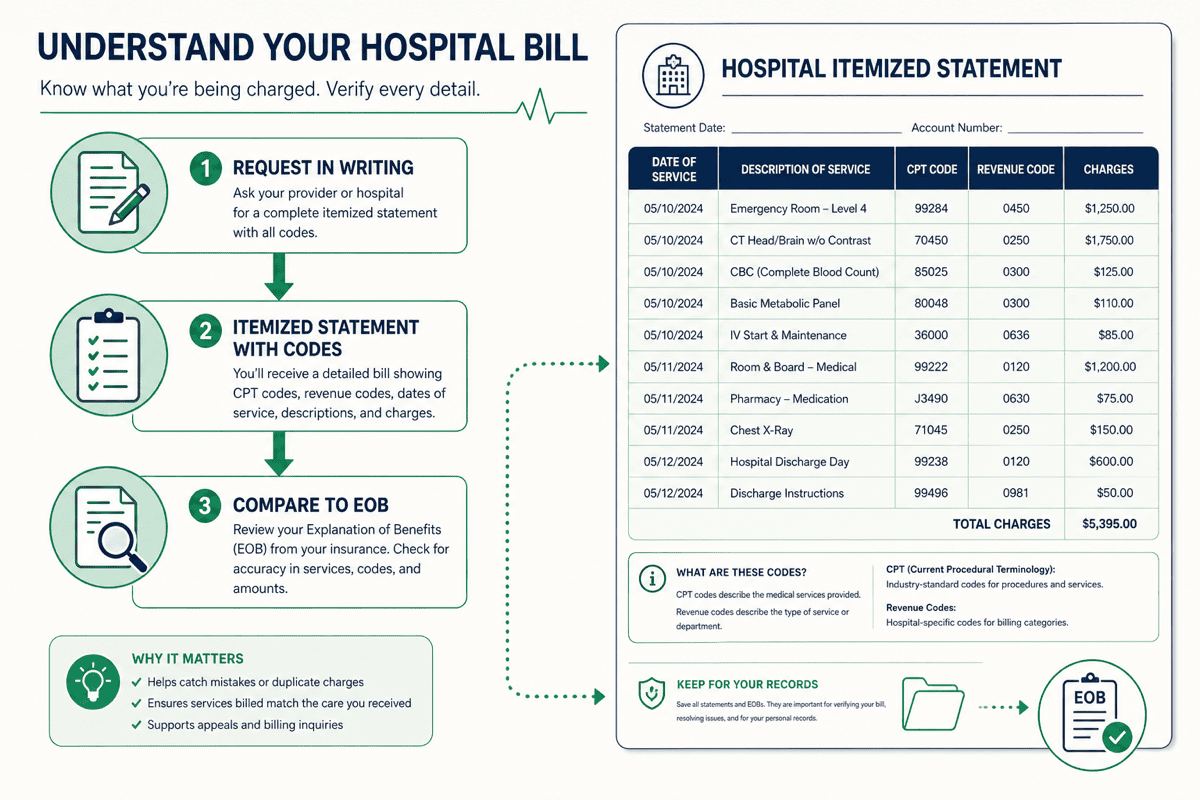
What Should an Itemized Hospital Bill Include?
Key Takeaway: An itemized statement lists every charge on its own line with codes you can match to your Explanation of Benefits. A one-page hospital total or balance-due letter is not enough to audit duplicates, unbundled charges, or services you did not receive.
Ask for an itemized bill by that name, and specify the fields you need: each date of service, a plain-language description, the CPT, HCPCS, or UB-04 revenue code, quantity or units, the chargemaster amount, and any contractual adjustment already posted. Facility bills often use revenue codes; professional bills use CPT/HCPCS. You may need both if the ER physician group billed separately from the hospital.
If you have insurance, keep the itemized statement next to the Explanation of Benefits (EOB). The EOB shows billed charges, plan allowed amounts, what the plan paid, and patient responsibility. For how to read those columns, see how to read an EOB.
| Document to gather | Why it matters |
|---|---|
| Hospital account number and dates of service | Billing staff need these to pull the correct UB-04 claim lines |
| Member ID and latest EOB | Lets you match allowed amounts and remark codes line by line |
| Separate professional bills (ER, radiology, pathology) | Each covered entity may need its own itemized request |
| Good faith estimate, if you received one before care | Compare pre-service estimate to post-service lines under No Surprises Act GFE rules |
How Do I Request an Itemized Bill in Writing?
Key Takeaway: Put the request in writing, name the account and dates, and list the data fields you need. Phone calls that ask for “a copy of my bill” often produce another summary statement.
Send the request to patient financial services, or file it as a HIPAA access request with Health Information Management. Include your full name, date of birth, account or medical-record number, dates of service, and a mailing or electronic delivery preference. Send it in a way you can prove: patient-portal message, email to the published HIM address, or certified mail.
Sample language you can adapt: “I request an itemized statement for account [number], dates of service [dates], listing each date, description, CPT/HCPCS or revenue code, units, and charge. A department total is not sufficient. This is an individual access request under 45 CFR 164.524.”
Does HIPAA Let Me Get Hospital Billing Records?
Key Takeaway: Yes. HHS states that the Privacy Rule gives you, with few exceptions, the right to inspect, review, and receive a copy of your medical records and billing records held by covered providers and plans. 45 CFR 164.524 is the access regulation.
HHS's individual medical-records page and professional right-of-access guidance list billing and payment records in the designated record set. The hospital cannot refuse a copy because the account is unpaid. It may charge a reasonable, cost-based copying fee. HHS guidance does not allow search-and-retrieval fees for an individual access request.
Do not treat a hospital “7–10 business days” voicemail as the law. The general federal outer limit is 30 calendar days from receipt of the request, with one possible 30-day extension if the hospital sends a written delay notice in time. Cite the regulation. Do not invent a hospital policy you have not been given in writing.
How Long Does HIPAA Give the Hospital to Respond?
Key Takeaway: Under 45 CFR 164.524(b)(2), a covered entity must act on an access request no later than 30 days after receiving it. If it cannot, it may extend once by no more than 30 days if, within the first 30 days, it gives you a written statement of the reasons for the delay and the date it will finish.
HHS FAQ “How timely must a covered entity be?” repeats that 30-day outer limit and the single 30-day extension. Many hospitals can produce an itemized UB-04-style statement faster than 30 days. The regulation is the ceiling, not a reason for the billing office to stall without a written extension.
What State Laws Add to Your Itemized-Bill Rights?
Key Takeaway: HIPAA sets a nationwide floor. Your state may also require hospitals to provide an itemized bill, publish charge information, or send consolidated statements on a faster schedule. Read the hospital's posted patient bill of rights and your state insurance or health department materials before you cite a deadline.
State rules vary. Do not assume one state's timeline applies everywhere. These are examples from primary sources, not a complete list:
- New York. The New York State Hospital Patients' Bill of Rights lists the right to receive an itemized bill and explanation of all charges. Public Health Law section 2831 requires a consolidated itemized bill no more than seven days after discharge or after a patient request, whichever is earlier.
- California. Health and Safety Code section 1339.51 requires hospitals to make a charge description master available, and section 127425(e)(3) requires a pre-collections notice that tells you how to obtain an itemized hospital bill from the hospital.
- All states. When a state statute gives a shorter window or additional detail, cite both the state rule and 45 CFR 164.524 in your request. If the hospital ignores both, contact your state hospital licensing agency or insurance department. For billing disputes tied to coverage denials, see filing a state insurance commissioner complaint.
Weak vs. Strong Itemized-Bill Request Language
Key Takeaway: Name the account, dates, and the data fields. A polite phone call that asks for “a copy of my bill” often produces another summary statement.
| ❌ Weak Request | ✓ Strong Request |
|---|---|
| “Can you send me my bill? I don't understand it.” | “I request an itemized statement for account [number], dates of service [dates], listing each date, description, CPT/HCPCS or revenue code, units, and charge. A department total is not sufficient.” |
| “HIPAA says you have to give me everything immediately.” | “This is an individual access request under 45 CFR 164.524 for billing records in my designated record set. Please act within 30 days of receipt, or send the written 30-day extension notice that regulation requires if you cannot.” |
| “Just take $50 a month until I get the itemized bill.” | “Please place a billing hold while this access request and any financial-assistance application are pending. I will compare the itemized statement to EOB [number] before I agree that the balance is correct or sign a payment plan.” |
How Is a Good Faith Estimate Different From an Itemized Bill?
Key Takeaway: A good faith estimate is a No Surprises Act notice for uninsured or self-pay scheduled care. An itemized bill is what you request after services. They are related consumer tools, not the same document.
CMS's good faith estimate page explains that providers usually must give uninsured or self-pay patients an estimate when care is scheduled in advance or when the patient asks. If the actual bill is at least $400 more than the estimate, you may be able to dispute it. That process does not replace HIPAA access to the post-service itemized claim.
Use AppealFlow'shospital billing appeal generatorto draft a structured appeal letter tied to your denial reason before the deadline on your notice.
Found Billing Errors or a Coverage Denial?
After you have the itemized lines, draft a billing dispute or insurance-appeal letter with AppealFlow. You still send the finished letter to the hospital or plan.
What to Do After You Have the Itemized Statement
Key Takeaway: Compare lines to the EOB, dispute errors in writing, then apply for nonprofit hospital financial assistance before you lock in a payment plan. Negotiation and charity care are sequential steps after you get the itemized bill.
- Match CPT/revenue codes and dates to the EOB and to the medical record if something looks wrong
- Write a line-level dispute for duplicates, cancelled procedures, or services not documented
- Request the financial assistance policy if the hospital is a 501(c)(3) facility. See how to apply for hospital charity care
- Only then negotiate remaining balances. Read how to negotiate medical bills
Separate clinician groups (emergency medicine, radiology, pathology, anesthesiology) may each need their own itemized request. HIPAA access applies to each covered entity that holds billing records about you.
Frequently Asked Questions
Common questions about itemized hospital bills, CPT codes, HIPAA access timelines, state patient-billing rights, and good faith estimates.
Generate Your Free Appeal Letter
AppealFlow.net drafts letters for billing disputes and insurance denials. Edit live, download as PDF or Word. No account required. You still send the letter to the hospital or plan.
- 100% Free
- No Signup
- PDF & Word Export
Disclaimer: This article is for educational purposes only and does not constitute medical, legal, or financial advice. AppealFlow.net is not a healthcare provider, insurance broker, or law firm. Hospital billing practices, HIPAA procedures, and state patient-billing statutes change. Verify current requirements with the hospital's HIM or billing office, your state health department, and HHS.gov before taking action. For medical emergencies, call 911. See our full disclaimer.