State Insurance Commissioner Complaint for Health Insurance
What Is a State Insurance Commissioner Complaint?
Key Takeaway: Your state insurance commissioner regulates insurers licensed in your state. A consumer complaint asks the Department of Insurance to review whether the insurer followed applicable law and fair claims-handling standards when it denied, delayed, or underpaid your claim.
Every state has a Department of Insurance, sometimes called the Division of Insurance or Office of the Insurance Commissioner. These agencies license carriers, monitor market conduct, and respond to consumer complaints. Filing is free and does not require an attorney.
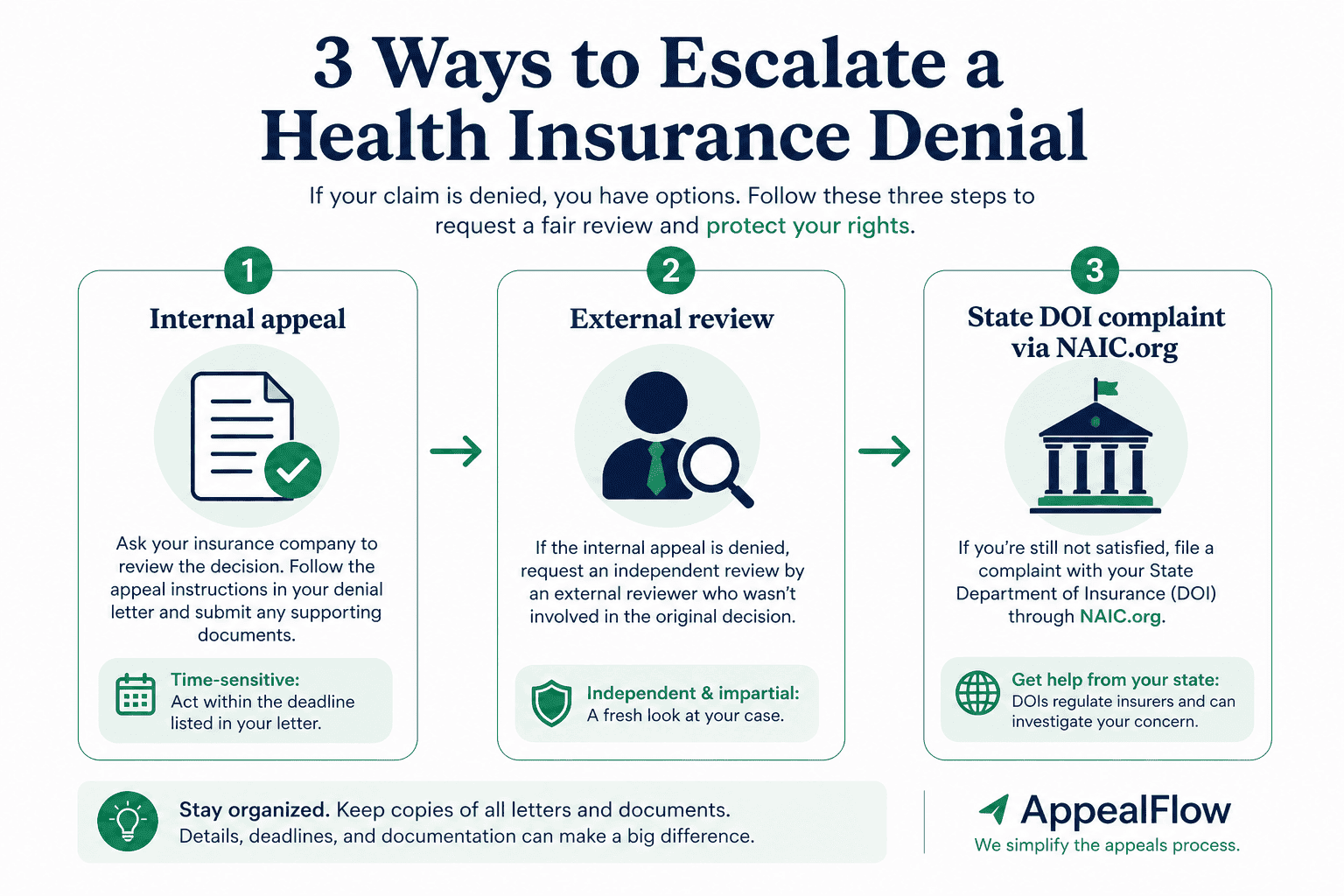
A DOI complaint is different from a coverage appeal. An internal appeal or external review asks whether the service should be covered based on your plan terms and medical evidence. A commissioner complaint asks whether the insurer handled your case properly under state insurance law and regulatory standards.
When Should You File a Complaint vs. an Appeal?
Key Takeaway: Use your formal appeal path to challenge the coverage decision itself. File a state DOI complaint when the insurer misses deadlines, mishandles your appeal, refuses required documents, or continues denying after you have exhausted internal levels.
| Situation | Start here | Also consider |
|---|---|---|
| First denial of a covered service | Internal appeal by the deadline on your notice | Document everything for a later DOI filing if needed |
| Final internal denial on an ACA plan | External review per your final denial notice | Parallel DOI complaint if conduct was unreasonable |
| Insurer missed a required decision deadline | State DOI complaint and follow-up appeal letter | Cite ACA Section 2719 or 29 CFR 2560.503-1 timelines in your filing |
| Insurer will not send denial in writing | State DOI complaint documenting the refusal | Written request for adverse benefit determination |
| Pattern of similar denials without review | DOI complaint with dates and reference numbers | Continue internal appeal to preserve benefit rights |
The Healthcare.gov external review guide explains that external review can reverse qualifying coverage denials on non-grandfathered ACA plans. A DOI complaint addresses a different question: did the insurer follow the rules while handling your case?
Do You Have to Exhaust Internal Appeals First?
Key Takeaway: You do not always need to finish every internal level before contacting your state DOI. You should still file timely internal appeals because they are the primary path to reverse a denial and create the record a regulator or court may review later.
For ERISA employer plans, federal law generally requires participants to follow the plan's internal claims and appeals procedures before suing over a denied benefit. The Department of Labor claims publication describes that exhaustion requirement. A parallel DOI or DOL complaint about claims-handling conduct does not replace filing your internal appeal on time.
For ACA-regulated individual and fully insured group plans, 45 CFR 147.136 implements internal and external review rights under the Affordable Care Act. External review follows internal appeals on qualifying cases. File your internal appeal first, then escalate to external review and a DOI complaint as your facts support each step.
Missing the internal appeal deadline can limit later options. Circle the date on your denial letter and read how long you have to appeal a health insurance denial for program-specific clocks before choosing a complaint-only strategy.
How Do You Find Your State DOI Through NAIC?
Key Takeaway: The National Association of Insurance Commissioners maintains a consumer portal that links to each state's Department of Insurance website, complaint form, and consumer helpline. Use your state's official form rather than a third-party complaint site.
- Go to NAIC.org. Visit NAIC.org and open the consumer section to locate your state's insurance department.
- Select your state. Each state DOI site lists an online complaint portal or downloadable PDF, mailing address, and phone number for consumer assistance.
- Confirm jurisdiction. Fully insured plans sold in your state are state-regulated. Self-funded ERISA employer plans are primarily regulated by the U.S. Department of Labor for benefit disputes, though your state may still accept network or billing complaints.
- Attach your record. Upload or mail copies of your denial letter, EOB, appeal submissions, and a dated timeline of insurer contact.
- Keep confirmation. Save the complaint reference number and any auto-reply from the state portal.
If you are unsure whether your plan is state-regulated or self-funded ERISA, call your state consumer helpline with your plan name and policy number. The representative can tell you which regulator handles your type of coverage dispute.
Need a Formal Appeal Letter First?
AppealFlow drafts regulation-informed appeal letters citing your denial reason and plan type. A strong internal appeal creates the documented record that supports any later DOI complaint.
What Can and Cannot the Commissioner Do?
Key Takeaway: State insurance commissioners investigate compliance and fair claims handling. They can require insurer responses and corrective action in some cases. They do not guarantee reversal of every clinical denial, and self-funded ERISA benefit disputes are primarily federal.
| Commissioner can | Commissioner typically cannot |
|---|---|
| Require the insurer to respond to your complaint | Override Medicare's five-level appeals system |
| Investigate missed deadlines or failure to send required notices | Act as your treating physician or decide medical necessity alone |
| Sanction insurers for repeated market conduct violations | Replace external review on every plan type |
| Refer patterns of misconduct for broader examination | Award punitive damages (that requires civil court in most states) |
Medicare beneficiaries follow the process at Medicare.gov. Medicaid managed care uses state fair hearing rules. A DOI complaint about an insurer licensed in your state may still help with billing or network conduct even when benefit disputes follow a different program.
Documents to Include With Your Complaint
Key Takeaway: Regulators review facts and timelines. Attach every denial letter, appeal submission, and insurer response so the DOI can see whether required steps were followed.
- Denial letter or adverse benefit determination with appeal rights and deadlines
- Explanation of Benefits (EOB) showing billed amount, allowed amount, and patient responsibility
- Internal appeal submissions and confirmation of delivery
- Final internal denial if you reached the last level
- External review request or decision if applicable
- Call logs with dates, representative names, and reference numbers
- Written timeline listing each event in chronological order
Weak vs. Strong Complaint Language
Key Takeaway: Vague frustration gives regulators little to investigate. Specific dates, reference numbers, and cited regulatory failures create a record the DOI can forward to the insurer with clear questions.
| Weak wording | Strong wording |
|---|---|
| “They denied my MRI for no reason.” | “Claim #ABC123 denied 2026-07-15 citing medical necessity. Internal appeal filed 2026-07-20 with treating neurologist letter. No decision by 2026-08-19 despite 30-day standard under my ACA plan.” |
| “The insurance company is terrible.” | “Insurer refused written adverse benefit determination on three calls (refs 8812, 9044, 9101). I cannot file a timely appeal without the required notice language.” |
| “Please make them pay.” | “Request investigation of failure to provide external review information after final denial dated 2026-08-01. Attached: denial, appeal packet, portal screenshots.” |
What Happens After You File?
Key Takeaway: The state forwards your complaint to the insurer and asks for a written response. Many states set a 30-day insurer reply window, but complex cases take longer. Your complaint stays on the insurer's regulatory record.
Continue your internal appeal and external review while the DOI process runs. Regulatory pressure sometimes prompts faster insurer action, but you should not stop pursuing benefit remedies that can directly reverse the denial. If conduct was egregious, see our guide on what a bad faith claim is for how regulatory complaints relate to broader legal options.
Outcomes vary by state law and plan type. The DOI may close the complaint with a letter explaining its findings, require additional insurer documentation, or refer the matter for market conduct review if similar complaints repeat. No outcome is guaranteed.
Frequently Asked Questions
Common questions about state insurance commissioner complaints, when to file versus appeal, NAIC state DOI links, exhaustion requirements, and what regulators can investigate.
Generate Your Free Appeal Letter
AppealFlow.net drafts formal appeal letters for health insurance denials. Edit live, download as PDF or Word. No account required. File your internal appeal first, then use NAIC.org if you need a state DOI complaint.
- 100% Free
- No Signup
- PDF & Word Export
Disclaimer: This article is for educational purposes only and does not constitute medical, legal, or financial advice. AppealFlow.net is not a healthcare provider, insurance broker, or law firm. State insurance commissioner complaint procedures, jurisdiction, and outcomes vary by plan type and state. Verify current requirements with your denial letter, NAIC.org, or your state Department of Insurance before taking action. For medical emergencies, call 911. See our full disclaimer.