How Long Do You Have to Appeal a Health Insurance Denial?
What Deadline Does Your Denial Notice Actually Control?
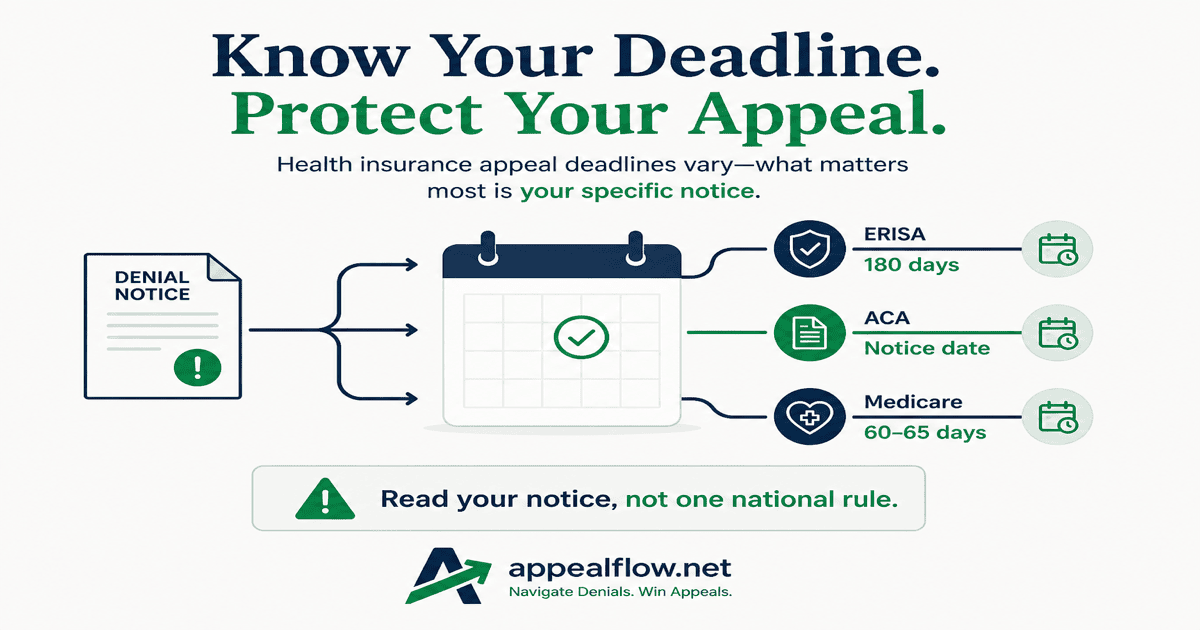
Key Takeaway: Your filing clock starts from the program that denied you, not from a blog post. ERISA employer coverage, ACA marketplace or group plans, Medicare, and Medicaid each print different rules. The date circled on your letter beats a generic “180 days for everyone” assumption.
A health insurance appeal is a written request to overturn a coverage or payment denial. The insurer must tell you how to appeal and how long you have. That information appears on your Explanation of Benefits, adverse benefit determination, or Medicare Summary Notice. If you only heard about the denial by phone, ask the plan to send the written notice with the appeal address or portal link.
Missing the filing window can end your rights at that appeal level. You may still have other options such as a corrected claim, a grievance, or a state insurance department complaint, but those are not substitutes for a timely appeal. Start by identifying whether the denial came from an ERISA employer plan, an ACA-regulated commercial plan, Medicare, or Medicaid. Then match that program to the table below before you draft a letter.
Which Appeal Clock Applies to Your Plan Type?
Key Takeaway: Federal floors and Medicare clocks do not swap. A sentence that works on an ERISA appeal letter can be wrong on a Medicare Advantage notice. Read the document in your hand, then verify it against the primary source for your program.
| System | Typical pattern | Never say |
|---|---|---|
| ERISA employer group health | At least 180 days to file an internal appeal from notice of denial. Check the Summary Plan Description if the plan allows longer. | “You always have 180 days.” |
| ACA marketplace / individual / many group plans | Internal appeal within 180 days of receiving notice of denial. External review within four months after the final internal determination. | “Same as ERISA in every detail.” |
| Medicare Advantage / Part D (Level 1) | 65 days from the date on the initial denial notice per Medicare.gov plan-appeal instructions | “Medicare works like commercial insurance.” |
| Original Medicare (Part A/B redetermination) | Deadline printed on the Medicare Summary Notice, often 120 days from receipt of the initial determination | “Medicare always gives you 60 days.” |
| Medicare later levels (Part D IRE, OMHA, Council) | Separate 60-day filing windows on the specific decision notice for that level | “One Medicare deadline for every level.” |
| Medicaid | State fair hearing and managed-care plan appeal clocks on the state or MCO notice | A national Medicaid deadline |
Sources to verify before you file: DOL claims-and-appeals publication for ERISA plans, Healthcare.gov internal appeals for ACA plans, and Medicare.gov claims and appeals for Medicare tracks. For Medicaid, use your state agency notice and see how to appeal a Medicaid denial.
How Long Do ERISA Employer Plans Have to Accept Your Appeal?
Key Takeaway: Job-based coverage governed by ERISA must give you at least 180 days to appeal an adverse benefit determination. That is a federal floor under claims procedure rules, not a promise every denial letter will print the correct date.
The Department of Labor's claims publication tells participants they have at least 180 days to file an appeal and to check the Summary Plan Description if the plan allows more time. After you file, the plan must decide urgent pre-service appeals within 72 hours of receiving your request and standard appeals within shorter decision clocks that differ for care you have or have not yet received.
If your employer plan uses two internal levels, each level generally gets half the usual decision time. You receive a reasonable period to escalate to the next level, not a fresh 180-day filing window. For the full workflow after a claim denial, see what to do when an insurance claim is denied.
What Is the ACA Internal Appeal Window on Your Notice?
Key Takeaway: Healthcare.gov states you must file an internal appeal within 180 days of receiving notice that the claim was denied. Your notice may also print a calendar date. Use whichever rule applies to your plan type and keep proof of when you received the letter.
Healthcare.gov's appeal overview explains that if your insurer refuses to pay a claim or ends coverage, you can appeal and have the decision reviewed. The same site's internal-appeals page sets the 180-day filing window from receipt of the denial notice.
| Situation | Typical federal pattern | Source to verify |
|---|---|---|
| Your time to file an internal appeal | 180 days from receiving the denial notice | Healthcare.gov internal appeals |
| Plan decides a pre-service appeal | 30 days if you have not received the service yet | Healthcare.gov internal appeals |
| Plan decides a post-service appeal | 60 days if you already received the service | Healthcare.gov internal appeals |
| Your time to request external review | Four months after the final internal determination | Healthcare.gov external review |
Filing time and decision time are different clocks. You must meet the notice deadline to open the appeal. The plan then has its own shorter window to respond. When internal review ends, see how to request external review for the next step.
Need a Draft Before the Deadline?
AppealFlow drafts a letter that names the denial date and the facts you enter. You still file on the portal or address printed on the notice before that clock runs out.
What If Medicare or Medicaid Denied the Claim Instead?
Key Takeaway: Medicare and Medicaid print their own deadlines. Do not cite ERISA 180-day rules or ACA Section 2719 on a Medicare Summary Notice or state Medicaid fair-hearing letter.
Original Medicare, Medicare Advantage, and Part D each use different notices and forms. Medicare.gov currently instructs Medicare Advantage and Part D enrollees to file a Level 1 appeal within 65 days from the date on the initial denial notice. Original Medicare redeterminations follow the deadline on the Medicare Summary Notice. Several later Medicare levels use 60-day windows on their decision letters, including Part D Independent Review Entity reconsideration when a plan upholds a denial.
The full Medicare walkthrough, including CMS-20027 and plan-specific steps, is in how to appeal a Medicare denial. Medicaid eligibility and managed-care denials use state fair hearings with clocks on the state notice. A hospital status change from inpatient to observation uses a separate fast-appeal notice, covered in what hospital observation status is.
How Do You Calculate the Date So You Do Not Miss It?
Key Takeaway: Write down the notice date, the receipt date if the rule is receipt-based, and the filing method the letter names. Portal upload, fax, and mail have different filed moments. Keep the envelope or the portal confirmation.
- Circle the appeal-by date on the denial and put a reminder on your calendar three days earlier
- Confirm plan type on your ID card, Marketplace plan documents, Medicare card, or Medicaid enrollment letter before you rely on a federal floor
- If the letter is shorter than the federal floor for your plan type, file anyway and quote the federal source in your appeal
- Urgent care uses a faster decision clock. See how to request an expedited appeal
Do not wait for a peer-to-peer slot. A clinician call does not pause the written-appeal deadline. File the appeal, then take the call if offered.
Weak vs. Strong Language About the Deadline
Key Takeaway: Name the notice date, the program, and the rule you are using. “I still have time” is not a filing date.
| ❌ Weak Request | ✓ Strong Request |
|---|---|
| “I have 180 days like everyone else.” | “Denial dated [date], received [date]. This is an ACA-regulated claim. I file this internal appeal within 180 days of receipt per Healthcare.gov internal-appeals guidance. Claim #[number].” |
| “My old job plan had 180 days, so Medicare does too.” | “This is a Medicare Advantage notice dated [date]. I am filing Level 1 within 65 days of that notice date per Medicare.gov, not under ERISA 180-day rules.” |
| “The insurer has 60 days, so I can wait two months to appeal.” | “I am filing my member appeal today, [date], within the [180-day / 65-day / notice] window. The plan's 60-day decision clock starts after you receive this appeal, not before.” |
Frequently Asked Questions
Filing windows for ERISA, ACA, Medicare, Medicaid, and external review after an internal denial.
Generate a Free Draft Appeal Letter
AppealFlow drafts a letter from the denial date and facts you enter. You still submit it through the process on your notice before your health insurance appeal deadline passes.
- 100% Free
- No Signup
- PDF & Word Export
Disclaimer: This article is for educational purposes only and does not constitute medical, legal, or financial advice. AppealFlow.net is not a healthcare provider, insurance broker, or law firm. Appeal clocks differ by plan and program. Verify the date on your notice, Healthcare.gov, DOL, Medicare.gov, or your state Medicaid agency before you file. For medical emergencies, call 911. See our full disclaimer.