Medicare Appeal Form: How to Appeal a Medicare Denial
Which Medicare Appeal Form Matches Your Denial?
Key Takeaway: There is no single Medicare appeal form for every denial. Original Medicare Part A and Part B use CMS-20027 or MSN instructions. Medicare Advantage and Part D use plan-specific appeal steps on your notice. A commercial ERISA appeal letter does not start a Medicare case.
Medicare.gov's claims and appeals hub sends you to different tracks for Original Medicare, Medicare health plans, and drug plans. An appeal challenges coverage or payment. A grievance challenges customer service or quality of care. Those are separate tools.
| Medicare type | Notice you receive | Level 1 form or process |
|---|---|---|
| Original Medicare (Part A/B) | Medicare Summary Notice (MSN) from a MAC | CMS-20027 or MSN instructions (circle line, explain disagreement, mail to MAC) |
| Medicare Advantage (Part C) | Organization determination from the plan | Plan Level 1 reconsideration per notice instructions |
| Part D drug plan | Coverage determination or exception decision | Plan redetermination; exception needs prescriber statement |
Medicaid is a different system. State Medicaid agencies use state notices and fair hearings. Dual eligibility can mean two denials and two processes. See how to appeal a Medicaid denial if Medicaid denied the item.
How Do I File CMS-20027 for Part A and Part B?
Key Takeaway: Original Medicare claim appeals follow 42 CFR Part 405 Subpart I. Level 1 is a redetermination by the MAC. Use the deadline printed on the MSN. CMS describes that first-level filing window as 120 days from receipt of the initial determination.
Medicare.gov's Original Medicare appeals page tells you to start with the MSN, file by the date on that notice, and either complete CMS Form CMS-20027 or follow the MSN instructions. Include your Medicare Number, the items or services in dispute, and why you disagree.
CMS's fee-for-service appeals page lists five levels: MAC redetermination; Qualified Independent Contractor (QIC) reconsideration; Office of Medicare Hearings and Appeals (OMHA) decision; Medicare Appeals Council review; and judicial review in federal district court.
- Mail CMS-20027 or your MSN appeal to the MAC address on the last page of the MSN
- If someone else files for you, attach CMS-1696 or a writing that meets 42 CFR 405.910
- Free counseling is available from a State Health Insurance Assistance Program (SHIP)
What Appeal Form Does Medicare Advantage Use?
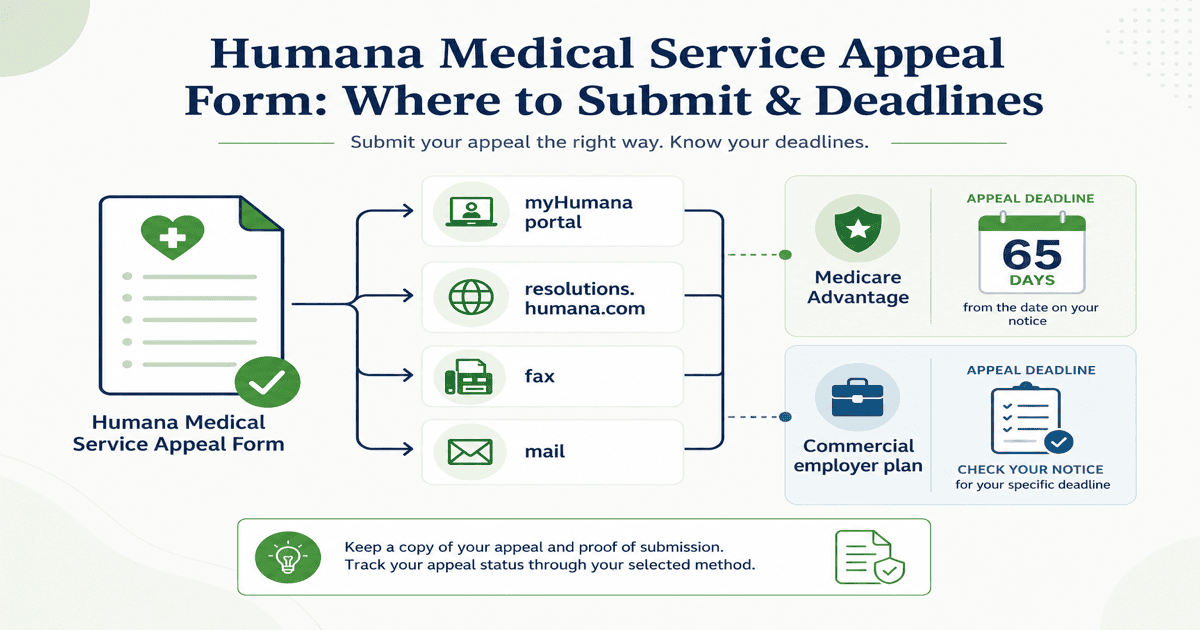
Key Takeaway: Medicare Advantage coverage decisions are organization determinations. Level 1 is a plan reconsideration. Medicare.gov currently says you, your representative, or your doctor must file that appeal within 65 days from the date on the plan's initial denial notice. If the plan upholds the denial, it automatically forwards the case to an Independent Review Entity.
Follow Medicare.gov's Medicare health plan appeals page and the instructions on your denial. Contact the plan using the number on your membership card. The plan notice names the portal, fax, or mailing address for your Level 1 appeal.
Standard decision clocks on Medicare.gov vary by request type: 30 days for a pre-service appeal, 60 days for a payment appeal, and 7 days for a Part B drug appeal, with a 72-hour fast appeal when waiting for the standard clock may seriously jeopardize your life, health, or ability to regain maximum function.
How Do Part D Coverage Determination Appeals Work?
Key Takeaway: Part D appeals start with a coverage determination, including an exception request. Level 1 is a plan redetermination. Medicare.gov currently uses a 65-day filing window from the date on the initial denial notice. If the plan upholds the denial, you generally must request the Part D Independent Review Entity within 60 days.
Medicare.gov's drug-plan appeals page explains that you have a right to a coverage determination, orally or in writing. For a drug you have not received yet, you or your prescriber can call, write, or use the model coverage determination request. For reimbursement of a drug you already bought, the request must be in writing. An exception requires a prescriber statement explaining the medical reason.
Extra Help (the Part D low-income subsidy) is a separate eligibility appeal if the issue is Extra Help itself, not whether the plan covers a drug. See Extra Help appeals for the Part D low-income subsidy.
What Are the Medicare Appeal Deadlines and 60-Day Clocks?
Key Takeaway: Every level has its own clock printed on the notice or described on Medicare.gov. Do not assume one national deadline. Original Medicare redeterminations use the MSN date. Several later levels use 60-day windows once you receive the prior decision.
| Level | Who reviews | Typical filing clock (confirm on the notice) |
|---|---|---|
| Level 1: Redetermination / plan appeal | MAC (Original) or plan (Advantage / Part D) | MSN deadline for Original Medicare; Medicare.gov currently lists 65 days from the initial denial notice date for Advantage and Part D Level 1 |
| Level 2: Reconsideration / IRE | QIC (Original) or IRE (Advantage / Part D) | Medicare.gov: 180 days after you get the MAC decision for Original Medicare; Part D IRE generally within 60 days of the plan decision if the plan upheld the denial |
| Level 3: OMHA | Administrative Law Judge or attorney adjudicator | 60 days from the QIC or IRE decision; 2026 ALJ amount-in-controversy is $200 per Medicare.gov |
| Level 4: Appeals Council | Medicare Appeals Council | 60 days after you get the OMHA decision |
| Level 5: Federal court | U.S. district court | 60 days after the Council decision; 2026 federal-court amount-in-controversy is $1,960 per Medicare.gov |
CMS generally issues a redetermination decision within 60 days of receiving the request. If you miss a deadline, Medicare may accept a late filing for good cause per CMS's good-cause late filing page. Explain the delay in writing and attach evidence. That is not a reason to wait.
When Can I Ask for an Expedited Medicare Appeal?
Key Takeaway: Ask for a fast decision when waiting for the standard timeframe may seriously jeopardize your life, health, or ability to regain maximum function. Ending hospital, SNF, home health, CORF, or hospice services uses a separate fast-appeal notice, not CMS-20027.
For Medicare Advantage items and services, Medicare.gov says the plan must give its fast-appeal decision within 72 hours if the plan or your doctor says waiting for the standard clock puts your health at serious risk. Part D uses the same 72-hour fast-appeal decision when the issue is getting the drug, not repayment.
Medicare.gov also describes a different fast appeal when you think Medicare-covered services are ending too soon in a hospital, skilled nursing facility, home health agency, comprehensive outpatient rehabilitation facility, or hospice. For rehab discharge steps, see how to appeal a Medicare discharge from a rehab facility.
Weak vs. Strong Medicare Appeal Language
Key Takeaway: Name the track, the notice date, the item or drug, and the clinical reason coverage should apply. Vague complaints about Medicare being unfair do not tell the reviewer which regulation or plan rule to apply.
| ❌ Weak Request | ✓ Strong Request |
|---|---|
| “Please approve this. I have 180 days like my old job insurance.” | “This is an Original Medicare Part B claim on MSN dated [date], claim [number]. I request a redetermination under 42 CFR Part 405 Subpart I using CMS-20027 by the deadline printed on the MSN.” |
| “My Advantage plan denied it. Send this to Medicare in Baltimore.” | “I request a Level 1 reconsideration of the organization determination dated [date] for [item] on dates of service [dates]. Filing within 65 days of that notice date as instructed on Medicare.gov.” |
| “The pharmacy said the drug is not covered. I already paid cash.” | “I request a written Part D coverage determination / exception for [drug, strength, NDC if known]. Prescriber supporting statement is attached. Submitted in writing for reimbursement as Medicare.gov requires for drugs already purchased.” |
Need a Draft Letter Before You File?
AppealFlow can draft a letter that names the denial and the clinical facts you enter. You still file on CMS-20027, the MAC address, or the plan portal printed on your notice.
What to Attach to Your Medicare Appeal Form
Key Takeaway: File the packet the notice names. Attach the notice, identifiers, dates, and clinical support. Do not substitute a commercial insurance appeal letter, a Medicaid fair-hearing form, or a hospital-discharge fast appeal for an MSN redetermination.
- Copy of the MSN or plan denial, including the date and any appeal number
- Your name, address, and Medicare Number as they appear on your card
- Items, services, or drug, with dates of service
- A written reason you disagree, plus treating-provider notes or a supporting statement
- CMS-1696 appointment of representative if someone else is filing
For a broader walkthrough of denied claims across plan types, see what to do when an insurance claim is denied. Commercial ERISA and ACA clocks do not control Medicare cases.
Frequently Asked Questions
Common questions about CMS-20027, Medicare Advantage organization determinations, Part D coverage determinations, and expedited appeals.
Generate a Free Draft Appeal Letter
AppealFlow drafts a letter from the facts you enter. For Medicare, you still submit CMS-20027, the MSN instructions, or your plan's organization-determination or coverage-determination process. The draft is not a filed appeal.
- 100% Free
- No Signup
- PDF & Word Export
Disclaimer: This article is for educational purposes only and does not constitute medical, legal, or financial advice. AppealFlow.net is not a healthcare provider, insurance broker, or law firm. Medicare appeal clocks, forms, and amount-in-controversy thresholds change. Verify current requirements with the notice you received, Medicare.gov, your plan, or 1-800-MEDICARE before taking action. For medical emergencies, call 911. See our full disclaimer.