Extra Help Appeal: Medicare Part D Low-Income Subsidy
Why Does Social Security Deny Extra Help Applications?
Key Takeaway: Most Low-Income Subsidy denials trace to income above SSA limits, countable resources over the threshold, incomplete application data, or a life change SSA was not notified about. The reason code on your notice determines which documents you need for reconsideration.
Medicare.gov's Extra Help overview explains that the program lowers Part D premiums, deductibles, and copays for people with limited income and resources. Social Security makes eligibility decisions using SSA's published income and resource rules, which update annually.
Common denial categories:
- Income above the federal limit: SSA may use IRS data from an earlier tax year. If your income dropped, attach current award letters or pay stubs.
- Countable resources over the asset cap: Bank accounts, stocks, and bonds count. Your home, one vehicle, burial plots, and certain life insurance are excluded when documented.
- Incomplete or inconsistent application: Missing spouse information, unsigned forms, or conflicting addresses can delay processing and surface as denials.
- Termination after a triggering event: An inheritance deposit, property sale, or Medicaid status change can end Extra Help mid-year until SSA receives updated proof.
Pull up your SSA denial notice and find the labeled reason for decision. Cross-reference it with the current limits on SSA.gov before you draft your reconsideration letter.
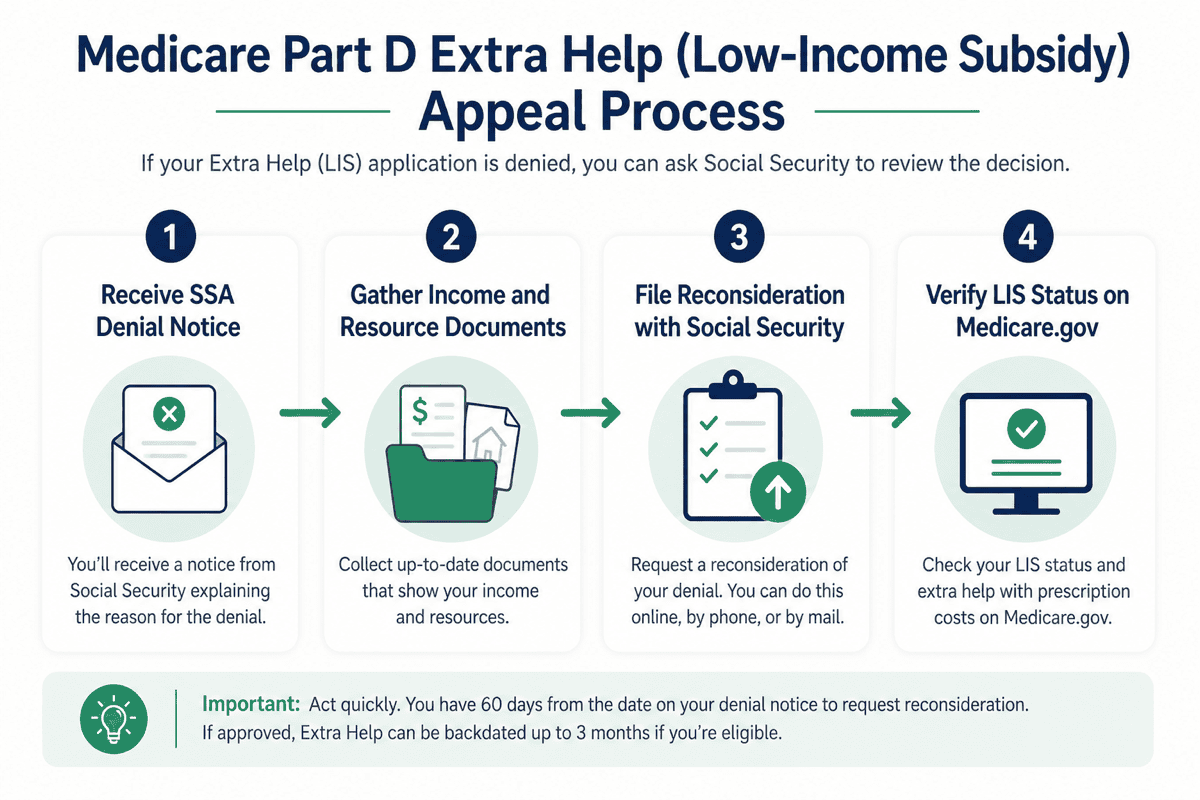
How Do I Appeal a Denied Extra Help Application?
Key Takeaway: Request reconsideration within the deadline on your notice, attach updated financial documentation, and keep copies of everything you submit. If SSA upholds the denial, you can request a hearing before an Administrative Law Judge within the window on the reconsideration decision.
- Confirm your appeal deadline. The denial notice states how many days you have. Write that date on your calendar the day the letter arrives.
- Request a copy of your SSA file. Call 1-800-772-1213 or visit your local SSA office and ask what income and asset figures SSA used. You need the exact numbers before you build your case.
- Gather current financial documentation. Collect recent bank statements, pay stubs, pension statements, Social Security award letters, and proof of non-countable assets.
- Write a clear reconsideration request. State that you disagree with the denial, identify the specific reason SSA cited, and explain with dates and dollar amounts why SSA's figures are wrong or outdated.
- Submit through the correct channel. File online through your SSA account, mail to your local SSA office, or call to request a phone appointment. Keep the receipt or confirmation number.
- Follow up at 30 and 60 days. Reconsideration decisions often take 30 to 90 days. Document every call with the representative name, date, and reference number.
- If denied again, request an ALJ hearing. You have a limited window from the reconsideration denial to request a hearing before an Administrative Law Judge. That review is independent of the examiner who handled your first request.
- Contact SHIP for free help. Your State Health Insurance Assistance Program at shiphelp.org provides counselors who specialize in Medicare and can review your documentation before submission.
Weak vs. Strong Extra Help Appeal Language
Key Takeaway: SSA adjudicators act on specific dollar amounts, dates, and account numbers. Replace general hardship statements with documented corrections to SSA's data.
| Weak statement | Strong statement |
|---|---|
| “I cannot afford my medications and really need Extra Help.” | “SSA denied my application citing 2024 AGI of $22,400. My current monthly income is $1,340 (Social Security award letter dated 06/2026 attached). The 2024 figure included a one-time IRA distribution of $14,200 (1099-R attached) that is not recurring income.” |
| “I do not have much money in the bank.” | “SSA counted total resources of $19,800. Attached bank statements show $12,340 in checking and $3,200 in savings. The remaining $4,260 was a temporary escrow deposit from my home sale disbursed to creditors on 03/15/2026 (closing statement attached).” |
| “Please reconsider my denial. I am on a fixed income.” | “I formally request reconsideration of decision dated 07/12/2026. My spouse passed away on 04/02/2026 (death certificate attached), reducing household income from $2,680/month to $1,340/month and changing my filing status from married to individual per SSA LIS criteria.” |
Use AppealFlow'sMedicare Part D appeal generatorto draft a structured appeal letter tied to your denial reason before the deadline on your notice.
Need a Part D Drug Appeal Letter?
Extra Help covers premiums and copays, but formulary denials still happen. AppealFlow's free generator drafts a formal Part D appeal letter you can attach to your plan's redetermination request.
What Documents Should I Attach to an Extra Help Appeal?
Key Takeaway: A complete LIS appeal packet includes the SSA denial notice, current income proof, asset statements with exclusions documented, a written explanation letter, and evidence of any life change SSA was not notified about. Missing any one component is a common reason reconsiderations stall.
Your written explanation should be one to two pages and address these points:
- Your name, Social Security number, and the date of the denial notice
- The exact reason SSA cited for denial (quote from the notice)
- Current monthly income with source breakdown
- Current countable resources with account numbers and balances
- List of excluded assets with supporting documents (home deed, vehicle registration)
- Explanation of any one-time income or deposits SSA may have misclassified
SSA wants official records, not self-reported estimates. A Social Security award letter, pension benefit statement, or three consecutive pay stubs carry more weight than a handwritten budget. If your income fluctuates, provide a six-month average with supporting pay records.
If you receive both Medicaid and Medicare, attach your Medicaid eligibility letter. Full-benefit dual eligibles are generally entitled to automatic full Extra Help. A Medicaid approval letter alone may be sufficient to overturn an LIS denial. See how to appeal a Medicaid denial if Medicaid also denied coverage.
Where Do I File: SSA, Medicare.gov, or My Part D Plan?
Key Takeaway: Extra Help eligibility appeals go through Social Security. Medicare.gov helps you verify LIS status and understand Part D appeal rights. Drug claim appeals after LIS is active follow your Part D plan's coverage-determination process.
| Platform | Used for | How to file |
|---|---|---|
| SSA.gov | Extra Help / LIS applications and reconsiderations | Online SSA account, phone, or local office |
| Medicare.gov | LIS status verification, Part D appeal rights overview | Check current subsidy level; follow Medicare.gov claims and appeals for drug plan steps |
| Part D plan | Formulary denials, prior auth, step therapy after LIS is active | Coverage determination and redetermination per plan notice; see Medicare Part D prior authorization appeal |
After SSA reinstates Extra Help, ask your pharmacy to reprocess any claims billed at full cost during the gap. Retroactive LIS approval may trigger refunds for overpaid copays back to the effective date SSA assigns.
What Is the Difference Between Full and Partial Extra Help?
Key Takeaway: Even partial Extra Help reduces Part D costs. Verify which tier SSA granted and whether additional documentation could move you to a higher level.
Medicare.gov describes subsidy levels based on income and resources:
- Full subsidy: No premium, no deductible, low fixed copays, and no coverage gap for eligible enrollees
- Partial subsidy (75%, 50%, or 25%): Reduced premium assistance and sliding-scale copays based on income tier
- Automatic qualification: Full Medicaid, certain Medicare Savings Programs, or SSI receipt can grant automatic full Extra Help
If SSA granted partial Extra Help but you believe you qualify for full subsidy, your appeal should show that countable resources fall below the full-subsidy threshold on SSA.gov, not just your income.
What If My Part D Drug Was Denied After LIS Approval?
Key Takeaway: Active Extra Help does not override formulary rules. A prior authorization denial or formulary exception rejection needs a separate Part D appeal through your drug plan, not another SSA reconsideration.
When the pharmacy cannot fill a prescription, request a written coverage determination or formulary exception with your prescriber's statement. If the plan denies coverage, file a redetermination using the deadline on that notice. Medicare appeal forms and levels differ from commercial insurance. For step therapy or non-formulary drugs, see formulary exception denied and what to do when insurance denied medication.
Do not confuse the two tracks. Paying full price at the pharmacy while waiting for an SSA reconsideration does not automatically trigger a refund. Retroactive Extra Help applies only if SSA determines you were eligible during the gap period. File your SSA appeal immediately and ask about temporary supply options while you wait.
Five Mistakes That Stall Extra Help Appeals
Key Takeaway: A formal reconsideration with corrected financial evidence is not the same as submitting a brand-new LIS application. Use the appeal process and deadlines on your denial notice.
- Reapplying instead of appealing. After denial, file a reconsideration that addresses the cited reason rather than restarting the clock with an identical application.
- Missing the deadline on your notice. Calendar the date the day you receive the denial letter.
- Not documenting asset exclusions. SSA counts bank balances unless you prove specific deposits are non-countable.
- Using outdated income records. Attach the most recent three months of income proof when tax data no longer reflects your situation.
- Stopping after one denial. You can request an ALJ hearing if reconsideration fails and your documentation is complete.
Frequently Asked Questions
Answers to common Medicare Part D Extra Help appeal questions from beneficiaries and caregivers.
Generate Your Free Part D Appeal Letter
AppealFlow drafts a formal appeal letter for Part D formulary denials, prior authorization rejections, and step therapy requirements. Edit it live, then download as PDF or Word. No account required.
- 100% Free
- No Signup
- PDF & Word Export
Disclaimer: This article is for educational purposes only and does not constitute medical or legal advice. AppealFlow is not a healthcare provider or law firm. Income and resource limits change annually. Verify current figures at SSA.gov and Medicare.gov. Review appeal letters with a SHIP counselor or qualified advisor before submission. For medical emergencies, call 911. See our full disclaimer.