Formulary Exception Denied: What to Do Next
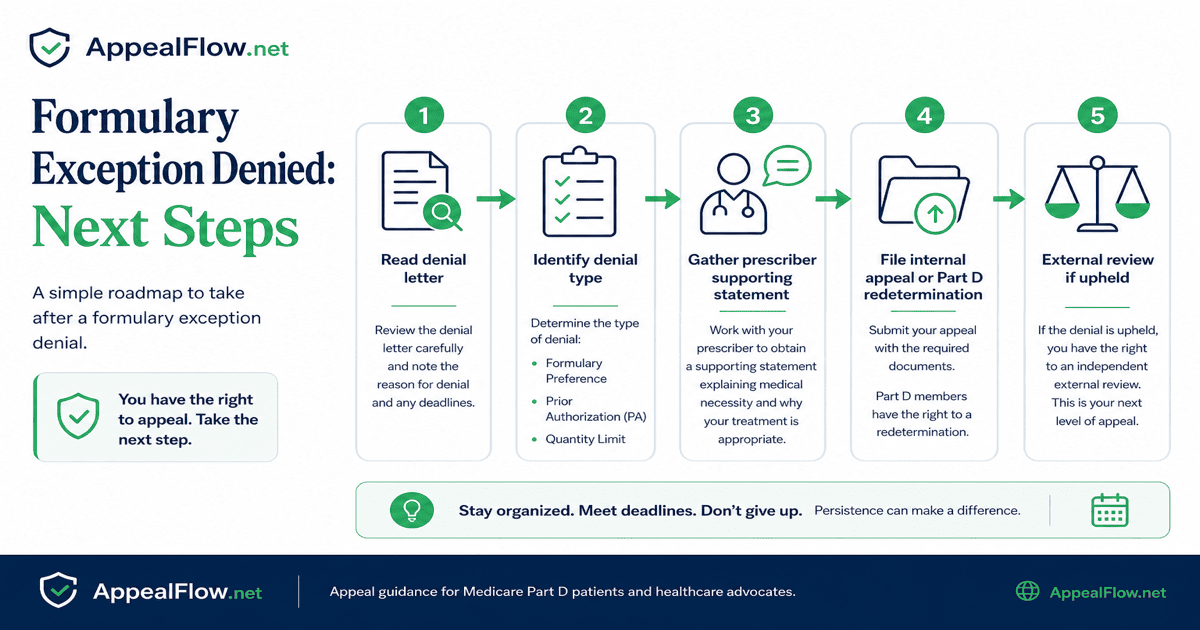
What Type of Pharmacy Denial Do You Have?
Key Takeaway: A formulary exception, prior authorization denial, quantity limit, and step therapy failure are different coverage decisions. The appeal path and documents change based on which label appears on your notice.
Your adverse benefit determination should state the decision type. If it does not, call member services and ask whether the pharmacy block is a formulary exclusion, prior authorization denial, quantity limit, or step therapy issue. Getting the label right prevents you from filing the wrong exception request.
| Denial type | What it means | Primary appeal strategy |
|---|---|---|
| Formulary exclusion | Drug is not on the plan formulary | Formulary exception with prescriber statement showing alternatives are contraindicated or ineffective |
| Prior authorization denial | Drug is on formulary but pre-approval was denied | Internal appeal addressing the specific PA criteria with clinical documentation |
| Quantity limit denial | Drug is covered below the prescribed dose or quantity | Quantity limit exception with physician dosing rationale |
| Step therapy denial | Required preferred steps were not satisfied | Step therapy exception. See our step therapy appeal guide |
How Do Commercial Plan Formulary Exception Appeals Work?
Key Takeaway: When a formulary exception is denied on an ACA-regulated or ERISA employer plan, you generally have internal appeal rights. Medical-judgment denials may qualify for external independent review after internal appeals are exhausted.
Most commercial drug benefits run through a pharmacy benefit manager with tiered formularies. Non-formulary drugs may require a formulary exception before the plan pays anything, or may be covered only at a higher cost-sharing tier.
After a denied exception, the plan should issue an adverse benefit determination with the specific reason and your appeal rights. File your internal appeal within the deadline on that notice. ACA marketplace plans and ERISA employer plans each set minimum filing windows in federal rules. Check your letter rather than assuming a single national deadline applies to every plan.
Contractual exclusion vs. medical necessity: If your plan document excludes an entire drug class, that may be a contractual exclusion rather than a medical necessity decision. Contractual exclusions often cannot be overturned through medical external review. A formulary exception denied for inadequate clinical documentation is usually a medical judgment and may qualify for external review on ACA plans.
What Are Medicare Part D Steps After a Denied Formulary Exception?
Key Takeaway: Medicare Part D uses coverage determinations, redeterminations, and Independent Review Entity review with defined clocks on your notice. Expedited review is available when delay would seriously jeopardize your health.
Under Medicare.gov Part D appeals guidance, the escalation path typically works like this:
- Coverage determination: You or your prescriber requests a formulary exception for a non-formulary drug or restricted drug. Standard decisions are often issued within 72 hours; expedited requests within 24 hours when clinically urgent.
- Redetermination: If denied, you generally have 60 days from the notice to request redetermination from the plan.
- IRE reconsideration: If redetermination upholds the denial, request review by the Independent Review Entity within 60 days.
- ALJ hearing, Medicare Appeals Council, and federal court: Further levels depend on the amount in controversy and timelines on your Medicare notice.
For specialty drugs with quantity limits or step therapy on Part D, the same exception and appeal framework applies. Use our prescription denial appeal generator to draft appeal language matched to your denial reason.
What Documents Do You Need for a Formulary Exception Appeal?
Key Takeaway: Formulary exception appeals usually turn on the prescriber supporting statement. It must name the formulary alternative and explain in clinical terms why it is inappropriate for you, not only that you prefer another drug.
| Document | What to include |
|---|---|
| Denial letter | Identifies formulary alternative(s), cites exception criteria, and states your appeal deadline |
| Prescriber supporting statement | Names the alternative; documents contraindication, failure, or inadequate response with dates and clinical evidence |
| Clinical notes | Diagnosis, treatment history, and adverse reactions to preferred drugs |
| Pharmacy records | Proof of prior fills and trial dates for failure exceptions |
| Guidelines or FDA labeling | Shows the requested drug is indicated and the alternative is not for your diagnosis or subtype |
Weak vs. Strong Formulary Exception Appeal Language
Key Takeaway: Strong appeals name the specific formulary alternative, document what happened when you tried it, and cite guidelines or labeling. Vague preference statements are easy for reviewers to deny again.
| Weak appeal language | Strong appeal language |
|---|---|
| “The covered drug doesn't work as well as the one my doctor prescribed.” | “The formulary alternative was trialed from [date] to [date] at [dose]. Clinical notes from [date] document inadequate response at maximum tolerated dose. The requested drug is indicated for [diagnosis] per [guideline], Section [X], after failure of the formulary drug.” |
| “My doctor says I need this specific medication and it's not fair that it's not covered.” | “The patient has a documented allergy to [ingredient] per records dated [date]. Re-challenge is contraindicated. The requested non-formulary drug does not contain [ingredient] and is the clinically appropriate alternative per [specialty society] guidance.” |
| “I can't afford the out-of-pocket cost at the non-preferred tier.” | “This is a tier exception request. Formulary alternatives in the preferred tier are contraindicated as documented above. I request [drug] at preferred-tier cost-sharing consistent with the plan's formulary exception policy.” |
Need a Draft Prescription Appeal Letter?
AppealFlow builds formulary exception and prescription denial appeal language from your denial reason and clinical facts. Edit live, then download PDF or Word.
What If Your Prescribed Quantity Exceeds the Plan Limit?
Key Takeaway: Quantity limit exceptions require your physician to document why the standard limit is clinically insufficient for your condition, not only that you need more medication each month.
Plans often cap monthly units for specialty drugs, controlled substances, and high-cost therapies. If your prescription exceeds the limit, the claim may pay only up to the cap. Your prescriber must submit a quantity limit exception with dosing rationale tied to guidelines and your clinical factors.
- Published dosing guidelines support a higher dose for your diagnosis or severity
- Weight, renal function, or another factor requires adjustment above the default limit
- The limit is based on a different indication than your diagnosis
- You were stable on the higher dose before the plan applied a new restriction
How Do GLP-1 and Specialty Drug Formulary Exceptions Differ?
Key Takeaway: GLP-1 and biologic denials may cite formulary restrictions or plan exclusions. Confirm which label applies before you invest in a formulary exception packet.
GLP-1 medications may face non-preferred tier placement, step therapy, or indication-based exclusions depending on whether the prescription is for type 2 diabetes or weight management. Medicare Part D coverage rules for weight-loss-only indications differ from diabetes indications. Check your plan document and denial reason code before filing.
For GLP-1 specific strategies, see our GLP-1 denial appeal generator. For brand-name drugs after generic failure, see brand-name drug appeal when generic fails.
What If the Plan Upholds the Denial?
Key Takeaway: An upheld formulary exception denial is not always the end of the process. Many ACA plans must offer external review for eligible medical judgments after internal appeals are exhausted.
Healthcare.gov's external-review page explains independent review after an upheld internal appeal for many marketplace plans. Medicare Part D uses the IRE and later levels described on your Medicare notice. Keep copies of everything you already submitted. External reviewers often work from the same record set.
For appeal deadline context across plan types, see how long you have to appeal a health insurance denial.
Frequently Asked Questions
Formulary exceptions, quantity limits, Medicare Part D redeterminations, and pharmacy appeal escalation paths.
Generate Your Prescription Denial Appeal Letter
AppealFlow drafts formulary exception and prescription denial appeal letters from your denial reason and prescriber facts. Pair the draft with your physician's supporting statement for a complete PBM packet.
- 100% Free
- No Signup
- PDF & Word Export
Disclaimer: This article is for educational purposes only and does not constitute medical, legal, or financial advice. AppealFlow.net is not a healthcare provider, insurance broker, or law firm. Formulary exception rights vary by plan type. Medicare Part D rules are at Medicare.gov. ERISA appeal rules are at DOL EBSA. See our full disclaimer.