How to Appeal a Step Therapy Denial
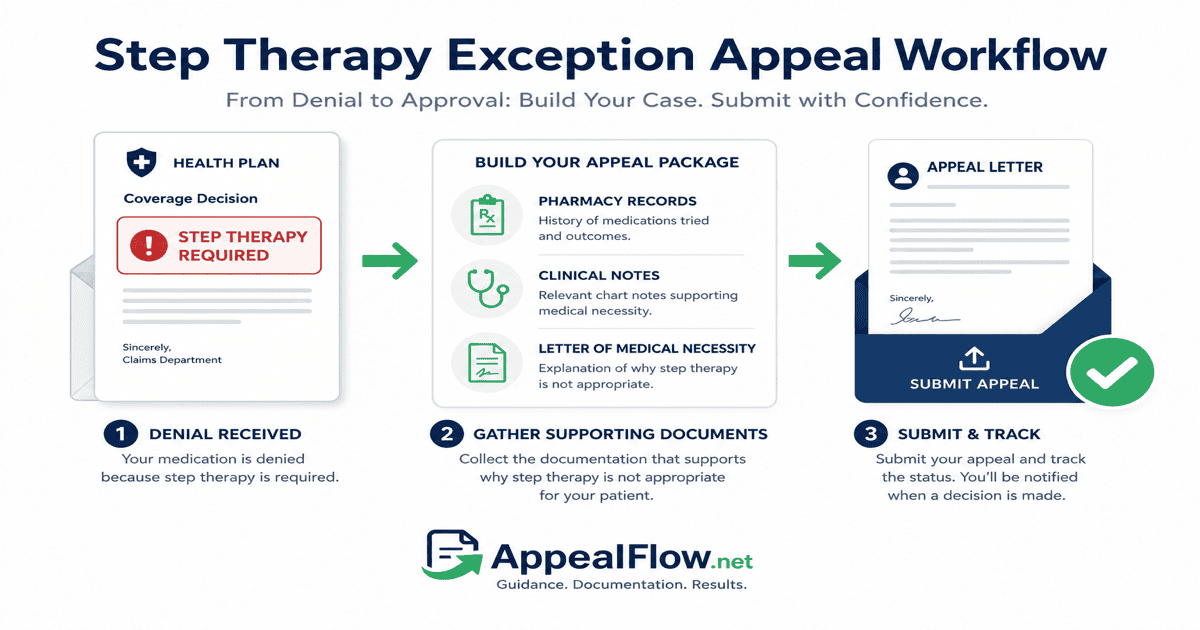
What Is Step Therapy and Why Was Your Drug Denied?
Key Takeaway: Step therapy requires you to try preferred treatments before the plan covers a more expensive drug. A step therapy denial means the insurer believes you have not completed those steps or that your records do not prove an exception applies.
Step therapy is also called fail-first. When your prescriber orders a medication, the plan may require trials of generics, older drug classes, or behavioral programs first. You must document that those options failed, caused intolerable side effects, or are clinically inappropriate for your diagnosis.
Common denial types include a prior authorization rejection at the pharmacy, a denied formulary exception when preferred drugs were not adequately tried, or a mid-year formulary change that adds step rules to a drug you already take. Step therapy sits inside the broader prior authorization framework, but it has a defined exception pathway when your clinical facts fit.
What Exception Criteria Can Waive Step Therapy?
Key Takeaway: Exception criteria are the grounds on which a plan may skip required steps. You must name the criterion you meet and attach evidence for each required drug, not just the one you want covered.
Criteria vary by insurer, but most commercial policies and many state step therapy laws recognize similar grounds:
| Exception ground | What to document | Common evidence |
|---|---|---|
| Prior failure of the step drug | Dates, doses, duration, and inadequate response | Pharmacy claims, progress notes with outcome language |
| Intolerance or adverse effect | Specific reaction, timing, and why re-challenge is unsafe | Clinical notes, allergy list, ER or urgent care records |
| Contraindication | Why the preferred drug is unsafe with your condition or other meds | FDA labeling, interaction checks, specialist notes |
| Guideline-supported first-line use | Published standard recommending requested drug for your subtype | Society guideline citation, pathology or diagnostic report |
| Harm from switching stable therapy | Risk of destabilizing a condition already controlled on requested drug | Prescriber letter, visit notes showing stable response |
Multi-step sequences require proof for each step. Failure on Drug A alone may not clear Drug B unless your plan policy treats the sequence that way. Read the cited medical policy section before you write.
What Documents Do You Need for a Step Therapy Exception Appeal?
Key Takeaway: Build one complete packet before you submit. Plans decide on the record they receive at filing. Number every attachment in the letter body so reviewers can find each piece quickly.
Request the plan clinical policy cited in the denial. Under DOL ERISA claims procedure rules, many plans must share documents relied on in the decision. Match your records to each bullet in that policy.
- Denial letter listing each required step drug and denial reason
- Pharmacy records showing dates, doses, and fills for prior trials
- Prescriber notes and a signed letter of medical necessity
- Labs, imaging, allergy records, or hospital notes supporting contraindication
- Clinical guideline excerpts when first-line use is part of your argument
Ask your clinic to schedule a peer-to-peer review while you assemble records. That call can overturn the denial before you mail the letter. Use the step therapy appeal generator to draft a starting letter from your facts, then edit every line before sending.
How Do State Step Therapy Laws Affect Your Plan?
Key Takeaway: Many states require exception processes for step therapy on fully insured plans. Self-insured ERISA employer plans are generally not subject to those state mandates. Your appeal rights then come from federal ERISA rules and your plan documents.
State laws differ in timelines, covered diagnoses, and complaint rights. ACA marketplace and many small-group plans are fully insured, so state rules may apply where you live. Check your state insurance department website for the statute that governs your plan type.
Confirm plan funding before citing state law. If your employer plan is self-insured, state step therapy override statutes usually do not apply. Ask HR whether the plan is self-funded or fully insured, then follow the appeal path named on your denial notice.
How Does Medicare Part D Handle Step Therapy Exceptions?
Key Takeaway: Part D plans that use step therapy must offer a coverage determination and formulary exception process. You need a physician supporting statement. Expedited decisions are due within 24 hours when delay would seriously jeopardize health.
Under Medicare.gov Part D appeals guidance, you can request an exception to utilization management when the step drug is inappropriate. The typical escalation path is coverage determination, plan redetermination, Independent Review Entity reconsideration, and higher Medicare appeal levels if the amount in dispute meets the threshold.
For GLP-1 weight-loss drugs with commercial step rules, see our guide on how to bypass step therapy for weight-loss medications. Medicare Part D still generally excludes weight-loss drugs from standard coverage, so the argument path differs from commercial pharmacy benefits.
How Do You Write Strong Step Therapy Appeal Language?
Key Takeaway: Strong appeals name the exception criterion, cite each required step drug, and attach numbered exhibits. Weak appeals ask for sympathy without showing why the step sequence does not apply to your chart.
Open with member ID, drug name, denial date, and a clear request for a step therapy exception. Walk through each required step in order. Close with a numbered enclosure list. Compare your draft to the general format in our guide on how to write an insurance appeal letter.
| Weak appeal language | Strong appeal language |
|---|---|
| “My doctor prescribed this medication and believes it is the right treatment for me.” | “I request a step therapy exception under prior failure. I completed [Drug A] from [date] to [date] at [dose]. Attached progress notes dated [date] document inadequate response. [Drug B] is contraindicated with my [condition] per FDA labeling, Exhibit B.” |
| “The preferred drug does not work for everyone and I need the non-preferred one.” | “Pharmacy records, Exhibit A, show documented hypersensitivity to [Drug A] on [date]. Re-challenge is not clinically appropriate. [Guideline] designates [requested drug] as first-line for [subtype] documented in pathology report dated [date], Exhibit C.” |
| “We tried the step therapy drugs already. Please approve the medication.” | “Per policy [number], this appeal documents failure of [Drug A] (Exhibit A), intolerance of [Drug B] (Exhibit B), and guideline support for [Drug C] (Exhibit C). I request a written determination within the timeframe named on my denial notice.” |
Draft your step therapy exception appeal letter
AppealFlow builds a formal letter from your exception ground, prior trial history, and clinical facts. Edit live, then download as PDF or Word.
What If Your Step Therapy Appeal Is Denied?
Key Takeaway: A final internal denial is not always the end of review. Many plans must offer external independent review for clinical coverage decisions. Read the final notice for the filing address, form, and deadline.
Healthcare.gov's appeals overview describes external review for many marketplace and employer plans after internal appeals end. Most step therapy disputes are clinical judgment calls eligible for that review when your plan type qualifies.
When the denial is a plan exclusion of the drug class itself, not just step therapy, external review may not apply. In those cases, compare a formulary exception path or plan change at renewal. Employer self-funded plans follow ERISA procedure rules named on the notice.
Frequently Asked Questions
Common questions about step therapy denials, exception criteria, state laws, Medicare Part D exceptions, and documenting prior failure or contraindication.
Build your step therapy appeal letter
AppealFlow drafts formal step therapy exception appeal letters from your denial reason and clinical documentation. Edit live, download as PDF or Word. No account required.
- 100% Free
- No Signup
- PDF & Word Export
Disclaimer: This article is for educational purposes only and does not constitute medical, legal, or financial advice. Step therapy laws vary by state and plan funding type. Medicare Part D exception procedures are described at Medicare.gov. See our full disclaimer.