How to Write a Health Insurance Appeal Letter
What Is a Health Insurance Appeal Letter?
Key Takeaway: A health insurance appeal letter is your written request for a plan review after a claim or prior authorization denial. It is not a casual email complaint. It is a structured document that ties your member ID, claim data, and clinical facts to the specific reason code on your denial notice.
Insurers route appeals by claim number and denial code. A clear letter helps your packet reach a physician reviewer instead of stalling in general correspondence. Your prescriber or treating clinician may also submit supporting documentation, but your patient letter frames the case and invokes the appeal rights listed on your notice.
If you are new to the overall workflow, read what to do when an insurance claim is denied for the steps that come before drafting the letter.
Essential Elements of an Appeal Letter
Key Takeaway: Every letter needs identifiers up top, a subject line with the denial code, body paragraphs that answer each listed reason, a numbered enclosure list, and a closing that requests a written decision. Missing any one of these elements can delay review or trigger an incomplete-submission response.
- Your name, address, phone, email, member ID, group number, and date
- Appeals department or PBM address exactly as printed on the denial letter
- RE line with claim number, denial date, and reason code such as CO-50 or a prior auth code
- Body paragraphs with dated clinical facts, ICD-10 codes, and guideline references when relevant
- Numbered exhibits listed in the closing and attached behind the letter
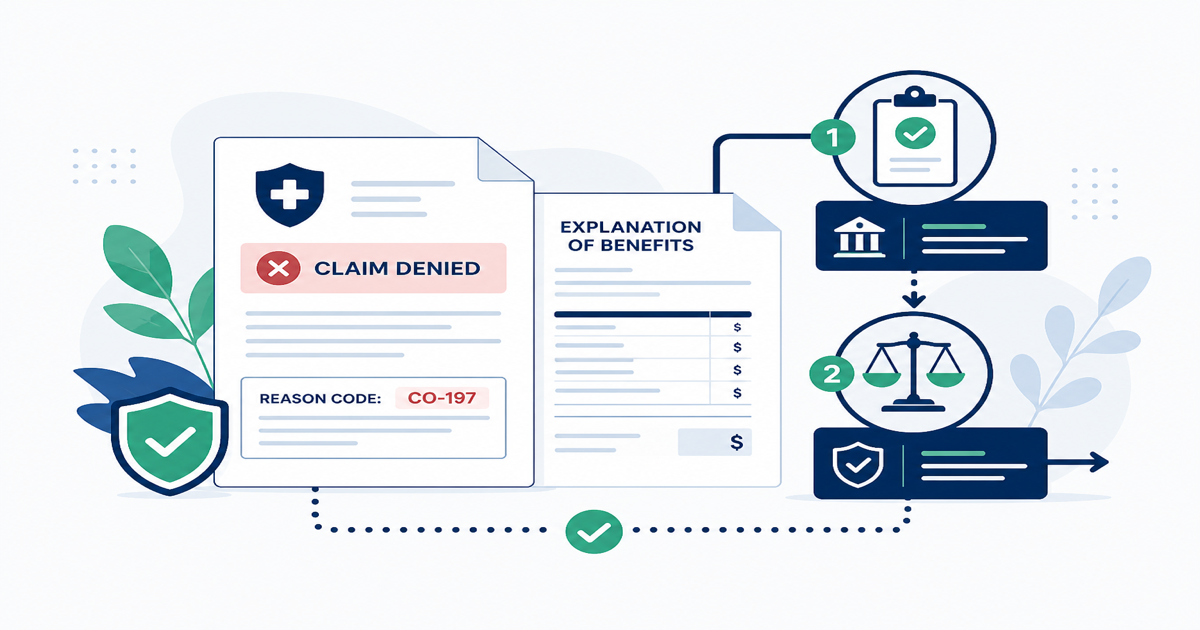
Compare your denial letter to your Explanation of Benefits before you write. The codes and dates in both documents should match what you put in the RE line.
Header Block and Opening Paragraph
Key Takeaway: Put the formal appeal request in sentence one. Cite ERISA Section 503 for many employer group plans or ACA Section 2719 for many marketplace plans only when those rights appear on your denial notice or plan documents. Ask for a written decision within the review period your plan must follow.
The U.S. Department of Labor explains that ERISA-covered group health plans must provide a process for participants to appeal adverse benefit determinations. DOL EBSA ERISA guidance describes those participant rights at a high level. Marketplace plan members can review internal and external appeal rules on Healthcare.gov.
Opening paragraph template:
I am writing to formally appeal the denial of [service or medication] under claim number [number], dated [denial date], reason code [code]. I request review under the internal appeals process described in my denial notice. Please issue a written decision within the timeframe required for my plan type.
Use the appeals address on your denial letter, not your doctor's office. Pharmacy denials often route through a PBM portal rather than your medical insurer's general correspondence desk.
Body Paragraphs by Denial Reason
Key Takeaway: Write one body paragraph per denial reason. Match the argument to the code on your notice. Medical necessity denials need guideline citations and diagnosis codes. Prior authorization denials need proof of submission or urgency. Step therapy denials need dated trials with outcomes.
For a medical necessity denial, cite the clinical guideline your treatment meets and reference ICD-10 codes from your visit notes. For a prior authorization denial, document the authorization request date and confirmation number, or explain why retrospective review is appropriate. For step therapy, list each required drug with dose, dates, and documented failure or intolerance.
Denial-specific guides can help you tailor the body. See how to appeal a prior authorization denial for PA language, or how to appeal a Wegovy insurance denial for a pharmacy step-therapy example.
Keep the patient letter concise. Put lab values, imaging impressions, and prescriber rationale in labeled exhibits. Reference each exhibit once in the body where it supports a specific denial reason.
Weak vs. Strong Appeal Letter Wording
Key Takeaway: Reviewers process high volumes of mail and portal uploads. Specific claim data, codes, and dated metrics move faster than emotional pleas without documentation. The table below shows language that stalls versus language that gives a reviewer what they need to act.
| Weak wording | Strong wording |
|---|---|
| “My insurance wrongly denied my medication. I really need this drug and my doctor agrees.” | “Formal internal appeal for claim CLM-44219, denial code PA-STEP-03, dated 8/1/2026. Member ID ABC789012. Request written decision per my plan appeals process.” |
| “I tried other medicines and they did not work.” | “Metformin 1000 mg twice daily, 90-day trial with documented GI intolerance. BMI 33.8, ICD-10 E66.01. Prescriber attestation attached as Exhibit A.” |
| “Please reconsider. Thank you for your time.” | “Enclosures: Exhibit A physician letter, Exhibit B lab results, Exhibit C prior auth confirmation. Submitted via member portal, confirmation number 88421 on 9/2/2026.” |
Need a Formatted Draft First?
AppealFlow's free health insurance appeal letter generator applies the header block, opening template, and enclosure list so you can focus on attaching the right clinical records.
What Documents Should You Attach?
Key Takeaway: Attach only records that answer the denial reason listed on your notice. Label each file as Exhibit A, B, or C and repeat those labels in your letter body and closing list. A mismatch between your enclosure list and your upload is a common reason appeals return without review.
- Copy of the denial letter and the EOB for the same claim
- Physician letter of medical necessity tied to the same denial code and ICD-10 codes
- Visit notes, lab results, or imaging reports referenced in your body paragraphs
- Prior authorization confirmations, step therapy logs, or PBM correspondence when applicable
CMS publishes consumer-facing materials on claims and coverage disputes for Medicare beneficiaries. If your case involves Medicare, start with Medicare claims and appeals guidance before adapting the same letter structure.
How Do I Submit Before the Deadline?
Key Takeaway: The deadline on your denial notice controls. Healthcare.gov states that many ACA marketplace plans must allow at least 180 days for an internal appeal. ERISA group plans must allow at least 180 days under federal rules cited by the Department of Labor. Medicare and Medicaid use separate clocks printed on their notices.
Submit through the channel your denial letter lists: member portal, fax, or mail to the appeals unit. Save portal confirmation numbers, fax transmission reports, or certified-mail receipts. Note the date and time of submission in your records.
For deadline details by plan type, see how long you have to appeal a health insurance denial. File early enough to fix a routing error before the clock runs out.
What Happens After You File?
Key Takeaway: After you submit, the plan must acknowledge receipt and issue a written decision within the standard or expedited timeframe that applies to your case. If the internal appeal is upheld, review your notice for external review or state complaint options described for your plan type.
Healthcare.gov describes external review for many marketplace plans after an unsuccessful internal appeal. ERISA plans follow a different external review framework described in your plan documents and on DOL materials. Document every follow-up call with the date, representative name, and reference number.
If your internal appeal succeeds, confirm the corrected claim or authorization appears in your insurer or PBM portal before you schedule care or fill a prescription. A verbal approval without an updated authorization can still fail at the pharmacy or billing desk.
Document Checklist Before You Send
Key Takeaway: Run through this checklist in order. Each step depends on the one before it. Submitting without matching exhibits to your enclosure list is one of the most common preventable delays.
| Step | Action | Verify |
|---|---|---|
| 1 | Pull denial letter and EOB | Claim number, denial code, and deadline match both documents |
| 2 | Draft letter with RE line | Member ID, denial date, and reason code appear in the subject line |
| 3 | Write body by denial reason | Each listed reason has a paragraph with dated clinical facts |
| 4 | Label exhibits | Exhibit letters match the enclosure list in your closing |
| 5 | Submit and confirm | Portal confirmation, fax report, or mail receipt saved with the date |
Frequently Asked Questions
Common questions about health insurance appeal letter format, attachments, deadlines, and submission channels.
Write Your Health Insurance Appeal Letter
AppealFlow drafts a formatted health insurance appeal letter with header block, denial code references, and rights language. Edit live, then download as PDF or Word. No account required.
- 100% Free
- No Signup
- PDF & Word Export
Disclaimer: This article is for educational purposes only and does not constitute medical or legal advice. AppealFlow.net is not a healthcare provider, insurance broker, or law firm. Appeal deadlines, review timeframes, and submission channels vary by plan type and state. Verify current requirements on your denial notice, plan documents, Healthcare.gov, or CMS.gov before acting. For medical emergencies, call 911. See our full disclaimer.