How to Read an Explanation of Benefits (EOB)
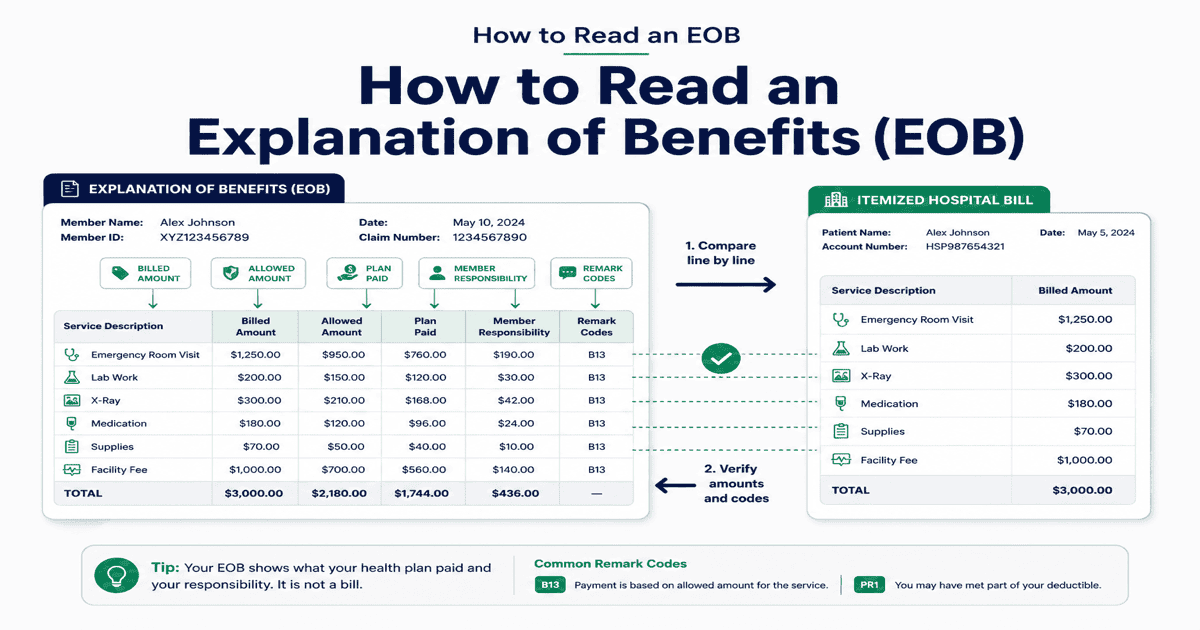
What Is an Explanation of Benefits?
Key Takeaway: The EOB is the plan's claim decision. The provider invoice is the bill. You use the first to check the second. Do not pay the billed-charges column on the EOB.
After a provider submits a claim, the plan issues a statement of what it allowed, paid, denied, and assigned to you. That statement is the Explanation of Benefits. Original Medicare sends a Medicare Summary Notice instead, which works the same way for appeals. CMS explains how to read an EOB and notes it is not a bill. Cost-sharing (deductible, copay, coinsurance, and allowed amounts) appears on that notice after the claim is processed.
Paying the hospital's “amount due” without this comparison is how people pay chargemaster balances the plan already reduced. If the extra amount is billed charges minus allowed amount, see our guide on balance billing and the CMS No Surprises Act hub for qualifying out-of-network emergency and facility situations.
How Do I Get a Copy of My EOB?
Key Takeaway: Download the PDF from the member portal as soon as the claim shows as processed, and keep the paper copy if one is mailed. The claim number on that file is what every later appeal should cite.
- Portal. Log in with the member ID on your card. Look under Claims, Documents, or Explanation of Benefits. Save the PDF; screenshots often crop remark codes.
- Mail. Many plans still send a paper EOB. If you moved, update the address on the card so denial clocks are not running against a notice you never saw.
- If nothing appears. Call the number on the card and ask whether the claim was received, rejected for missing data, or sent to a different policy. A missing EOB is not proof the provider was paid.
What Are the Key Fields on an EOB?
Key Takeaway: Billed is what the provider submitted. Allowed is what the plan will recognize. Plan paid and you owe are calculated from the allowed amount after deductible, copay, and coinsurance, not from sticker price.
| Column (typical label) | What it means |
|---|---|
| Billed / charged | Provider's submitted charges (chargemaster or fee ticket) |
| Allowed / eligible / negotiated | Maximum the plan recognizes for a covered service. Coinsurance should be a percent of this number. See what coinsurance is. |
| Plan paid | What the insurer issued to the provider (or to you, if you paid up front) |
| Deductible / copay / coinsurance | Member cost-sharing applied to this claim. Match to your SBC rows. |
| You owe / member responsibility | The figure to compare to the provider invoice |
| Remark / reason codes | Why a line was reduced, denied, or pended. Copy them into appeals. |
How Do I Compare an EOB to an Itemized Bill?
Key Takeaway: Request an itemized bill with CPT or revenue codes and line it up against the EOB. Denial remark codes tell you whether the next step is a corrected claim, more records, or a formal appeal.
A one-page hospital statement is not enough. Ask billing for an itemized bill. See how to get an itemized hospital bill. Then work through this checklist:
- Match date of service, provider NPI or name, and each CPT or revenue code.
- Flag duplicates, services you did not receive, and lines allowed at $0 that the hospital is still collecting.
- Read remark codes. “Not medically necessary,” timely filing, missing prior authorization, and non-covered benefit are different jobs: medical records versus a corrected claim versus a coverage appeal.
- Confirm the invoice total matches the EOB member-responsibility amount, not the billed-charges column.
Do not pay the billed column. If the invoice total equals billed charges minus a small insurance payment, the provider may not have written the account down to the EOB member-responsibility amount.
Use AppealFlow'sEOB dispute appeal generatorto draft a structured appeal letter tied to your denial reason before the deadline on your notice.
EOB Shows a Denial or a Wrong You-Owe Amount?
AppealFlow drafts letters that cite the claim number, remark code, and the EOB member-responsibility line so you can appeal a denial or dispute a mismatched invoice.
How Long Do I Have to Appeal From an EOB?
Key Takeaway: The deadline is the date on that notice. Do not assume 180 days for every plan, and do not apply an ERISA clock to a Medicare Summary Notice.
The U.S. Department of Labor explains that if you participate in a private-sector workplace plan, ERISA claims rules generally give you at least 180 days from the denial notice to file an internal appeal. Check the Summary Plan Description in case the plan allows longer. That is a group-health pattern, not a Marketplace or Medicare universal rule.
Original Medicare: start with the Medicare Summary Notice and file by the date printed on it. Medicare.gov's Original Medicare appeals page tells you to use that MSN date (sample notices describe a 120-day receipt window). Medicare Advantage and Part D use the deadlines on those plan notices, often shorter than ERISA's 180-day floor. Marketplace individual policies print their own internal and external-review windows. See how long you have to appeal a health insurance denial for plan-type specifics.
Weak vs. Strong Wording on an EOB Dispute
Key Takeaway: “I don't understand this bill” does not identify a claim. Quote the claim number, date of service, remark code, and the you-owe amount you want the invoice aligned to.
| ❌ Weak Request | ✓ Strong Request |
|---|---|
| “I don't understand this bill.” | “EOB claim #[number], date of service [date], remark code [code]: [narrative]. Member responsibility is $[X]. Provider invoice is $[Y]. Please reprocess or issue a corrected statement that matches the EOB you-owe line.” |
| “Insurance should have paid this.” | “This line was denied under remark [code]. I am filing an internal appeal by the date on the notice ([deadline]). Attached: EOB, itemized bill, and [clinical records / corrected coding request] addressing that remark.” |
| “I have 180 days, so I will call later.” | “The notice dated [date] states appeals must be received by [printed deadline]. This is [ERISA group / Marketplace / Medicare MSN] coverage. I am submitting by that printed date, not a generic 180-day assumption.” |
What If the Provider Bills More Than the EOB Says I Owe?
Key Takeaway: Write both offices. Attach the EOB. Ask the provider to adjust to member responsibility. If the gap is billed-minus-allowed, raise balance billing and, where it applies, No Surprises Act protections.
Keep paying only the disputed extra amount on hold if the provider agrees in writing. If the plan underpaid according to the SBC, appeal the plan with the same packet. Charity care is a separate track for hospital balances. It does not replace an insurance appeal when the EOB is wrong.
Frequently Asked Questions
Common questions about EOBs, allowed amounts, remark codes, appeal deadlines, and mismatched invoices.
Generate Your Free Appeal Letter
AppealFlow.net drafts formal appeal and billing-dispute letters from your EOB claim number and remark codes. Edit live, download as PDF or Word. No account required.
- 100% Free
- No Signup
- PDF & Word Export
Disclaimer: This article is for educational purposes only and does not constitute medical, legal, or financial advice. AppealFlow.net is not a healthcare provider, insurance broker, or law firm. Appeal deadlines and EOB formats vary by plan and by Medicare versus commercial coverage. Verify the date on your notice, your SPD, or Medicare.gov before taking action. For medical emergencies, call 911. See our full disclaimer.