Medicaid Denial Appeal Process: How to Appeal a Medicaid Denial
What Does the Medicaid Denial Appeal Process Look Like?
Key Takeaway: Medicaid is a federal-state program. Each state runs its own eligibility rules, notices, and fair-hearing office. Managed-care enrollees usually start with the plan. Fee-for-service and eligibility denials usually start with the state agency named on the letter.
Medicaid.gov's eligibility-policy page states that states must give individuals the opportunity to request a fair hearing about a denial, an action the person believes was erroneous, or a case where the state has not acted with reasonable promptness. States may structure that process in different ways, including delegation in some MAGI eligibility cases. The notice in your hand tells you which office is hearing your file.
Official contacts for applications, eligibility, claims, and cards are on Medicaid.gov's state agency directory. Use that directory if the notice is missing a phone number or you need the state Medicaid or CHIP agency, not a commercial insurer portal.
How Do I Request a State Fair Hearing?
Key Takeaway: For eligibility and fee-for-service coverage actions, the usual next step is a state fair hearing requested the way the notice allows. Federal rules set a ceiling on how long the state may give you. They do not print one national due date.
42 CFR 431.221 requires the agency to let an individual or authorized representative submit a hearing request, including a request for an expedited fair hearing. The agency may not limit or interfere with that request and may help the person submit it. Paragraph (d) requires the agency to allow a reasonable time, not to exceed 90 days from the date the notice of action is mailed, to request a hearing.
That 90-day figure is a federal maximum for the state's chosen window on eligibility and fee-for-service hearings. Your state may print a shorter date. Circle the deadline on the notice you received. Do not assume you have 90 days in every state.
What If My Denial Came From Medicaid Managed Care?
Key Takeaway: Federal managed-care rules generally let you request a state fair hearing after the plan upholds the adverse benefit determination. If the plan misses the timing or notice requirements in 42 CFR 438.408, the appeal can be deemed exhausted and you may request the hearing without waiting.
42 CFR 438.408 requires each Medicaid MCO, PIHP, or PAHP to resolve grievances and appeals within state-established timeframes that may not exceed the federal limits in that section. For a standard appeal, the state must set a resolution timeframe no longer than 30 calendar days from the day the plan receives the appeal. For an expedited appeal, no longer than 72 hours. Those clocks can be extended by up to 14 calendar days in the situations the regulation lists.
Section 438.408(f) generally allows a state fair hearing only after you receive notice that the plan is upholding the adverse benefit determination. If the plan fails to follow the notice and timing rules in that section, the enrollee is deemed to have exhausted the plan appeal and may initiate a state fair hearing. The written resolution notice must tell you how to request the hearing and, when the appeal was not fully in your favor, about requesting benefits while the hearing is pending.
For the hearing request after a plan resolution, 42 CFR 438.408(f)(2) requires the enrollee to have no less than 90 calendar days and no more than 120 calendar days from the date of the plan's notice of resolution. The state chooses a number inside that range. The plan notice prints the window that applies to you. It is not a single national Medicaid deadline.
Need a Draft Before You File With the State or Plan?
AppealFlow can draft a letter from the facts on your notice. You still file the hearing request or plan appeal with your state Medicaid agency or managed-care plan. AppealFlow does not file a fair hearing or represent you.
Why Is There No National Medicaid Appeal Deadline?
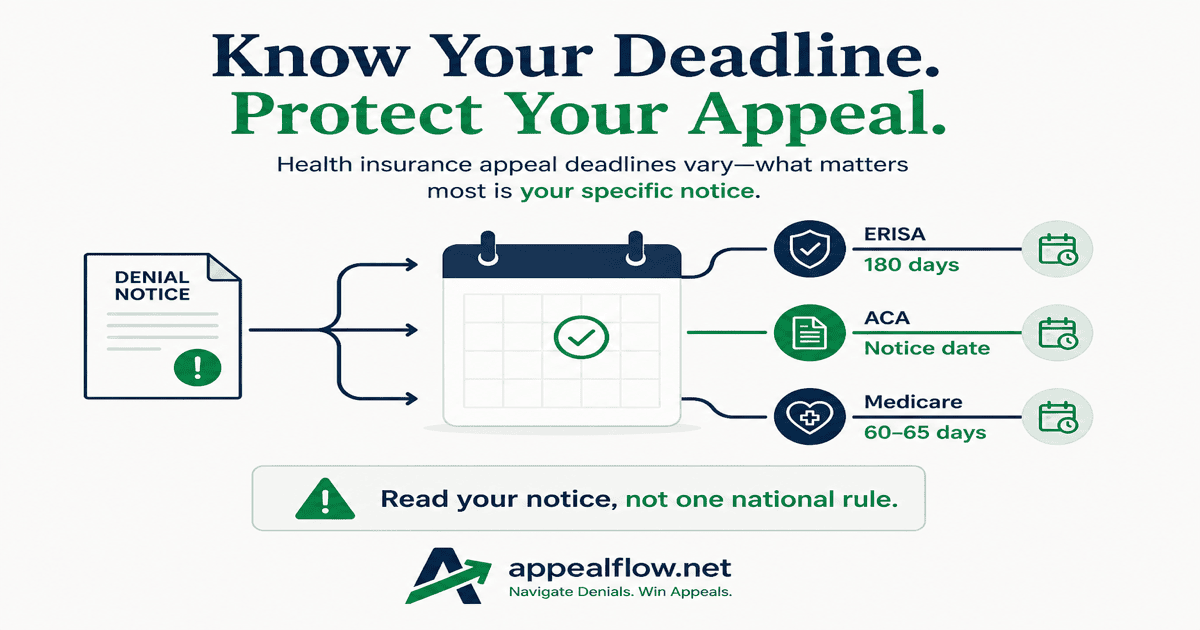
Key Takeaway: Read the date on your notice. Federal regulations cap or range the time states and plans may use. They do not replace the deadline printed for your case.
| Situation | What federal rules set | What you actually use |
|---|---|---|
| Eligibility or fee-for-service hearing request | State must allow a reasonable time not exceeding 90 days from the mailed notice of action (42 CFR 431.221(d)) | The request-by date on your state notice |
| Managed-care plan decision on a standard appeal | State timeframe no longer than 30 calendar days from the day the plan receives the appeal (42 CFR 438.408(b)(2)) | The plan's acknowledgment and resolution notice |
| Fair hearing after a managed-care plan upholds | State must give no less than 90 and no more than 120 calendar days from the plan's resolution notice (42 CFR 438.408(f)(2)) | The hearing-request date on the plan resolution letter |
Do not write “I have 90 days under Medicaid.” That sentence is not a filing date. Commercial ERISA and Marketplace appeal clocks are also the wrong citation. For how those other programs differ, see how long you have to appeal a health insurance denial.
What Documents Should I Attach to a Medicaid Appeal?
Key Takeaway: Match your packet to the reason on the notice. A generic “please approve Medicaid” letter without records rarely answers a clinical or eligibility denial.
- The denial or notice of action, including case or member ID, date mailed, and the stated reason
- Proof of identity, income, or household size for eligibility denials, plus any renewal forms you already submitted
- Treating-provider notes, test results, or a letter of medical necessity for service denials
- Prior authorization history, referral letters, or pharmacy records when the denial cites authorization or formulary rules
- Authorized-representative paperwork if someone other than you is filing the appeal or hearing request
For wording structure, see our guide on how to write an insurance appeal letter. Medicaid packets still must follow the filing method on your state or plan notice.
What If I Have Both Medicare and Medicaid?
Key Takeaway: Dual eligibility does not merge the tracks. A Medicare denial uses Medicare appeals. A Medicaid denial uses the state or managed-care process above. File on the notice that denied the item.
Original Medicare, Medicare Advantage, and Part D use federal Medicare appeals. Those are redeterminations, organization determinations, or coverage determinations, not a Medicaid fair-hearing form. The walkthrough is in how to appeal a Medicare denial. If both programs issued a decision on the same service, you may need both packets. Do not mail a Medicaid hearing request to a Medicare contractor, and do not send a Medicare redetermination to the state fair-hearing office unless the notice says to.
Weak vs. Strong Wording on a Medicaid Hearing Request
Key Takeaway: Name the notice date, the agency or plan, the action you are appealing, and the filing method on the letter. “Please reconsider my Medicaid” does not identify a case.
| ❌ Weak Request | ✓ Strong Request |
|---|---|
| “I have 90 days to appeal Medicaid like everyone else.” | “Notice of action dated [date], mailed [date if shown]. I request a state fair hearing on [eligibility / service] under the deadline printed on that notice. 42 CFR 431.221(d) requires the state to allow a reasonable time not exceeding 90 days from the mailed notice. I am filing by the date this letter prints, not a national 90-day assumption.” |
| “Send this to Medicare. I have both, so one appeal covers it.” | “This notice is from [state Medicaid agency / Medicaid managed-care plan]. I am requesting a Medicaid [plan appeal / fair hearing] on case #[number]. I will file any Medicare denial on the Medicare notice separately.” |
| “The Marketplace said I am not Medicaid-eligible, so use this fair-hearing form.” | “The enclosed notice is a Marketplace eligibility decision. I am following the Marketplace appeal instructions on that notice. This is not a Medicaid fair-hearing request unless a state Medicaid notice also denied me.” |
Are Marketplace Eligibility Appeals the Same as Medicaid Fair Hearings?
Key Takeaway: No. A Healthcare.gov or state-based Marketplace decision about premium tax credits, or a finding that you are not Medicaid-eligible, uses the appeal paragraph on that Marketplace notice. CHIP can also use a different state process. Use the form that matches the letter you actually received.
Medicaid.gov's eligibility-policy page describes coordination between the HHS Appeals Entity and Medicaid or CHIP agencies in assessment states. That coordination is not a reason to file a Marketplace appeal on a Medicaid hearing form, or the reverse. If you have two notices, keep the case numbers separate and file each on its own instructions.
Frequently Asked Questions
Fair hearings, managed-care exhaustion, dual eligibility, Marketplace notices, and where to get state agency contacts.
Generate a Free Draft Letter
AppealFlow.net drafts a letter from the facts on your Medicaid or managed-care notice. You still file it with your state agency or plan. No account required.
- 100% Free
- No Signup
- PDF & Word Export
Disclaimer: This article is for educational purposes only and does not constitute medical, legal, or financial advice. AppealFlow.net is not a healthcare provider, insurance broker, or law firm. Medicaid rules and hearing deadlines are set by each state and by the notice you received. Verify them with your state Medicaid agency, your managed-care plan, Medicaid.gov, and 42 CFR Parts 431 and 438 before you file. For medical emergencies, call 911. See our full disclaimer.