How to Request External Review After an Insurance Denial
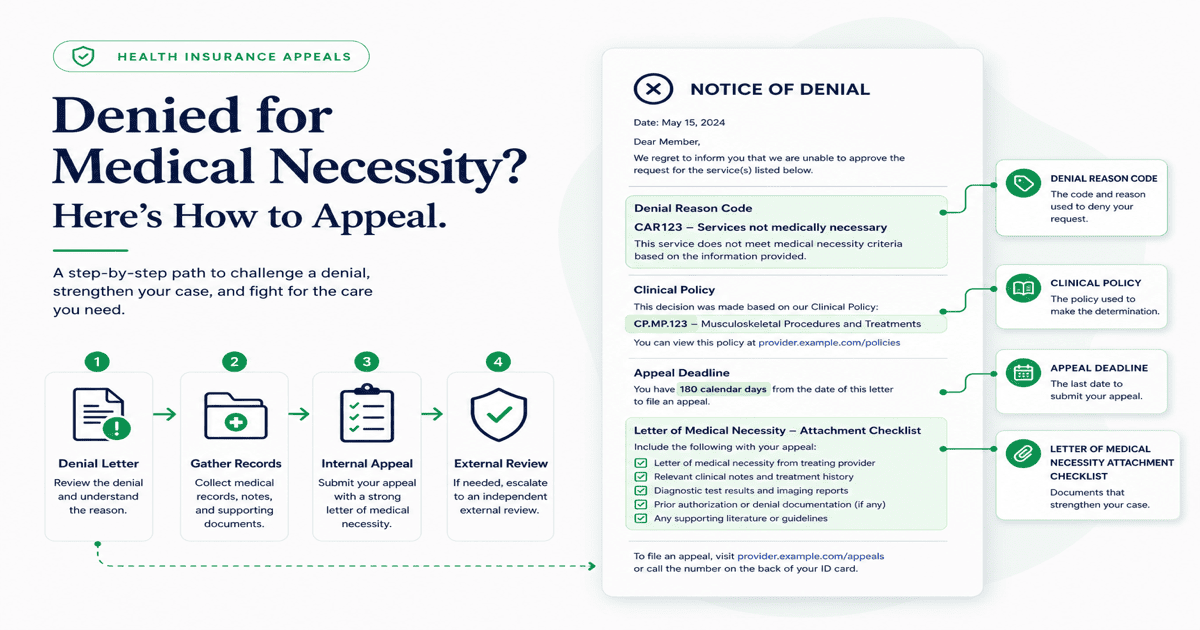
What Is External Review and When Can You Request It?
Key Takeaway: External review is the independent step after internal appeals end. An Independent Review Organization (IRO) re-evaluates the same medical record without a financial stake in upholding the denial. For qualifying ACA plans, the IRO decision is binding on the insurer.
If you are new to this step, start with our explainer on what an external review in health insurance is. That page covers who runs the review, which plans must offer it, and how it differs from a state insurance commissioner complaint.
You generally request external review only after your plan's internal appeal process produces a final upheld denial. The right is established under ACA Section 2719 and Healthcare.gov external review guidance. Your final internal denial notice must tell you where to file, what to include, and the deadline.
For a side-by-side view of the two appeal stages, see internal appeal vs external review. Commissioner complaints can trigger regulatory investigations but do not produce a binding coverage decision on your individual claim the way an IRO review can.
Which Plans Offer External Review After Internal Appeals?
Key Takeaway: ACA external review rights apply to most non-grandfathered individual and group market plans. Self-insured ERISA employer plans often use the federal external review process. Medicare and Medicaid follow separate systems with different notice language.
| Plan type | External review available? | Where to confirm |
|---|---|---|
| ACA marketplace individual, non-grandfathered | Yes | Final denial notice and state or federal IRO program named on the letter |
| Fully insured employer group, non-grandfathered | Yes | State external review program in most states; notice lists filing address |
| Self-insured ERISA employer plan | Often yes | Summary Plan Description and federal external review instructions on denial |
| Grandfathered plan | Varies | Plan documents and state law; ACA external review may not apply automatically |
| Medicare Original, Advantage, Part D | No (separate system) | Medicare.gov five-level appeals process, not ACA IRO filing |
| Medicaid managed care | Varies by state | State fair hearing and managed care appeal rules on your notice |
Do not file ACA external review for a Medicare claim. Medicare beneficiaries use MAC redetermination and QIC reconsideration, not an ACA IRO. Sending the wrong request to the wrong program wastes time while appeal clocks keep running.
What Types of Denials Qualify for External Review?
Key Takeaway: External review covers adverse benefit determinations based on medical judgment. Pure contractual exclusions where a benefit is simply not listed may not qualify. Read the denial letter to see which category the insurer applied.
Under ACA external review regulations, eligible denials usually involve medical necessity, appropriateness of care, healthcare setting or level-of-care criteria, or experimental or investigational treatment determinations. Rescissions of coverage may also qualify even when internal appeals were not completed.
- Medical judgment denials: The plan decided care does not meet clinical criteria. An IRO can re-evaluate that judgment against your records and accepted guidelines.
- Rescissions: Retroactive cancellation of coverage may be eligible for external review under ACA rules.
- Contractual exclusions: If the plan cites a flat exclusion such as “weight loss drugs are not covered” without applying medical necessity criteria, external review on clinical grounds may not be available. Request the exact plan provision cited.
Prior authorization and medical necessity denials for covered benefits are usually eligible. For internal appeal strategy before external review, see how to appeal a prior authorization denial.
How Do You File for External Review Step by Step?
Key Takeaway: Follow the instructions on your final internal denial notice exactly. Missing the filing deadline can forfeit external review rights on qualifying plans.
- Read the final denial notice: It must include external review rights, contact information, and the filing deadline. Many notices allow about four months from the final internal denial date, but your letter controls.
- Choose the state or federal path: Fully insured ACA plans in states with approved programs usually file through the state IRO. Self-insured ERISA plans and certain other coverage types may use the CMS CCIIO external appeals program.
- Submit a written request: Mail, fax, or use the online portal named on your notice. Include claim reference numbers, the final denial, your internal appeal packet, and a concise explanation of why the denial is wrong.
- Confirm the insurer forwards the file: Once an IRO is assigned, the plan must send the complete claim file, including clinical documentation and the basis for denial.
- Send new evidence promptly: You may submit additional records directly to the IRO. Do this quickly because review clocks start when the IRO accepts the case.
- Await the decision: Standard review must finish within 45 days. Expedited review must finish within 72 hours when urgent care is at stake.
What Documents Should You Submit to the IRO?
Key Takeaway: Give the IRO the same strong clinical record you would use in internal appeal, plus any new evidence that addresses the specific criterion the plan cited.
| Document | Why include it |
|---|---|
| Final internal denial notice | Identifies the decision under review and the clinical criteria applied |
| Complete internal appeal packet | Shows the full record the plan already reviewed |
| Updated treating provider letter | Addresses each denial criterion with diagnosis, treatment history, and rationale |
| Clinical guidelines or peer-reviewed literature | Supports that the denied care matches accepted standards |
| New test results or imaging reports | Objective evidence not in the internal appeal record |
| Numbered cover letter | Lists each attachment and maps facts to the plan's stated denial reason |
Weak vs Strong Wording in Your External Review Request
Key Takeaway: IRO reviewers read clinical records and plan criteria, not emotional appeals. Specific citations to denial language and numbered attachments get reviewed faster than generic disagreement.
| Weak wording | Strong wording |
|---|---|
| “I disagree with the denial.” | “Denial letter dated [date] cites Policy Section 4.2 requiring documented neurological deficit; attached MRI report shows [finding].” |
| “Please review my case.” | “Attached Exhibit 1 final denial, Exhibit 2 internal appeal, Exhibit 3 updated letter of medical necessity addressing criterion B.” |
| “This treatment is medically necessary.” | “Treating physician letter maps ICD-10 diagnosis to plan criterion 3 and cites [guideline] supporting inpatient level of care.” |
External Review Deadlines to Circle on Your Notice
Key Takeaway: Every deadline on your denial packet is plan-specific. Copy dates to a calendar the day the letter arrives and keep proof of every submission.
- First internal appeal deadline: Printed on your initial adverse benefit determination. Missing it can end your administrative rights before external review.
- Final internal denial date: Starts the external review filing window named on that letter. For timing context, see how long you have to appeal a health insurance denial.
- External review filing deadline: Must appear on your final internal denial notice under ACA Section 2719. Do not assume a national default without reading your letter.
- IRO decision clock: 45 days for standard review and 72 hours for qualifying expedited review under federal implementing rules.
What If You Need Expedited External Review?
Key Takeaway: When standard external review timing would seriously jeopardize your life, health, or ability to regain maximum function, you can request expedited review with a 72-hour decision clock. In some urgent cases you may request expedited external review while an internal appeal is still pending.
Expedited external review is common for ongoing inpatient care, cancer treatment, or surgery denials where delay would harm you. You can also request it when a concurrent review decision threatens to terminate an authorized level of care before discharge.
The IRO must communicate an expedited decision immediately by phone or electronic message and follow up in writing. If the denial is overturned, the plan must provide coverage consistent with the decision without waiting for another internal review cycle.
Use AppealFlow'sexternal review appeal letter generatorto draft a structured appeal letter tied to your denial reason before the deadline on your notice.
Prepare Your External Review Submission
AppealFlow drafts formal appeal letters for medical necessity and prior authorization denials. Use the same letter for internal appeal and external review packets.
How Is Medicare Different from ACA External Review?
Key Takeaway: Medicare does not use ACA IRO external review. Follow the five-level Medicare appeals process on your Medicare notice instead of filing with an ACA external review address.
According to Medicare.gov appeals guidance, the Medicare process includes MAC redetermination, QIC reconsideration, ALJ hearing, Medicare Appeals Council review, and federal court for qualifying amounts in controversy. Medicare Advantage and Part D use parallel structures with plan-specific notice language.
For Medicare-specific strategy, see how to appeal a Medicare denial. Do not confuse QIC reconsideration with ACA external review even though both involve independent reviewers.
What Happens After the IRO Decision?
Key Takeaway: When an IRO overturns a denial on a qualifying plan, the insurer must provide coverage consistent with that decision. When the IRO upholds the denial, you have exhausted administrative appeal for that claim on most commercial plans.
If the IRO overturns the denial, the plan must authorize or pay the benefit. The insurer cannot appeal the IRO decision on qualifying ACA external review cases. If care was already provided, the plan must process payment according to the decision.
If the IRO upholds the denial, next steps may include a state insurance department complaint for potential regulatory violations, ERISA federal court action after exhaustion for employer plans, or consulting a licensed attorney about bad-faith claims on fully insured plans. A commissioner complaint does not directly reverse a coverage decision the way external review can. See state insurance commissioner complaints for health insurance.
Frequently Asked Questions
Common questions about filing external review, eligibility, timelines, and how Medicare appeals differ from ACA IRO review.
Generate Your Free Appeal Letter
AppealFlow.net drafts formal appeal letters for medical necessity, prior authorization, and prescription denials. Edit live, download as PDF or Word. No account required. You still file through your plan's internal appeal and external review process.
- 100% Free
- No Signup
- PDF & Word Export
Disclaimer: This article is for educational purposes only and does not constitute medical, legal, or financial advice. AppealFlow.net is not a healthcare provider, insurance broker, or law firm. External review rights depend on your plan type and state. Verify your specific rights in your plan documents and denial letter. ACA external review guidance is available from Healthcare.gov and CMS CCIIO. Medicare appeals guidance is at Medicare.gov. See our full disclaimer.