Internal Appeal vs External Review
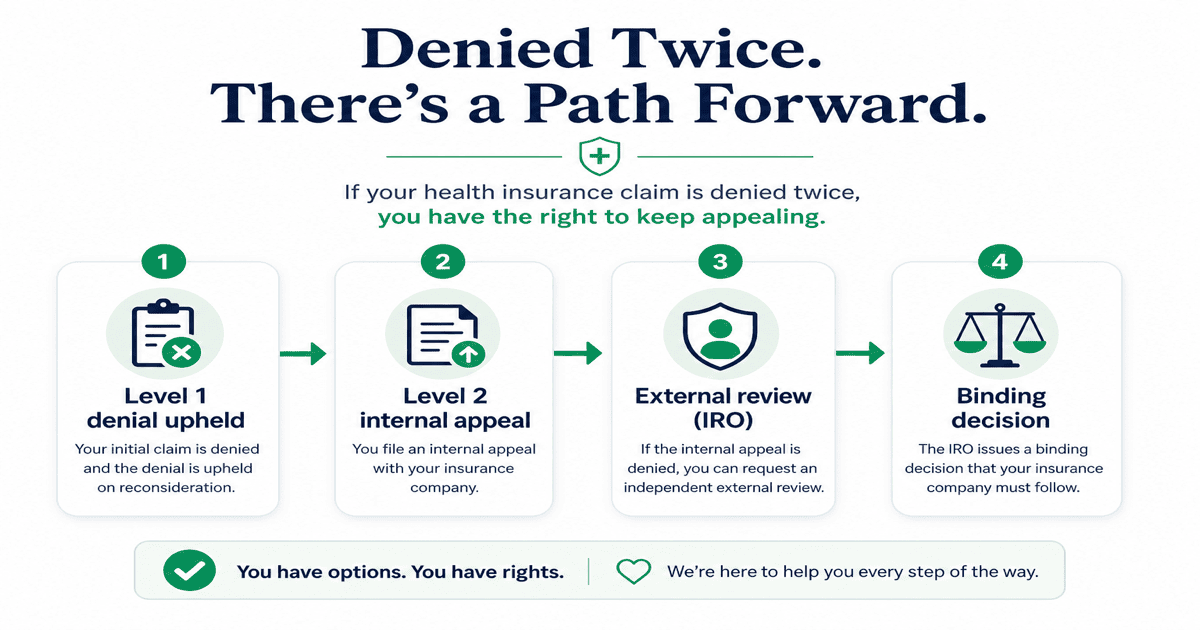
Internal Appeal vs External Review: Side-by-Side Comparison
Key Takeaway: Internal appeals stay inside the insurer's process. External review moves the medical judgment question to an independent reviewer. For many ACA-regulated plans, only the external step is binding on the insurer.
| Feature | Internal appeal | External review |
|---|---|---|
| Who decides | The health plan or its utilization-management vendor | An Independent Review Organization (IRO) |
| When it happens | First, after the initial adverse benefit determination | After internal appeals are exhausted or when the plan misses a required decision deadline |
| Where you file | Insurer appeals portal, fax, or mail address on the denial notice | Contact on your final internal denial notice or HHS/Maximus for federal-process plans |
| Typical levels | One or more reconsideration levels named on the notice | Usually one independent review of the medical record |
| Standard decision time | 30 days for standard claims; 72 hours for urgent per ERISA 29 CFR 2560.503-1 | 45 days standard; 72 hours or less expedited per Healthcare.gov |
| Filing deadline | Printed on the denial notice (often 180 days for ERISA plans) | Typically 4 months after the final internal denial for ACA plans |
| Binding effect | Plan must follow its claims procedures; not always the final step | Binding on the insurer for qualifying ACA Section 2719 plans when eligible |
For a deeper definition of the independent step, see what an external review in health insurance is. For filing instructions after internal appeals end, see how to request external review after an insurance denial.
What Is an Internal Appeal?
Key Takeaway: An internal appeal asks the insurer to reconsider its own denial using the plan's claims procedures. You submit new medical records, a written argument, and sometimes request a peer-to-peer call with the plan's medical director.
When a health plan issues an adverse benefit determination, whether for medical necessity, prior authorization, or a formulary exception, your first formal coverage challenge is an internal appeal filed with the insurer. Under ERISA claims procedures at 29 CFR 2560.503-1, many employer plans must provide at least one level of internal review with specific decision timeframes. ACA-regulated plans follow parallel internal appeal rules in 45 CFR 147.136.
The internal appeals unit reads your letter, clinical notes, and the plan policy cited in the denial. It may uphold, partially overturn, or fully overturn the decision. A peer-to-peer call is still part of the internal process, not external review. If the plan upholds the denial, your final notice should explain whether external review is available and how to request it.
What Is External Review?
Key Takeaway: External review is the independent step after internal appeals. An IRO with no financial stake in upholding the denial re-reads the same medical record and plan terms.
Healthcare.gov external review guidance describes this as a review of the insurer's decision by an independent organization. The Independent Review Organization must meet accreditation and conflict-of-interest standards in 45 CFR 147.136. You do not typically speak with the IRO directly; the review is document-based unless your state program allows additional input.
For qualifying non-grandfathered ACA individual and group plans, the IRO decision is binding on the insurer when the case is eligible and filed on time. That makes external review the last formal coverage step before litigation for many commercial plans. See what is an external review in health insurance for IRO rules, binding effect, and how the process differs from Medicare appeals.
When Does Each Step Apply by Plan Type?
Key Takeaway: Every denial starts with an internal appeal if you want to challenge it. External review is available only on qualifying plans after internal appeals end. Medicare, Medicaid, and grandfathered plans follow different tracks.
| Plan type | Internal appeal | External review |
|---|---|---|
| ACA marketplace / individual | Required first step; deadlines on denial notice | Available after internal appeals under ACA Section 2719; binding when eligible |
| Large employer / self-funded ERISA | Claims procedures in the SPD; often 180-day filing window | Federal external review may be available after internal appeals per DOL ACA guidance |
| Grandfathered plans | Plan-specific internal process only | ACA Section 2719 external review generally does not apply |
| Medicare Advantage / Part D | Redetermination by the MAC on Medicare.gov | QIC reconsideration and further Medicare levels, not ACA IRO review |
| Medicaid managed care | Plan grievance and fair hearing request per state rules | State fair hearing, not federal ACA external review |
Read the card and the notice. A Medicare card means Medicare.gov appeal levels, not ACA external review. A marketplace plan ID means ACA Section 2719 may apply. Never assume one plan type's rules apply to another.
What Documents Do You Need for Each Step?
Key Takeaway: Both steps use the same core file. The difference is where you send it and which deadline clock applies. Build one complete packet and reuse it for internal appeal and external review.
- Denial letter and EOB with claim number, denial reason code, and cited plan provision
- Plan clinical policy the insurer applied, available from member services or the appeals portal
- Treating provider notes that map your diagnosis and symptoms to the plan's criteria
- Prior authorization history and any peer-to-peer summary from the internal step
- Written appeal letter that cites plan language and clinical evidence, not emotional pleas alone
For letter structure and weak vs strong wording, see how to write an insurance appeal letter. For appeal deadlines by plan type, see how long you have to appeal a health insurance denial.
How Do Internal Appeal and External Review Deadlines Differ?
Key Takeaway: Internal appeal clocks start on the adverse benefit determination date printed on your denial notice. External review clocks start on the final internal denial date. Missing either window can end your rights even when the medical case is strong.
ERISA employer plans often allow 180 days from the notice date to file an internal appeal, though the exact window is on your denial letter and Summary Plan Description. ACA marketplace plans follow the internal appeal filing period in your notice. Once internal appeals end with an upheld denial, ACA plans generally give you four months from that final notice to request external review, per Healthcare.gov.
Expedited timelines apply when treatment is urgent. Internal urgent appeals must be decided within 72 hours under ERISA claims regulations. Expedited external review must be decided within 72 hours or less depending on medical urgency. Request expedited processing in writing and document the clinical urgency.
Draft Your Internal Appeal Letter
Start with a formal letter for the internal appeal step. You still file through the process named on your denial notice.
What If Internal Appeal Fails: When to Request External Review
Key Takeaway: When your final internal denial notice arrives, read the external review section before the filing deadline passes. You generally cannot skip internal appeals and go straight to external review on ACA plans.
If the insurer upholds the denial at the final internal level, your notice must include external review instructions under ACA Section 2719 and ERISA claims rules. Submit a written external review request to the address or portal named on that notice. For federal-process plans, you may file with HHS/Maximus as described in how to request external review after an insurance denial.
You may also qualify for external review if the plan misses a required internal decision deadline. Keep dated proof of every submission. If the IRO overturns the denial, the plan must provide coverage consistent with the decision for qualifying ACA plans. For broader denial rights, see what to do when an insurance claim is denied.
How Does Medicare Fit Into Internal Appeal vs External Review?
Key Takeaway: Medicare uses its own multi-level appeal system. A Qualified Independent Contractor at the reconsideration level is not the same as an ACA IRO external review.
If your insurance card says Medicare, follow the appeal instructions on your Medicare notice and on Medicare.gov claims appeals. Medicare redetermination is the first level, not a commercial internal appeal. QIC reconsideration involves an independent contractor, but it follows Medicare rules and deadlines, not ACA Section 2719.
Frequently Asked Questions
Common questions about how internal appeals and external review differ, when each applies, and what deadlines control each step.
Generate Your Free Appeal Letter
AppealFlow.net drafts formal appeal letters for coverage denials. Edit live, download as PDF or Word. No account required. You still submit through your plan's internal appeal and external review process.
- 100% Free
- No Signup
- PDF & Word Export
Disclaimer: This article is for educational purposes only and does not constitute medical, legal, or financial advice. AppealFlow.net is not a healthcare provider, insurance broker, or law firm. Internal appeal and external review rules, deadlines, and binding effect vary by plan type. Verify current requirements with your denial letter, Summary Plan Description, or Medicare.gov before taking action. For medical emergencies, call 911. See our full disclaimer.