What Is a Bad Faith Insurance Claim?
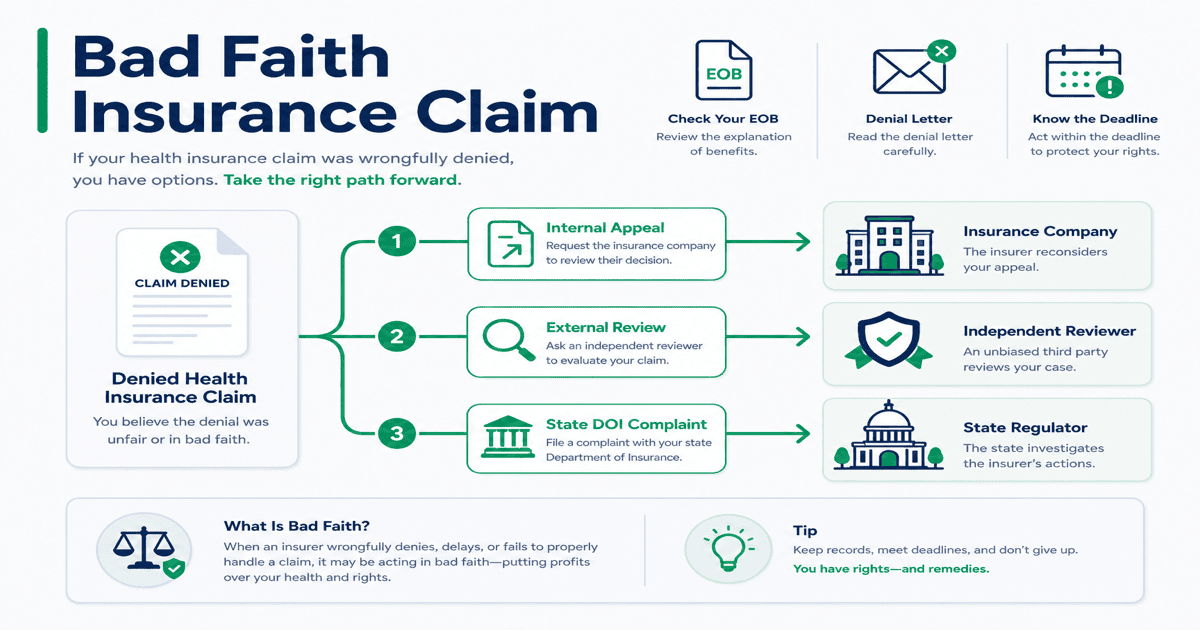
What Is a Bad Faith Insurance Claim?
Key Takeaway: Bad faith occurs when an insurer handles a health claim unreasonably: denying without investigation, misreading policy language to avoid payment, missing required appeal deadlines, or conducting reviews without examining the medical record. State insurance codes and contract law impose a duty of good faith and fair dealing in most jurisdictions.
Every health plan is a contract. When you pay premiums, the insurer agrees to cover eligible claims according to the plan terms. A bad faith insurance claim argues the insurer breached that contract and, in many states, violated a separate legal duty to handle claims honestly and promptly.
A denial alone is not bad faith. Insurers can lawfully deny claims that fall outside coverage. Bad faith typically requires showing the insurer had no reasonable basis for its decision and knew or should have known coverage applied. A coverage appeal asks whether the service should be paid. A bad faith claim asks whether the insurer acted unreasonably in saying no.
For related conduct patterns, see our guide on what bad faith insurance is. You can pursue a standard appeal and document bad-faith conduct at the same time. The two processes are separate and complementary.
How Does a Bad Faith Claim Differ From a Coverage Appeal?
Key Takeaway: A denied claim appeal seeks reversal of a coverage decision through internal and external review. A bad faith claim seeks additional damages for unreasonable conduct. Pursue both simultaneously. Your appeal creates the documented record that supports a regulatory complaint.
| Factor | Coverage appeal | Bad faith claim |
|---|---|---|
| Goal | Reverse denial and recover the benefit | Recover benefit plus damages for misconduct |
| Forum | Insurer appeal, external review, IDR where applicable | State DOI complaint, civil court |
| Cost | Free through regulatory appeal channels | Attorney fees if litigating; some states award fees if bad faith is proven |
| Timeline | Often 30 days standard or 72 hours expedited per plan type; check your notice | Months to years if litigated |
Start with your formal appeal every time. An external review overturning the denial is strong evidence that the insurer lacked a reasonable basis for denial. For how the two appeal levels work, see internal appeal vs external review.
What Are Common Signs of Bad Faith in Health Insurance?
Key Takeaway: Documented patterns include denying without investigation, misquoting policy exclusions, missing appeal decision deadlines, lowballing clearly covered claims, and using boilerplate denial letters without reviewing medical records submitted with the claim.
In health insurance claim handling, conduct regulators and courts often examine includes:
- Failure to investigate: Denying a claim without reviewing submitted medical records or contacting the treating physician.
- Misapplication of policy language: Citing exclusions that do not apply to your specific diagnosis or service, or interpreting ambiguous terms always in the insurer's favor.
- Ignoring appeal deadlines: Failing to respond within required timeframes under ERISA claims procedures at 29 CFR 2560.503-1 or ACA Section 2719 appeal rights.
- Sham peer review: Having a reviewer with no relevant specialty overturn a treating physician's medical necessity determination without examining records.
- Pattern of similar denials: Denying the same service class across many policyholders without individualized review, sometimes uncovered through state market conduct examinations.
Each instance alone may not prove bad faith. A documented pattern of unreasonable conduct strengthens your case. Keep a claim diary from the first denial forward.
How Do I Document Bad Faith Conduct?
Key Takeaway: Build your record contemporaneously: save every denial letter, EOB, appeal submission, call log with representative names and reference numbers, and portal confirmation. Insurers cannot easily dispute dated documentation you created in real time.
Your documentation packet should include:
- Complete policy or plan document, including riders and your Summary of Benefits and Coverage.
- All denial and partial-payment letters with reason codes and cited policy provisions.
- Appeal submissions and insurer responses with timestamps from portal uploads.
- Call logs: date, time, representative name, call reference number, and summary of what was said.
- Medical records the insurer had access to but apparently did not review.
- Financial harm documentation: out-of-pocket payments, delayed treatment costs, and collection notices.
Under ERISA 29 CFR 2560.503-1, employer plan participants can request documents the plan relied on in a denial. Review whether the reviewing physician actually examined your records. Many denials cite generic criteria without case-specific analysis.
Weak vs. Strong Language in Bad Faith Disputes
Key Takeaway: Regulatory complaints and demand letters succeed when they cite specific policy provisions, statutory violations, and a documented timeline, not accusations of dishonesty without evidence.
| Weak statement | Strong statement |
|---|---|
| “My insurance company is acting in bad faith and treating me terribly.” | “Claim for CPT 27447 was denied citing ‘not medically necessary' without reviewing the operative report and MRI submitted on file. Peer reviewer specialty: internal medicine, not orthopedics. I request supervisory review per plan Section 8.3.” |
| “They keep denying everything I submit. I want to sue them.” | “Internal appeal filed with portal confirmation. Insurer response was due per ACA Section 2719. No response received by the stated deadline. I am filing a complaint with the state Department of Insurance and requesting expedited external review.” |
| “This denial is unfair and I deserve my benefits.” | “Policy Section 4.B covers surgical procedures when medically necessary. Treating surgeon attests failure of conservative therapy (attached). Denial template cites an unrelated cosmetic exclusion. ICD-10 code confirms primary osteoarthritis. Request reconsideration with a qualified orthopedic reviewer.” |
Need a Formal Appeal Letter First?
AppealFlow's free generator drafts appeal letters that cite ERISA and ACA appeal rights. That documented record is the foundation of any bad-faith complaint.
How Do I File a Bad Faith Complaint?
Key Takeaway: Start with a free complaint to your state Department of Insurance through NAIC.org. Continue your formal appeal and request external review. Consult a licensed insurance attorney if conduct is egregious and state law allows civil bad-faith recovery.
- File your internal appeal. Preserve your contractual appeal rights before escalating. Submit through your insurer's portal with complete documentation.
- Request external review. An independent overturn strengthens any bad-faith argument. See how to request external review after an insurance denial.
- File a state DOI complaint. Visit NAIC.org and select your state's consumer complaint portal. Describe the unreasonable conduct with dates and reference numbers. For a full walkthrough, see how to file a state insurance commissioner complaint.
- Report ERISA violations if applicable. Employer plan participants can contact the U.S. Department of Labor EBSA about fiduciary concerns. ERISA limits bad-faith damages in federal court.
- Consult an attorney for civil litigation. Many bad-faith attorneys work on contingency for state-regulated plans. ERISA employer plans have more limited recovery options.
State insurance commissioners investigate consumer complaints at no cost. Regulatory pressure often prompts insurers to reverse denials to avoid formal sanctions. Your complaint becomes part of the insurer's regulatory record.
What Are ERISA vs. State-Regulated Plan Rules?
Key Takeaway: ERISA-governed employer health plans limit federal court recovery to benefits owed plus possible interest and attorney fees in some circumstances. Individually purchased, marketplace, and fully insured state plans may allow broader bad-faith remedies including punitive damages, depending on your state.
Plan type determines your legal options. If you receive health insurance through an employer, your plan may be ERISA-governed. Under ERISA Section 514, federal law preempts most state bad-faith laws for covered employer plans. Remedies are generally limited to the denied benefit amount, potential interest, and attorney fees only if the insurer acted arbitrarily and capriciously.
State-regulated plans, including ACA marketplace coverage and many individually purchased policies, fall under state insurance codes with stronger bad-faith protections in some states. Check your plan documents and insurance card to identify whether your coverage is self-funded ERISA or state-regulated.
How to identify your plan type: ERISA plans are often labeled self-funded or administered without state insurance regulation. Marketplace and individual plans include state-mandated consumer protections and external review rights.
What Damages May Be Available in a Bad Faith Case?
Key Takeaway: Recoverable damages vary by state and plan type. Common categories include the denied benefit amount, interest, attorney fees, and in some states punitive damages. Document all financial harm caused by the improper denial.
Beyond the underlying claim amount, bad faith may involve:
- Contract damages: The full value of the denied or underpaid benefit.
- Statutory interest: Many state insurance codes impose interest on delayed claim payments. The rate and start date vary by state.
- Consequential damages: Out-of-pocket costs for care you paid while waiting and costs of delayed treatment.
- Attorney fees: Available in many states when bad faith is proven, which can make contingency representation viable.
- Punitive damages: Some state insurance codes allow punitive awards when conduct is willful or reckless. ERISA plans generally do not allow punitive damages in federal court.
Do not assume punitive damages are available. Verify with a local insurance attorney before investing in litigation. Even without punitive damages, a successful appeal plus state commissioner complaint often resolves the underlying denial at no cost. For dispute steps beyond appeals, see how to dispute insurance claims.
What Mistakes Weaken a Bad Faith Case?
Key Takeaway: Skipping the formal appeal, failing to document interactions, missing deadlines, and filing suit before exhausting administrative remedies are the most common errors that undermine bad-faith claims.
- Skipping the internal appeal. Courts and regulators expect you to exhaust plan remedies first. File your appeal before escalating.
- Not keeping call records. “They told me on the phone it was covered” is unprovable without dates, names, and reference numbers.
- Missing appeal deadlines. A late appeal gives the insurer a legitimate procedural defense, which weakens any bad-faith argument.
- Destroying evidence. Save every email, portal screenshot, and mailed letter. Insurers retain records; you must too.
- Assuming all plans have the same remedies. ERISA and state-regulated plans follow different rules. Verify your plan type before choosing a strategy.
Frequently Asked Questions
Answers to common questions about what a bad faith insurance claim is and how to pursue one.
Generate Your Free Insurance Appeal Letter
AppealFlow drafts formal appeal letters that build the documented record you need for any bad-faith complaint. Edit live, then download as PDF or Word. No account required.
- 100% Free
- No Signup
- PDF & Word Export
Disclaimer: This article is for educational purposes only and does not constitute legal advice. AppealFlow is not a law firm. Bad faith laws vary significantly by state and plan type. Consult a licensed insurance attorney before filing suit. For medical emergencies, call 911. See our full disclaimer.