What Is Bad Faith Insurance?
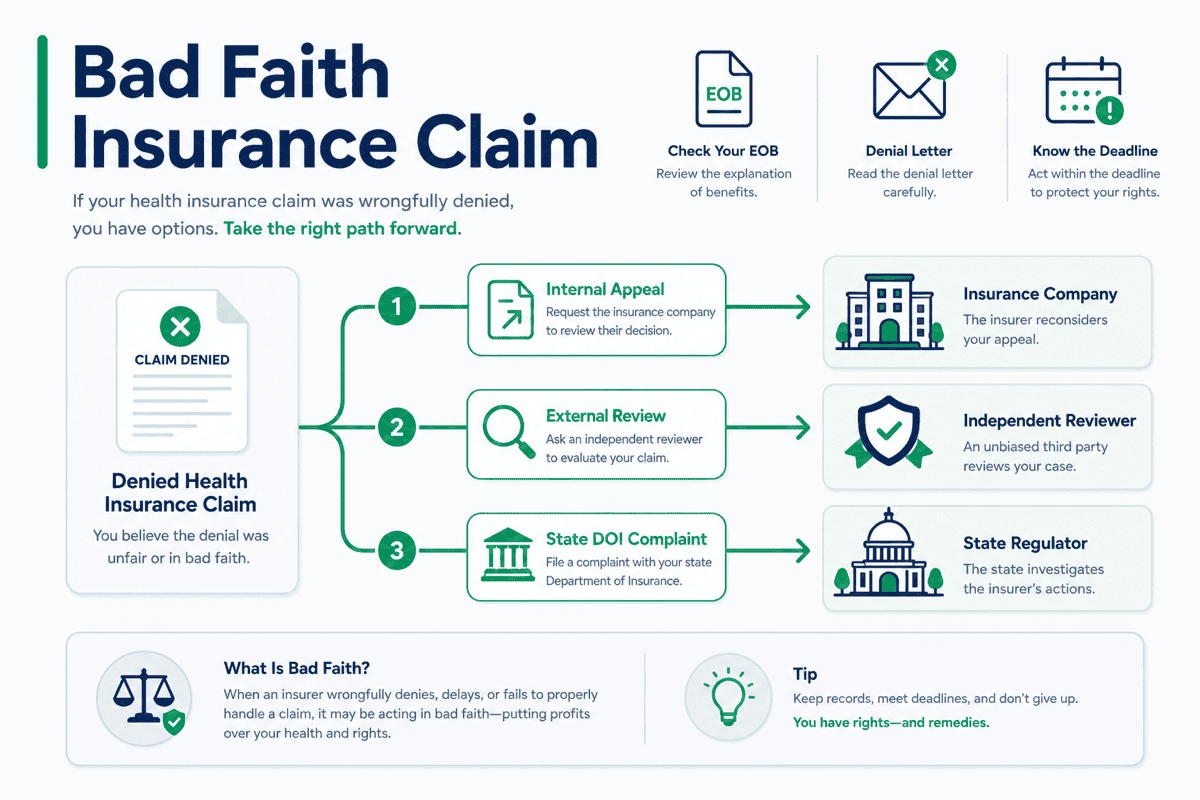
What Does Bad Faith Insurance Mean in Health Coverage?
Key Takeaway: Bad faith is about how an insurer handles your claim, not just the final denial reason. Every health plan contract includes a duty of good faith and fair dealing. When an insurer ignores evidence, misreads your policy, or misses required deadlines, that conduct can support a regulatory complaint or state bad-faith claim in addition to your standard appeal.
In health insurance, patients most often encounter bad-faith conduct when an insurer denies a service that appears covered, loses appeal documents, sends contradictory explanations across phone calls and letters, or refuses to provide the claim file after a written request. The denial letter may look routine. The handling of your case is what crosses the line.
State insurance departments and courts evaluate whether the insurer acted reasonably given the records available at the time of the decision. That is different from asking whether you personally agree with a medical necessity denial. For a standard coverage dispute, see whether insurance can deny a claim and what federal appeal rights apply on your notice.
You can locate your state insurance commissioner through NAIC.org. Filing a consumer complaint is free and does not require an attorney.
How Is Bad Faith Different From a Coverage Denial?
Key Takeaway: A coverage denial means the insurer decided the service does not meet plan rules. You appeal with clinical evidence and plan citations. Bad faith means the insurer handled a potentially covered claim without a reasonable investigation or honest application of your policy, regardless of the reason code on the letter.
Not every denial is bad faith. Insurers deny claims every day for valid reasons: missing prior authorization, medical necessity criteria not met, or services excluded from the plan. Those denials trigger your internal appeal rights under ERISA for most employer plans or ACA Section 2719 for many individual and marketplace plans.
Bad faith enters when the process itself is defective. Examples include denying without reviewing attached medical records, misquoting your certificate of coverage, or failing to respond to an urgent appeal within the timeframe required on your denial notice. You can pursue both tracks at once: file your formal appeal with complete documentation while logging conduct that may support a commissioner complaint.
| Standard coverage denial | Potential bad-faith conduct |
|---|---|
| Denial cites a specific plan exclusion or medical policy | Denial ignores plan language that covers the service |
| Appeal reviewed within the timeframe on your notice | Appeal ignored, lost, or decided without reviewing submitted records |
| Consistent reason codes across EOB, letter, and calls | Changing explanations or no written response after required deadlines |
What Are Common Signs of Bad Faith Claims Handling?
Key Takeaway: Watch for missed deadlines, sham investigations, pressure to accept partial payment without appeal rights explained, and threats when you exercise appeal rights. Document every interaction with dates, representative names, and reference numbers.
- Failure to investigate: The insurer denies without requesting records, contacting your provider, or reviewing documentation you already submitted.
- Deadline violations: Your denial notice lists appeal response timeframes. Silence past those windows may support a regulatory complaint, especially for urgent appeals under ACA Section 2719 and ERISA claims procedure rules in 29 CFR 2560.503-1.
- Misrepresentation of policy language: The denial letter cites provisions that do not appear in your certificate of coverage or paraphrases exclusions in ways that contradict the contract.
- Lowball settlement offers: Offering partial payment on a claim your policy covers in full, then pressuring you to accept quickly without explaining appeal rights.
- Retaliatory conduct: Threatening to cancel coverage or discouraging appeals after you push back on a denial.
Keep a claim journal from the day you receive your first denial. Log every phone call, portal message, fax confirmation, and certified-mail receipt. That timeline becomes evidence whether your case resolves through appeal, regulatory pressure, or litigation.
Important: Do not stop your formal appeal while documenting bad-faith conduct. Missing appeal deadlines ends your coverage dispute permanently, even if you later file a regulatory complaint. Calendar the deadline on your denial notice the day it arrives.
What Are Your Federal Appeal Rights While You Document Bad Faith?
Key Takeaway: Federal law guarantees a written denial reason and an internal appeal path for most group and individual health plans. Use those rights to build the record that supports both your benefit dispute and any commissioner complaint about how the insurer handled your case.
ERISA-covered employer plans must provide a full and fair review under 29 CFR 2560.503-1. Your adverse benefit determination must explain the reason, cite plan provisions, and state how to appeal. Many plans allow up to 180 days from the denial notice for a first-level internal appeal, but confirm the exact date on your letter and Summary Plan Description.
ACA Section 2719 requires many individual and small-group plans to offer internal appeals and external review for qualifying coverage disputes. If your insurer misses required deadlines or refuses to provide your claim file, note that in any bad-faith complaint. See our guide on how long you have to appeal a health insurance denial for plan-type deadlines.
Request your Summary Plan Description and certificate of coverage. Compare the insurer's denial language word-for-word against what your documents actually say. When the denial misquotes your plan, that discrepancy belongs in both your appeal letter and your commissioner complaint.
How Do State Bad Faith Laws and Remedies Work?
Key Takeaway: State bad-faith statutes apply mainly to state-regulated health plans. Self-funded ERISA employer plans follow federal benefit rules, which generally limit recovery to the benefit owed plus interest. Know which category your plan falls into before deciding whether to pursue state remedies or consult an attorney.
| Plan type | Typical bad-faith path | What to verify first |
|---|---|---|
| Self-funded ERISA employer plan | Federal ERISA appeal; limited federal remedies for benefits owed | Summary Plan Description and denial notice plan administrator |
| ACA marketplace / individual plan | Internal appeal, external review, state DOI complaint, possible state bad-faith suit | Final denial notice and state external review instructions |
| Fully insured employer plan | May be state-regulated despite employer sponsorship; remedies vary by state | Whether your state regulates the underlying policy |
For a deeper look at how regulatory complaints relate to legal claims, see our guide on what a bad faith claim is. Outcomes vary by state law and are never guaranteed.
How to File a Bad Faith Complaint With Your State Commissioner
Key Takeaway: File a free complaint with your state Department of Insurance through NAIC.org. Include your policy number, claim timeline, denial letters, appeal submissions, and specific examples of unreasonable insurer conduct. Many states require a written insurer response within about 30 days, but timelines vary.
- Locate your state portal. Visit NAIC.org and use the consumer complaint tool to reach your state insurance department.
- Gather documentation. Policy documents, Explanation of Benefits, denial letters, appeal submissions with delivery confirmation, call logs, and written correspondence from the insurer.
- Write a factual timeline. Date each event: claim submission, denial receipt, appeal filing, follow-up calls, and any missed deadlines. Stick to facts regulators can verify.
- Cite specific violations. Reference missed appeal deadlines, failure to provide your claim file, or denial reasons that contradict your plan language.
- Submit and track your complaint. Most states assign a complaint number. Continue your formal appeal in parallel. Our state insurance commissioner complaint guide walks through filing steps in detail.
State insurance commissioners enforce fair claims handling. They do not substitute their medical judgment for the insurer's in every case. Your strongest path to payment usually remains a well-documented internal appeal citing plan language and clinical evidence.
Weak vs. Strong Bad Faith Complaint Language
Key Takeaway: Commissioner complaints succeed when they cite specific dates, policy provisions, and procedural violations. Replace general frustration with a documented timeline and direct quotes from your plan documents and denial letters.
| Weak wording | Strong wording |
|---|---|
| “My insurance company is terrible and denied my claim for no reason.” | “On 2026-06-12, [Carrier] denied claim #CLM-88421 for lumbar MRI (CPT 72148) citing not medically necessary. Certificate of Coverage section 4.2 covers outpatient diagnostic imaging with prior auth obtained 2026-06-01 (ref PA-77201). Attached: denial letter, PA confirmation, and provider letter submitted with appeal on 2026-06-20.” |
| “They never responded to my appeal and I think that is illegal.” | “I filed an urgent internal appeal on 2026-07-03 (tracking #APL-9934). As of 2026-07-08 I received no written decision. My denial notice requires a response within 72 hours for urgent appeals under ACA Section 2719. Call log attached for follow-ups on 2026-07-05 and 2026-07-07.” |
| “Please investigate my insurer because they treat all customers this way.” | “I request investigation of failure to conduct a reasonable claims review. Denial dated 2026-08-01 cites a cosmetic exclusion, but the claim is Mohs surgery (CPT 17311) for basal cell carcinoma (ICD-10 C44.319). Plan SPD page 22 lists skin cancer treatment as covered. Insurer did not contact my dermatologist before denial.” |
Building Your Appeal and Bad Faith Record?
AppealFlow drafts formal health insurance appeal letters you can edit live, then download as PDF or Word. Strong appeal documentation also supports a commissioner complaint.
When Should You Talk to a Licensed Attorney?
Key Takeaway: You do not need an attorney to file a commissioner complaint or a standard internal appeal. Consider legal counsel when the denied amount is substantial, the insurer's conduct is clearly unreasonable, or your plan type may allow state bad-faith remedies beyond federal ERISA limits.
Bad-faith lawsuits involve state-specific statutes, evidence rules, and damage calculations. Strong candidates for consultation include large denials where coverage is documented in your plan, repeated missed appeal deadlines, and cases where improper handling caused measurable financial harm such as collections or delayed treatment.
For ERISA employer plans, legal options are narrower under federal precedent. An attorney can still help you navigate administrative exhaustion requirements and identify whether your plan is actually state-regulated despite being employer-sponsored. Most attorneys offer an initial consultation; ask about contingency fees and state punitive damage caps before filing suit.
- Before hiring: Exhaust internal appeals and request external review where your notice allows it
- Bring to consultation: Complete claim file, timeline, commissioner complaint confirmation, and all insurer correspondence
- Ask about: Plan type, state bad-faith statutes, and whether ERISA preemption limits your remedies
What Mistakes Weaken a Bad Faith Case?
Key Takeaway: Skipping your formal appeal, submitting complaints without documentation, missing deadlines, confusing billing disputes with coverage denials, and accepting partial settlements without reading release language are the most common errors.
- Skipping the internal appeal. Regulators and courts expect you to exhaust plan remedies first. File your ERISA or ACA appeal before or simultaneously with your commissioner complaint.
- Filing complaints without evidence. Attach denial letters, timelines, and plan excerpts that show the specific violation.
- Missing appeal deadlines. A lapsed appeal ends your coverage dispute regardless of how strong your bad-faith evidence is.
- Confusing billing errors with coverage denials. Balance billing and coding mistakes follow different paths. See how to dispute insurance claims to identify whether your EOB shows a coverage determination or a provider billing issue.
- Accepting partial payment without a release review. Some settlement offers include language waiving further appeals or bad-faith claims. Read every document before signing.
Frequently Asked Questions
Common questions about bad faith insurance in health claims, state remedies, commissioner complaints, and how bad faith differs from a standard coverage denial.
Generate Your Free Appeal Letter
AppealFlow.net drafts formal health insurance appeal letters for denied claims. Edit live, download as PDF or Word, and file by the deadline on your denial notice. No account required.
- 100% Free
- No Signup
- PDF & Word Export
Disclaimer: This article is for educational purposes only and does not constitute medical or legal advice. AppealFlow.net is not a healthcare provider or law firm. Bad-faith remedies, commissioner complaint procedures, and appeal deadlines vary by plan type and state. Verify current requirements with your denial letter, Summary Plan Description, NAIC.org, or a licensed professional before taking action. For medical emergencies, call 911. See our full disclaimer.