Copay vs Coinsurance
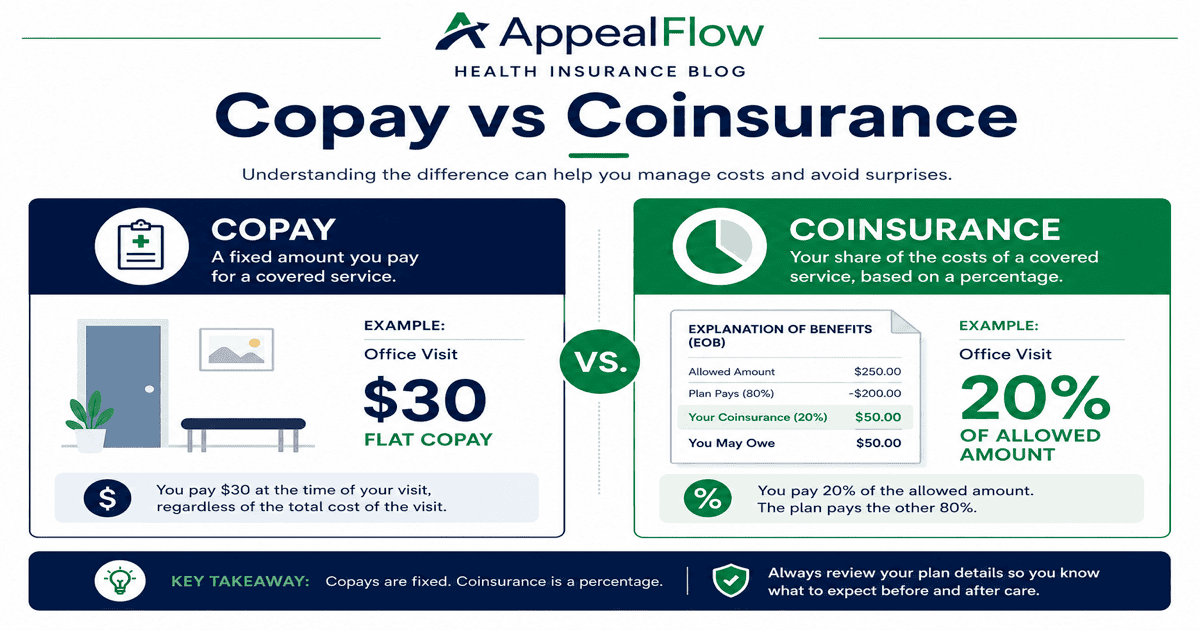
How Copays and Coinsurance Split the Same Claim
Key Takeaway: A copay answers “how many dollars at this visit type?” Coinsurance answers “what percentage of the allowed amount remains after the deductible?” One date of service can use both rules on different claim lines.
Healthcare.gov defines a copayment as a fixed amount you pay for a covered service. Its example uses a $100 allowable cost and a $20 copay: after the deductible is met you pay $20; if the deductible is not met you pay the $100 allowable amount. That is one plan design. Many Summary of Benefits documents instead collect an office-visit copay even before the deductible. Neither version is a federal default — the SBC controls.
Coinsurance is the percentage of the allowed amount you pay after the deductible, such as 20% of $100 = $20 in Healthcare.gov's office-visit example. For a fuller walkthrough of allowed amounts and the $100 example, see what coinsurance is.
Copay vs Coinsurance vs Deductible
Key Takeaway: Use this table when you read an SBC or EOB. If a column on the EOB does not match the SBC row for that service, ask the plan to reprocess before you pay the invoice.
| Rule | What you pay | When it usually applies | Tied to allowed amount? |
|---|---|---|---|
| Copay | Fixed dollars (for example $30 primary care) | Listed visit types, some drugs, sometimes before deductible | No — the dollar fee is set in the SBC |
| Coinsurance | Percentage of allowed amount (for example 20%) | After deductible on many hospital, imaging, and specialist claims | Yes |
| Deductible | Dollar threshold you meet first on specified services | Until the year-to-date accumulator reaches the SBC number | You pay allowed amounts (not chargemaster) until it is met |
The Uniform Glossary of Coverage and Medical Terms that accompanies the SBC uses the same definitions across Marketplace and many group plans. If your insurer's portal uses different labels (“member rate,” “patient share”), map them back to copay, coinsurance, and deductible on that glossary rather than guessing.
What If One Visit Has Both a Copay and Coinsurance?
Key Takeaway: The office-visit copay often covers only the professional evaluation line. Associated labs, imaging, or a facility fee can still hit deductible and coinsurance on separate claim lines.
A primary-care visit can post as $30 copay for the CPT office code and 20% coinsurance on a venipuncture or rapid test billed by the same clinic, or by an outside lab. Urgent care and hospital outpatient departments split professional and facility claims even more often. Paying the copay at checkout does not mean the account will be $0 after adjudication.
Wait for the EOB. If two invoices arrive (clinic and lab), match each to its claim number. For how to read billed, allowed, plan paid, and you owe, see how to read an Explanation of Benefits.
Does Preventive Care Have a Copay or Coinsurance?
Key Takeaway: Recommended in-network preventive services on the federal list are generally $0 copay and $0 coinsurance for most non-grandfathered plans, even before the deductible. That does not make every “screening” visit free.
Healthcare.gov lists preventive care benefits that Marketplace and many other non-grandfathered plans must cover when you use an in-network provider. Cost-sharing can still apply if the service is billed as diagnostic, is not on that list, includes extra procedures, or is out of network. Ask the office how it will code the visit before you assume $0.
EOB Applied the Wrong Cost-Sharing Rule?
AppealFlow drafts letters that cite the SBC row, claim number, and EOB mismatch so you can ask the plan to reprocess copay versus coinsurance errors.
How Do I Know Which Rule Applies Before I Pay?
Key Takeaway: Read the SBC first, then the processed EOB. Do not treat the amount collected at the desk as the final member share.
- Find the service category on the SBC (primary care, specialist, lab, outpatient facility)
- Note whether that row is a copay, coinsurance, deductible-then-coinsurance, or $0 preventive
- After the claim processes, match each invoice to the EOB you-owe line and remark codes
Checkout is not adjudication. A copay collected at the window can be an estimate. If a later invoice adds coinsurance on labs, compare it to the EOB before you pay the extra amount.
Weak vs. Strong Wording When Copay and Coinsurance Are Mixed Up
Key Takeaway: Quote the SBC service row and the EOB claim line. Asking the office to “take off the extra” without those two citations leaves the billing team guessing.
| Weak request | Strong request |
|---|---|
| “I already paid my copay. Why is there another bill?” | “I paid the $[copay] primary-care copay on [date]. EOB claim #[number] shows an additional coinsurance amount on CPT [code] (lab). Please confirm that line is coinsurance of the allowed amount per the SBC lab row, not a second copay, and adjust the invoice to the EOB you-owe total.” |
| “This was a checkup. It should have been free.” | “This visit was scheduled as in-network preventive care. Please confirm coding against the Healthcare.gov preventive list and the SBC $0 in-network preventive row. If any line was billed as diagnostic, identify the CPT and the medical-record support for that change.” |
| “The percentage on my bill does not match my card.” | “SBC lists [X]% coinsurance for [service category]. EOB claim #[number] applied [Y]% to billed charges of $[A] instead of allowed amount $[B]. Please reprocess using the allowed amount and the SBC percentage.” |
What Should I Do If the Invoice Does Not Match the EOB?
Key Takeaway: Dispute the difference in writing with both the provider and the plan. Paying the higher number first makes it harder to unwind an allowed-amount or copay/coinsurance error.
Send the EOB, the invoice, the SBC page, and a short request to reprocess or to write the account down to member responsibility. If the extra amount is billed charges minus allowed amount, treat it as a balance billing question, not as extra coinsurance.
Frequently Asked Questions
Common questions about copays, coinsurance, deductibles, preventive visits, and EOB mismatches.
Generate Your Free Appeal Letter
AppealFlow.net drafts formal letters when a claim applied the wrong copay or coinsurance rule. Edit live, download as PDF or Word. No account required.
- 100% Free
- No Signup
- PDF & Word Export
Disclaimer: This article is for educational purposes only and does not constitute medical, legal, or financial advice. AppealFlow.net is not a healthcare provider, insurance broker, or law firm. Copay and coinsurance designs vary by plan, verify current terms on your SBC, EOB, and Healthcare.gov before taking action. For medical emergencies, call 911. See our full disclaimer.