How to Write an Appeal Letter for Insurance
What Is an Insurance Appeal Letter?
Key Takeaway: An insurance appeal letter is a formal written request asking your health plan or pharmacy benefit manager to reverse a claim denial. It cites your member ID, the denial reason code, clinical evidence, and your legal appeal rights under federal law.
When patients ask how to write an appeal letter for insurance, they are usually staring at an Explanation of Benefits with a denial code they do not understand. The letter is your opportunity to tell a medical director — a physician employed by the insurer — why their automated denial was wrong. This is not a complaint email. It is a structured legal document that triggers a formal review process with mandated response timelines.
Every adverse benefit determination from a health plan gives you appeal rights when your notice includes that option. Your letter activates those rights. Without it, the denial stands and you may owe the full billed amount.
For the full format walkthrough, see how to write a health insurance appeal letter. If you have not yet started the appeals process, read how to file an appeal for deadline rules, portal instructions, and the full workflow from denial to decision.
What to Include in Your Insurance Appeal Letter
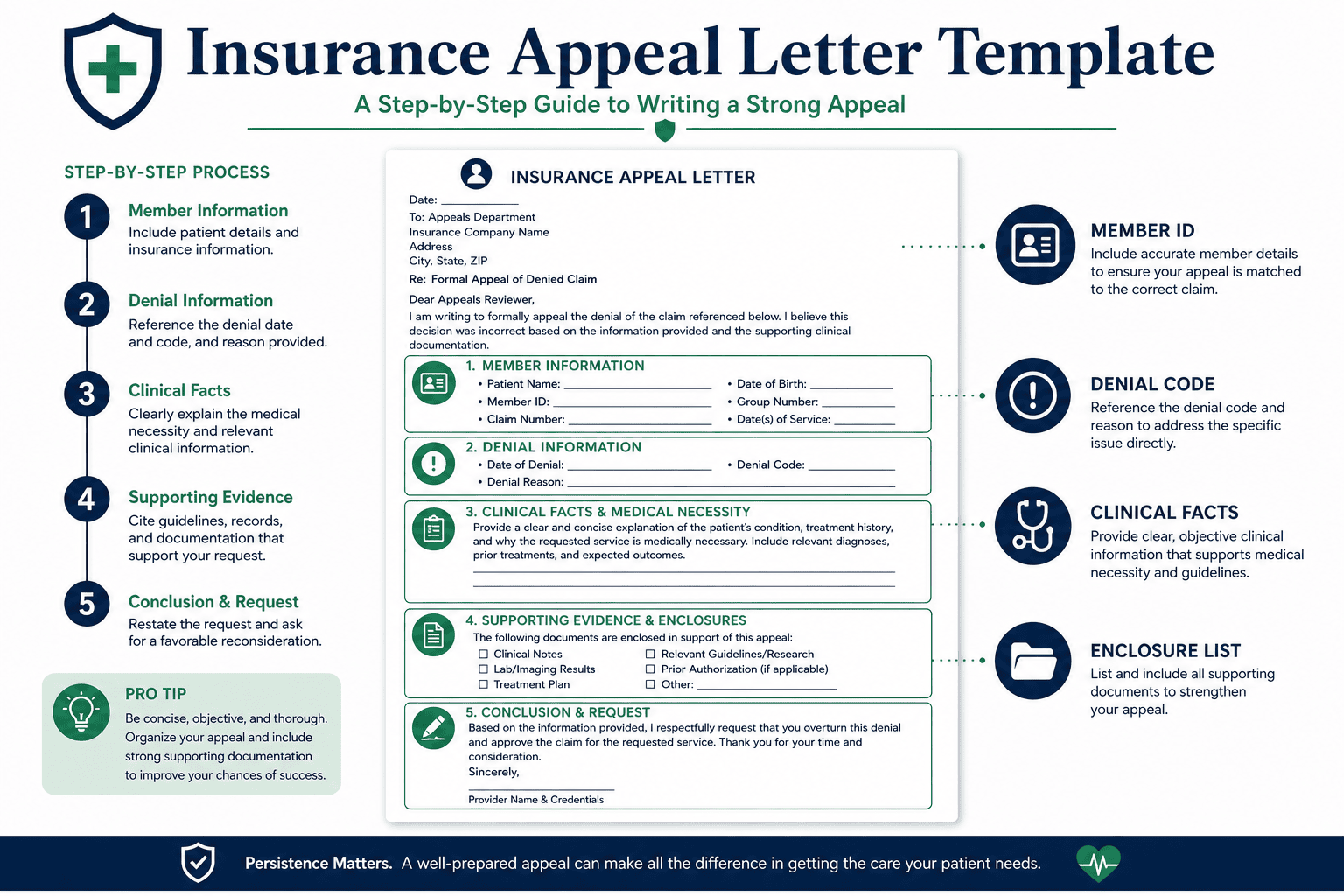
Key Takeaway: Every appeal letter needs six elements: patient identifiers, denial details, legal rights invocation, a clinical argument addressing the denial code, a list of attached documents, and your contact information. Missing any one element delays review or triggers an automatic denial.
Medical directors review dozens of appeals daily. A letter that follows a predictable structure gets processed faster than a rambling narrative. Use this checklist before you write:
- Header block: Your full name, address, phone, email, member ID, group number, and date
- Recipient: Appeals Department or Pharmacy Benefits Manager, address from your denial letter, not your doctor's office
- Subject line: “Formal Appeal, Claim #[number], Denial Date [date], Reason Code [code]”
- Opening paragraph: State you are filing a formal internal appeal under ERISA §503 (employer plans) or ACA §2719 (marketplace plans)
- Body paragraphs: Address each denial reason with clinical facts, ICD-10 codes, and guideline references
- Enclosure list: Numbered list of every attached document (Exhibit A, B, C)
- Closing: Request a written decision within the mandated timeframe and provide your preferred contact method
Keep the letter one to two pages. The physician's letter of medical necessity carries the clinical weight, your patient letter frames the case and invokes legal protections.
Step-by-Step: How to Write an Appeal Letter for Insurance
Key Takeaway: Gather your denial letter and EOB first, request your complete claim file, get a physician letter of medical necessity, draft your appeal addressing the specific denial code, and submit through the correct portal before your deadline.
- Pull your denial documents. You need the formal denial letter with the reason code, your EOB showing the denied line items, and the appeal deadline. If you only received a phone denial, call member services and request everything in writing before you start drafting.
- Identify the denial reason code. Common codes include CO-50 (not medically necessary), CO-197 (prior authorization required), and PA-STEP (step therapy not met). Your letter must directly address this code, not a generic argument about why you need care.
- Request your complete claim file. Under ERISA §503, employer plans must provide every document used in the denial decision. This includes internal clinical review notes and peer-to-peer call summaries that reveal what evidence the insurer considered, or missed.
- Get a letter of medical necessity from your physician. This is the single most important attachment. It must address the specific denial reason, cite diagnosis codes, document failed prior therapies, and explain clinical rationale.
- Draft your appeal letter. Open with identifiers and legal rights invocation. In the body, explain why the denial was incorrect using dated clinical facts. Close with your enclosure list and a request for written decision.
- Review and attach supporting records. Include only records referenced in your letter, visit notes, lab results, imaging reports, prescription history. Label each attachment and match it to your enclosure list.
- Submit through the correct channel. Medical claims: insurer portal or Availity. Pharmacy denials: Express Scripts, OptumRx, Caremark, or CoverMyMeds. Confirm receipt and save confirmation numbers.
- Follow up at 14 and 30 days. Insurers must respond within 30 days for standard appeals. Document every call with date, representative name, and reference number.
Weak vs. Strong Appeal Letter Language (Before & After)
Key Takeaway: Insurers approve appeals with specific clinical evidence, not emotional appeals. Replace vague statements with dated metrics, ICD-10 codes, denial reason codes, and guideline references.
| ❌ Weak Statement | ✅ Strong Statement |
|---|---|
| “I am writing because my insurance denied my MRI. My doctor says I need it.” | “I appeal denial code CO-50 for lumbar MRI (claim #CLM-44219). Attached: physician letter documenting 8 weeks of failed conservative treatment, ACR Appropriateness Criteria, and exam findings of L4-L5 radiculopathy (ICD-10 M54.16). Request overturn per plan policy Section 6.1.” |
| “Please approve my medication. I have tried other things and they did not work.” | “Prior auth denied, step therapy PA-STEP-03. Attached: 90-day metformin trial records (weight loss <3%), documented GI intolerance, BMI 33.8 (E66.01), and prescriber attestation that FDA criteria for requested GLP-1 therapy are met. Submitted via CoverMyMeds.” |
| “This denial is wrong. I am requesting you reconsider immediately.” | “Formal internal appeal under ERISA §503. Denial dated 8/1/2026, member ID ABC789012. Request complete claim file and written decision within 30 days. Enclosures: physician LMN, operative report, pathology results, NCCN guidelines. Appeal deadline: 1/28/2027.” |
Need an Appeal Letter Drafted?
AppealFlow's free generator creates regulation-informed appeal letters citing denial codes, ERISA rights, and clinical justification, ready to edit and download in under 60 seconds.
Appeal Letter Templates by Denial Type
Key Takeaway: Different denial reasons require different letter strategies. A medical necessity appeal cites clinical guidelines; a step therapy appeal documents failed prior treatments; an out-of-network appeal may invoke No Surprises Act protections for emergency care.
Medical Necessity Denials (CO-50)
Cite the clinical guideline your treatment meets, ACR criteria for imaging, NCCN guidelines for oncology, ADA standards for diabetes medications. Your physician's letter should reference the same guideline and explain how your clinical presentation satisfies each criterion.
Prior Authorization Denials (CO-197)
Document that prior auth was submitted (include confirmation number and date) or explain why retrospective authorization is appropriate. For urgent cases, request expedited review with a physician certification that delay poses serious health risk, 72-hour decision required.
Step Therapy Denials (PA-STEP)
List each required therapy with start date, end date, dose, outcome (weight lost, symptom change), and reason for discontinuation. Insurers want proof you completed the minimum duration, often 90 days, not just that you tried something briefly.
Pharmacy / Medication Denials
Route your appeal through the PBM portal, not your medical insurer. Reference the prior auth denial code, attach prescriber documentation with ICD-10 codes, and cite FDA approval criteria if applicable. CoverMyMeds is the most common electronic submission channel for pharmacy appeals.
Where to Submit Your Insurance Appeal Letter
Key Takeaway: Medical claims go through your insurer's member portal or Availity. Medication denials go through your pharmacy benefit manager, Express Scripts, OptumRx, or Caremark. Using the wrong channel delays or loses your appeal.
| Platform | Used By | Appeal Submission |
|---|---|---|
| Availity | Many Blue Cross Blue Shield plans | Member portal → Claims → Appeal a Decision |
| CoverMyMeds | Multiple PBMs; prescriber-initiated PA | Prescriber submits via key code; patient attaches appeal docs |
| Express Scripts | Cigna, some BCBS plans | Member portal → Pharmacy → Appeals |
| OptumRx | UnitedHealthcare, some employer plans | OptumRx.com → Prior Authorization → File Appeal |
| Caremark (CVS) | Aetna, CVS Health plans | Caremark.com → Coverage & Claims → Appeal a Decision |
Always confirm receipt. Portal submissions generate confirmation numbers. Fax submissions need transmission reports. Certified mail provides delivery proof for deadline-sensitive appeals. Never assume your doctor's office submitted on your behalf without verifying yourself.
Common Mistakes When Writing Insurance Appeal Letters
Key Takeaway: The top reasons appeal letters fail: missing the deadline, not addressing the specific denial code, submitting through the wrong portal, and attaching a generic physician letter instead of one tailored to the denial reason.
- Writing before you have the denial letter. You need the reason code and appeal instructions. Phone denials are not enough to build a targeted letter.
- Using emotional language instead of clinical facts. Medical directors are physicians. They respond to ICD-10 codes, guideline citations, and dated metrics, not frustration.
- Forgetting to invoke appeal rights. Explicitly reference ERISA §503 or ACA §2719. This triggers formal review timelines and legal protections that a generic request letter does not.
- Submitting to the wrong department. Pharmacy appeals sent to your medical insurer's general address get lost. Check your denial letter for the correct submission channel.
- Not following up. Appeals can sit in queues for weeks. A documented follow-up call at day 14 often accelerates review.
Deadline warning: ERISA plans allow 180 days; ACA marketplace plans allow 60 days. Calendar your deadline the day you receive the denial. Missing it forfeits your appeal rights with virtually no exceptions.
What Timelines Should You Expect After You File?
Key Takeaway: Standard internal appeals often receive a written decision within 30 days of complete submission. Expedited reviews may apply when delay poses serious health risk. The exact clock is on your denial notice.
A well-written letter does not guarantee approval. Insurers overturn denials when the clinical record clearly meets their criteria. Your letter frames that record, invokes your appeal rights, and helps route the packet to a physician reviewer.
If your internal appeal is denied, request external review when your plan notice lists that option. Under ACA Section 2719, external review is available at no cost for many marketplace plan members after internal denial.
Frequently Asked Questions
Answers to the most common questions about how to write an appeal letter for insurance.
Generate Your Free Insurance Appeal Letter
AppealFlow.net drafts a formal, legally grounded appeal letter citing ERISA rights, denial reason codes, and your specific clinical situation, edit it live, then download as PDF or Word. No account required.
- 100% Free
- No Signup
- PDF & Word Export
Disclaimer: This article is for educational purposes only and does not constitute medical or legal advice. AppealFlow.net is not a healthcare provider or law firm. Success rates cited are estimates based on industry advocacy data and vary by plan. Always review appeal letters with your prescriber before submission. For medical emergencies, call 911. See our full disclaimer.