How to Beat LEAT and Alternate-Benefit Insurance Denials
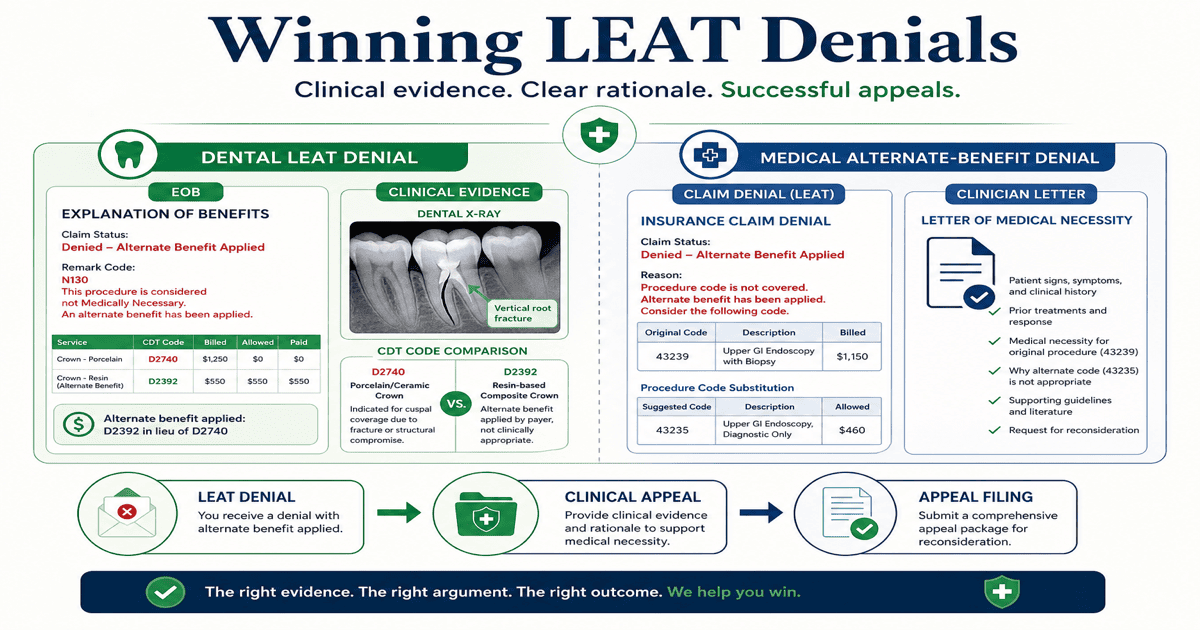
What Is LEAT and How Does It Work on Your Claim?
Key Takeaway: LEAT is a plan design feature, not a billing mistake. The insurer substitutes a cheaper covered treatment when it believes that option is clinically adequate for your condition unless you prove otherwise with clinician documentation.
LEAT appears most often on dental claims, where carriers may pay a large filling allowance when your dentist billed a crown, or an extraction allowance when you received a root canal. The adjustment usually shows on your Explanation of Benefits as “alternate benefit applied,” “least expensive alternative treatment,” or similar wording with substituted CDT codes.
Medical plans can use parallel alternate-benefit language when a reviewer believes a lower-level procedure, generic device tier, or conservative therapy meets plan criteria before approving surgery or advanced imaging. The label on your notice matters because your appeal must respond to the specific remark and plan policy section cited, not a generic request for more coverage.
How Does LEAT Show Up on Dental vs Medical Claims?
Key Takeaway: Dental LEAT disputes center on radiographs and CDT code substitutions. Medical alternate-benefit disputes center on plan medical policies, conservative-treatment documentation, and letters of medical necessity.
| Claim type | Typical LEAT pattern | Core evidence |
|---|---|---|
| Dental restorative | Crown downcoded to large filling; root canal to extraction | Pre-operative radiographs, dentist narrative, CDT comparison |
| Dental periodontal | Surgery downcoded to scaling and root planing | Pocket depth charting, bone loss on radiographs |
| Medical surgical | Advanced procedure denied when plan favors conservative path | Failed therapy records, clinician letter, plan policy excerpts |
| Medical imaging or therapy | Higher-level service adjusted to lower-level alternate | Symptom progression notes, specialty guideline citations |
For crown-specific LEAT strategy, see our denied dental crown clinical appeal guide. For medical necessity framing on health claims, see how to fight a not medically necessary denial.
What Should You Do First After a LEAT Adjustment?
Key Takeaway: Read the denial letter and your plan Evidence of Coverage before you pay the balance or draft a long appeal against a hard exclusion. The remark code tells you whether LEAT language applies and which records to request from your clinician.
Healthcare.gov's internal-appeals page explains that you can appeal when a plan denies or reduces a claim. Start by confirming the appeal deadline on your notice, requesting the plan policy section cited if it is not attached, and building a numbered attachment list. For the general workflow, see what to do when an insurance claim is denied.
What Are Common LEAT Denial Scenarios?
Key Takeaway: LEAT denials follow predictable patterns. Matching your scenario to the substituted code determines which clinical records your dentist or physician must supply in the appeal packet.
| Recommended treatment | LEAT alternate | Evidence to rebut |
|---|---|---|
| Crown (D2740) | Large filling (D2392) | Radiographs showing insufficient remaining structure for filling retention |
| Root canal (D3330) | Extraction (D7140) | Narrative that the tooth is restorable and extraction is not clinically indicated |
| Periodontal surgery (D4260) | Scaling and root planing (D4341) | Pocket depths, bleeding indices, bone loss on radiographs |
| Medical procedure upgrade | Lower-level or conservative alternate per plan policy | Documented failed conservative care and letter of medical necessity |
How Do You Appeal a LEAT Denial Step by Step?
Key Takeaway: LEAT appeals need clinician evidence tied to the substituted code on your Explanation of Benefits. Patient preference alone rarely overturns an alternate-benefit adjustment.
- Review your Explanation of Benefits. Find the LEAT or alternate-benefit remark. Note the procedure code your clinician submitted versus the code the plan substituted.
- Confirm your appeal deadline. The filing window is on your denial notice. For general deadline patterns across plan types, see how long you have to appeal a health insurance denial. Your notice still controls.
- Request clinical records from your clinician. Dental LEAT appeals need dated pre-operative radiographs and a signed narrative. Medical appeals need visit notes and a letter of medical necessity addressing the plan policy cited on the denial.
- Write your formal appeal letter. Reference member ID, claim number, codes billed versus substituted, and a numbered attachment index. Use the medical necessity appeal generator for a starting draft, then edit every line for your facts.
- Submit through the channel on your notice. Use the member portal, fax, or mailing address listed on the denial letter. Keep portal screenshots or fax confirmation.
- Track the review and follow up. Note call dates, representative names, and reference numbers. Ask member services for the expected decision timeframe in your plan documents.
What Belongs in Your LEAT Appeal Packet?
Key Takeaway: Reviewers evaluate LEAT appeals against dated clinical records and code comparisons, not preference statements. Missing pre-operative radiographs on dental claims is the most common fixable gap on first submission.
- Denial letter or Explanation of Benefits with LEAT remark and claim number
- Signed clinician narrative on letterhead with NPI
- Procedure code table showing billed code versus substituted alternate
- Pre-operative radiographs for dental restorative LEAT disputes
- Periodontal charting when gum disease affects tooth prognosis
- Failed conservative treatment records for medical alternate-benefit appeals
- Patient appeal letter referencing member ID and requested overturn
Weak vs. Strong LEAT Appeal Language
Key Takeaway: Replace subjective complaints with radiographic findings, remaining structure estimates, and procedure code references tied to the alternate benefit on your Explanation of Benefits.
| Weak statement | Strong statement |
|---|---|
| “My dentist said I need a crown, not a filling. Please pay for the crown.” | “Tooth #14 (D2740 submitted): periapical radiograph shows mesial-distal fracture line extending subgingivally. Remaining tooth structure is insufficient for direct restoration retention. Large composite (D2392) would predictably fail given cusp involvement documented on films dated [date].” |
| “The cheaper treatment will not work for me.” | “Periodontal charting attached: teeth #3 and #14 show pocket depths of 6 to 7 mm with bone loss on radiograph. Scaling and root planing alone is insufficient per attached clinician narrative. Osseous surgery (D4260) is required to arrest disease progression.” |
| “I disagree with the LEAT denial. Please reconsider.” | “I appeal the alternate-benefit adjustment on claim #[number]. Attached: clinician narrative, pre-operative radiographs, code comparison (submitted D2740 vs alternate D2392), and Explanation of Benefits showing the LEAT remark. Request full benefit at the submitted procedure rate.” |
Draft your LEAT appeal letter
The free medical necessity appeal generator produces alternate-benefit rebuttal language, procedure code references, and an attachment checklist you can edit before submission.
How Is LEAT Different from Downcoding?
Key Takeaway: LEAT substitutes a cheaper treatment the plan deems adequate. Downcoding changes your submitted procedure code on the claim. Both reduce payment, and both can be appealed with clinical evidence tied to the remark on your notice.
Patients often confuse LEAT with downcoding because the financial result is similar. LEAT appeals must prove the alternate treatment fails clinically for your tooth or condition. Downcoding appeals argue the submitted code accurately reflects the service performed. Many dental packets address both when the Explanation of Benefits shows a substituted CDT code and an alternate-benefit remark.
For endodontic LEAT disputes, see our guide on appealing a denied root canal, which uses the same alternate-benefit rebuttal framework.
What Deadlines Apply to LEAT Appeals?
Key Takeaway: The controlling clock is on your denial notice, not a blog estimate. ERISA, ACA marketplace, Medicare, and standalone dental plans each use different internal appeal windows.
| Plan type | Typical internal appeal pattern | Where to verify |
|---|---|---|
| ERISA employer health or dental | Often up to 180 days from notice for internal appeal | Denial letter, Summary Plan Description, DOL EBSA materials |
| ACA marketplace / individual | Deadline printed on notice; external review after internal denial | Healthcare.gov internal and external review pages |
| Standalone dental carrier | Often 60 to 180 days per carrier handbook | Dental member handbook and denial letter |
Honest assessment: If the cheaper treatment could reasonably work and your clinician recommended the upgrade for durability alone, LEAT appeals are harder to sustain. Plans are generally not required to pay for the most durable option, only the least expensive clinically adequate one under your contract language.
Frequently Asked Questions
LEAT meaning, dental vs medical alternate benefits, required records, and how patient appeals differ from clinician letters.
Generate Your LEAT Appeal Letter
AppealFlow.net drafts alternate-benefit and medical-necessity rebuttal language from your denial facts. Pair it with your clinician narrative and radiographs for a complete packet.
- 100% Free
- No Signup
- PDF & Word Export
Disclaimer: This article is for educational purposes only and does not constitute medical or legal advice. AppealFlow.net is not a healthcare provider or law firm. Always review appeal letters with your clinician before submission. For dental emergencies, contact your dentist or call 911. See our full disclaimer.