What Is a Medical Insurance Policy Number?
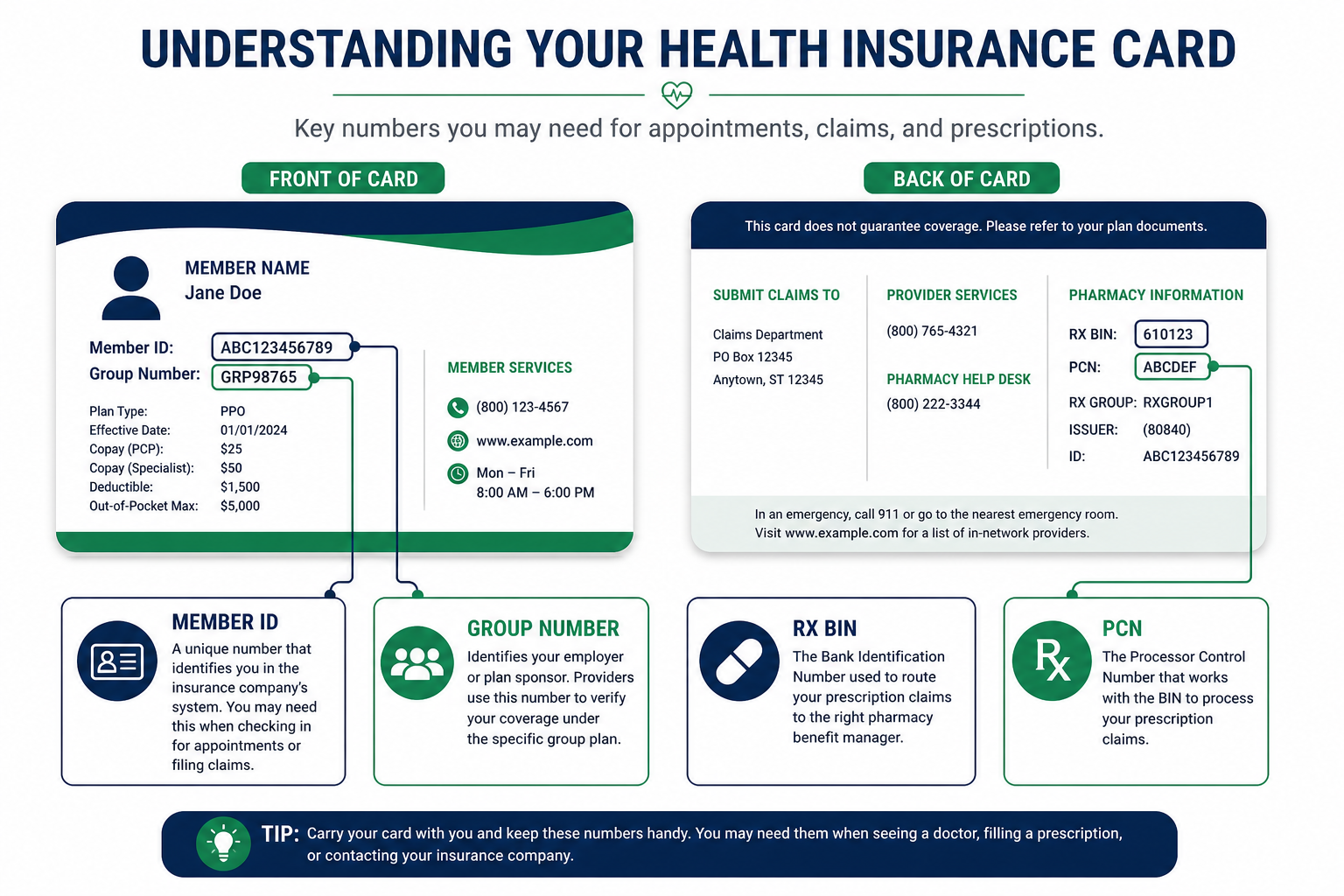
What Is a Medical Insurance Policy Number, Exactly?
Key Takeaway: The policy number identifies the insurance contract, the legal agreement between your employer, insurer, or marketplace and the plan administrator. Your member ID identifies you as a person covered under that contract. Both numbers are required on every claim, prior authorization, and appeal.
When patients ask what a medical insurance policy number is, they are usually staring at an insurance card full of codes and wondering which one matters. The policy number is the plan-level identifier. It tells the claims system which benefit design, deductible structure, network rules, and formulary apply to the service being billed.
Think of it this way: your member ID is your name on the roster. Your policy number is the name of the team you play for. A hospital billing department needs both to route your claim to the right adjudication engine and apply the correct coverage rules.
On employer-sponsored plans, one policy number may cover thousands of employees under a single group contract. On ACA marketplace plans, each enrollee may have a unique plan ID tied to a specific metal tier and carrier product. Medicare Advantage plans use a contract number in the format H####-###-###. Original Medicare uses your Medicare Beneficiary Identifier (MBI) rather than a traditional policy number, but supplemental Medigap policies have their own policy numbers printed on separate cards.
For a step-by-step guide on locating this number on your card, EOB, and insurer portal, see our companion article on where to find your health insurance policy number.
How Is a Policy Number Different From a Member ID?
Key Takeaway: Your member ID identifies you individually. Your policy number identifies the insurance contract itself. Submitting only one of these on a claim or appeal is one of the most common administrative errors that causes processing delays before medical review even begins.
| Identifier | What It Identifies | Typical Label on ID Card | Shared Across Family? |
|---|---|---|---|
| Member ID | You as an individual enrollee or family subscriber | Member ID, Subscriber ID, Enrollee ID | No, each person has a unique member ID |
| Policy number | The insurance contract or plan under which you are covered | Policy #, Plan #, Contract # | Yes, all family members on the same plan share it |
| Group number | Your employer's or organization's group contract | Group #, GRP, Employer ID | Yes, shared by all employees on the same employer plan |
On many employer-sponsored plans, the group number and policy number are the same value or closely related. On individual marketplace plans, you may see a HIOS plan ID instead of a traditional group number. When in doubt, include every identifier printed on your insurance card, insurers prefer too much information over too little.
What Does a Medical Insurance Policy Number Look Like?
Key Takeaway: Policy number formats vary by insurer and plan type. There is no universal standard, but most are alphanumeric strings between 6 and 15 characters. The label on your card matters more than the format itself.
After reviewing thousands of insurance cards across major carriers, these are the most common formats I see:
- Blue Cross Blue Shield: Often a three-letter prefix followed by digits (e.g., ABC123456789). The prefix identifies the local BCBS plan.
- UnitedHealthcare: Group number appears below the member ID, typically 6–9 digits (e.g., 123456).
- Aetna: Policy or group number labeled “GRP”, often 6 digits shared across all employees at a company.
- Cigna: Group number on the front of the card, sometimes labeled “Account Number.”
- ACA marketplace plans: HIOS plan ID, a 10- or 14-character identifier assigned by Healthcare.gov (e.g., 12345CA0010001).
- Medicare Advantage: Contract number in format H####-###-### (e.g., H1234-001-000).
- Medicaid: State-specific format, often a case number or recipient ID separate from your member ID.
If your card shows multiple numbers and you are unsure which is the policy number, call member services and ask: “What is my policy or group number for filing claims?” The representative can confirm which field on your card corresponds to the contract identifier.
Where Does Your Policy Number Appear on Documents?
Key Takeaway: Your policy number appears in at least five places: your physical or digital insurance card, every Explanation of Benefits, your insurer's member portal, your Summary Plan Description, and enrollment confirmation documents. Check all sources if your card is missing or outdated.
- Insurance ID card (physical or digital). Look for fields labeled Policy, Plan, Group, or Contract. This is the fastest source when you are at a provider's office or pharmacy.
- Explanation of Benefits (EOB). Every EOB header lists your member ID and plan or group number. This is the most reliable source after open enrollment, when your card may still show last year's numbers.
- Insurer member portal. Log in to your carrier's website or a clearinghouse like Availity. The policy number appears on your dashboard, downloadable ID card, or profile page.
- Summary Plan Description (SPD). For employer plans, HR provides this document. The policy or plan number is on the cover page or benefits summary section.
- Enrollment confirmation. ACA marketplace enrollees receive a plan ID on their Healthcare.gov confirmation and insurer welcome packet. Medicare enrollees find contract numbers on Medicare.gov and their plan welcome letter.
What Is a Medical Insurance Policy Number Used For?
Key Takeaway: Your policy number routes every insurance transaction, medical claims, pharmacy claims, prior authorizations, eligibility checks, and formal appeals, to the correct benefit contract. Without it, systems cannot match your service to the right coverage rules.
Here is where your policy number is required in everyday healthcare interactions:
- Medical claim submission. Providers enter your policy or group number on CMS-1500 (professional) or UB-04 (institutional) claim forms alongside your member ID.
- Prior authorization requests. Insurers use the policy number to pull up the correct medical policy, step-therapy requirements, and formulary tier for the requested service or medication.
- Pharmacy benefit claims. PBMs like Express Scripts use your group or policy number with your RX BIN and PCN to route pharmacy claims to the correct formulary.
- Eligibility verification. When a provider calls to verify your coverage before a procedure, they provide your member ID and policy number to confirm active enrollment and benefit levels.
- Insurance appeals. Every formal appeal letter, portal submission, and fax packet should include your policy number so the insurer can match your appeal to the original claim record.
- Coordination of benefits. When you have secondary insurance, both carriers need each other's policy numbers to determine primary vs. secondary payment responsibility.
A missing or incorrect policy number does not always produce an immediate denial. Sometimes the claim processes under the wrong plan year or benefit tier, producing an unexpected patient responsibility that only surfaces weeks later on your EOB. That is why verifying identifiers before submission matters as much as fixing them after a denial.
Wrong vs. Correct Policy Number Usage on Claims and Appeals
Key Takeaway: Insurer intake teams route appeals by matching identifiers to claim records. Vague headers or swapped member ID and policy number fields cause administrative rejections that waste your appeal deadline window.
| ❌ Wrong Usage | ✅ Correct Usage |
|---|---|
| “I am appealing a denied MRI. My member ID is W123456789. Please review my case.” | “Re: Internal Appeal, Member ID W123456789, Policy/Group GRP-88420, Claim #CLM-2026-44102, DOS 03/22/2026, Provider: Dr. Robert Chen (NPI 1234567890). Patient: Jane Smith, DOB 08/14/1985.” |
| Entering your member ID in the policy number field on an online appeal form because both fields look similar. | Copying the policy number exactly as it appears on your current EOB header, labeled Policy, Group, or Plan, and verifying it matches your active insurance card before submitting. |
| “I submitted my appeal through the portal last month but have not received a response.” | “Follow-up on appeal submitted 04/10/2026 via Availity, confirmation #AV-998877. Member ID W123456789, Policy GRP-88420, Claim CLM-2026-44102. Request written status update per ERISA §503 30-day decision requirement.” |
The pattern is consistent: wrong submissions omit the policy number or confuse it with your member ID. Correct submissions include both identifiers plus the claim number, date of service, and provider NPI so the insurer can locate your record in one lookup.
Need an Appeal Letter With the Right Identifiers?
AppealFlow's free generator prompts for member ID, policy number, claim number, and denial details , then drafts a formal appeal letter ready for submission in under 60 seconds.
Entering Your Policy Number on Availity, Express Scripts, and Medicare.gov
Key Takeaway: Online portals require your policy or group number alongside your member ID to pull up the correct claim. Auto-populated fields from an old plan year are a common source of misfiled appeals, verify your profile after every open enrollment.
| Platform | Used By | Where to Enter Policy Number |
|---|---|---|
| Availity | BCBS, Aetna, Humana, many regional plans | Member login → Claims → search by member ID + payer; policy number auto-fills on claim lookup or enter manually on appeal forms |
| Express Scripts | Cigna, some BCBS pharmacy benefits | Member portal → Coverage & Claims → Group # field on prior auth and appeal forms |
| Medicare.gov | Original Medicare and Medicare Advantage enrollees | My Medicare → Claims → view plan contract number; Medicare Advantage appeals use the H####-###-### contract ID from your plan welcome letter |
On Availity, your policy number often auto-populates when you search for a claim by member ID and date of service. On Express Scripts, you must enter the group number manually on pharmacy prior authorization and appeal forms, it does not always carry over from your medical plan profile. On Medicare.gov, Original Medicare enrollees use their MBI rather than a traditional policy number, but Medicare Advantage and Medigap supplemental plans each have separate contract or policy numbers you need for appeals.
After open enrollment or a job change, log into each portal and confirm your profile reflects the current plan year and policy number before filing any appeal. Portals often retain prior-year data until you update your profile or re-enroll through your employer's benefits system.
What Happens When the Wrong Policy Number Is on Your Claim?
Key Takeaway: A mismatched policy number on your EOB means the claim processed under the wrong plan or plan year. Fix the identifier before appealing the medical denial, otherwise your appeal attaches to the wrong record and gets returned as incomplete.
If your EOB shows a policy number you do not recognize, take these steps before filing an appeal:
- Compare the EOB policy number to your current insurance card. If they differ, the claim may have been submitted with outdated information from your provider's billing records.
- Call member services. Ask the representative to confirm which policy number is active for your account and whether the claim was processed under the correct plan year.
- Request claim reprocessing. If the wrong policy number caused the denial, ask for correction and reprocessing before you invest time in a formal appeal.
- Update your provider's records. Give your doctor's office your current member ID and policy number so future claims route correctly.
- File your appeal with the correct identifiers. Once the claim is reprocessed under the right policy, appeal any remaining medical denial with the updated claim number.
Common myth: Appealing a medical denial will automatically fix an administrative error like a wrong policy number. It will not. Administrative errors require a separate correction request, often resolved faster than a full medical appeal.
Five Policy Number Mistakes That Delay Claims and Appeals
Key Takeaway: Identifier errors are preventable. Double-check every number against your current insurance card and most recent EOB before submitting any claim-related paperwork.
- Using an expired insurance card after open enrollment. Policy numbers change with new plan years. Always check your most recent EOB or portal profile.
- Confusing member ID with policy number. Both are required. Submitting only one causes routing failures that look like coverage denials.
- Letting your provider's office use outdated demographics. Verify your identifiers are current in your provider's billing system at every visit.
- Not including identifiers on faxed appeal packets. Cover sheets get separated from attachments. Repeat member ID, policy number, and claim number on every page header.
- Appealing before fixing an identifier mismatch. Correct administrative errors first, then appeal any remaining medical denial on the corrected claim.
In my experience reviewing appeal submissions, roughly 15–20% of first-time appeals are returned for incomplete identifiers before a medical reviewer ever opens the file. That administrative delay can eat into your 30-day ERISA response window or 60-day ACA appeal deadline. Taking five minutes to verify your policy number against your EOB prevents weeks of back-and-forth.
Frequently Asked Questions
Answers to the most common questions about what a medical insurance policy number is and how to use it on claims and appeals.
Generate Your Free Appeal Letter
AppealFlow.net drafts a formal appeal letter with fields for member ID, policy number, claim number, and denial details, edit it live, then download as PDF or Word. No account required.
- 100% Free
- No Signup
- PDF & Word Export
Disclaimer: This article is for educational purposes only and does not constitute medical or legal advice. AppealFlow.net is not a healthcare provider or law firm. Identifier formats vary by insurer and plan type. Always verify your policy number with member services before submitting appeals. For medical emergencies, call 911. See our full disclaimer.