Health Insurance Policy Number: Where to Find It for Claims and Appeals
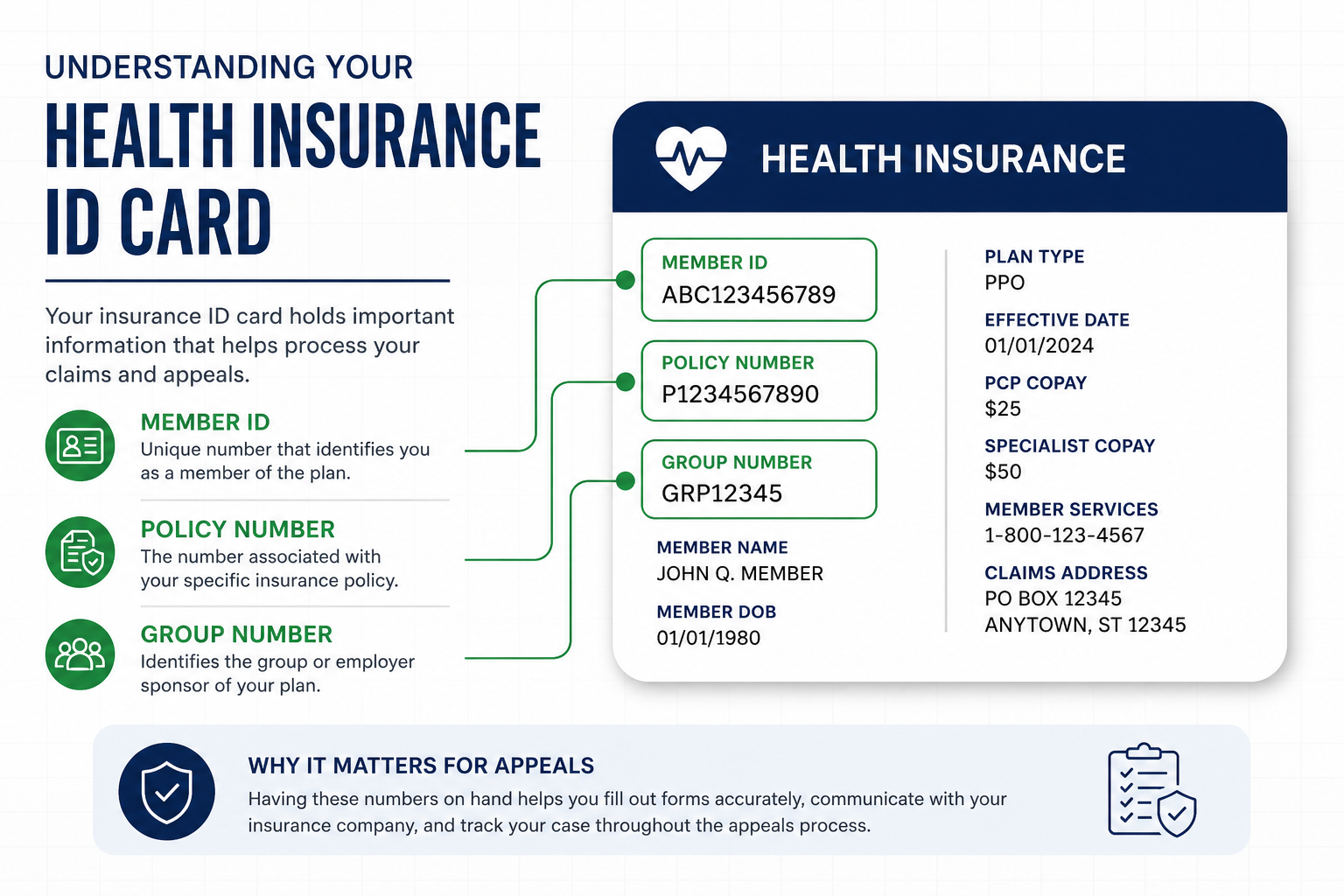
What Is a Health Insurance Policy Number?
Key Takeaway: The policy number links your claim to the correct benefit design, employer group, and plan year. Without it, payers cannot match your service to the right coverage rules, which leads to processing errors that look like denials.
Most patients know their member ID but struggle to locate the policy or group number. That gap causes real problems: claims attached to the wrong plan year, appeals returned as incomplete, and prior authorizations filed under expired contracts. Your policy number tells the insurer which employer or individual contract governs your benefits, which plan year applies, and which medical policies and formularies the claims team should use.
Your member ID is your individual identifier. Your policy number is the contract identifier. Both are required for correct routing. For a shorter definition focused on card labels, see what a medical insurance policy number is.
How Is a Policy Number Different From a Member ID or Group Number?
Key Takeaway: These identifiers serve different purposes. Confusing them on paperwork is a top reason claims and appeals get rejected on administrative grounds before a medical reviewer sees your case.
| Identifier | What it identifies | Typical label on ID card |
|---|---|---|
| Member ID | You as an individual enrollee or family subscriber | Member ID, Subscriber ID, Enrollee ID |
| Policy number | The insurance contract or plan under which you are covered | Policy #, Plan #, Contract # |
| Group number | Your employer's or organization's group contract | Group #, GRP, Employer ID |
On many employer-sponsored plans, the group number and policy number are the same value or closely related. ACA marketplace plans may show a plan ID or HIOS ID. Medicare Advantage plans use a contract number in H####-###-### format. When labels differ, include every identifier shown on your card.
Where Can I Find My Health Insurance Policy Number?
Key Takeaway: Your policy number appears on your insurance card, your Explanation of Benefits, your member portal, and often your Summary Plan Description. Check all four if your card is missing or outdated after open enrollment.
- Insurance card. Look for Policy, Plan, Group, or Contract. Carrier layouts differ, but the number is usually near your member ID.
- Explanation of Benefits. Every EOB header lists your member ID and plan or group number. This is the most reliable source when your card is outdated. See how to read an EOB for where identifiers sit on the form.
- Member portal. Log in to your insurer's site. The policy number appears on your dashboard, downloadable ID card, or profile page.
- Summary Plan Description. For employer plans, HR provides this document. The policy or plan number is on the cover page or benefits summary.
- Enrollment confirmation. ACA marketplace enrollees receive a plan ID on their Healthcare.gov enrollment materials.
- Member services. Call the number on your card. Representatives can confirm your policy number using your member ID, date of birth, and verifying information on file.
How Do I Use My Policy Number on Claims and Appeals?
Key Takeaway: Every claim form, prior authorization request, and appeal letter should include your member ID, policy or group number, claim number, date of service, and provider NPI. Missing any one field can delay processing.
When filing a formal appeal, include these identifiers in the header of your letter:
- Member or subscriber ID
- Policy or group number
- Claim number from your EOB or denial letter
- Date of service for the denied care
- Provider name and NPI
- Patient name and date of birth, especially on family plans
Providers enter these fields on CMS-1500 or UB-04 claim forms. When you file a patient-initiated appeal, mirror the same identifiers so the payer can match your letter to the correct claim record. For letter structure, see how to write an insurance appeal letter and how to file an appeal.
Weak vs. Strong Identifier Usage in Appeal Letters
Key Takeaway: Insurer intake teams route appeals by matching identifiers to claim records. Vague header information causes administrative rejections that waste your appeal deadline window.
| Weak statement | Strong statement |
|---|---|
| “I am appealing a denied claim. My name is Jane Smith and I have Aetna.” | “Re: Internal Appeal. Member ID W123456789, Policy/Group GRP-88420, Claim #CLM-2026-44102, DOS 03/22/2026, Provider: Dr. Robert Chen (NPI 1234567890). Patient: Jane Smith, DOB 08/14/1985.” |
| “My member ID is on the attached card. Please find my claim.” | “Level 1 internal appeal for claim CLM-2026-44102 denied 04/05/2026 under remark code CO-50. Identifiers match my current plan year: Member ID W123456789, Group GRP-88420, Plan Year 01/01/2026–12/31/2026.” |
| “I filed this appeal online but haven't heard back.” | “Follow-up on appeal submitted 04/10/2026 via portal, confirmation #AV-998877. Member ID W123456789, Policy GRP-88420, Claim CLM-2026-44102. Request written status and the decision deadline printed on my denial notice.” |
Need an Appeal Letter With the Right Identifiers?
AppealFlow prompts for member ID, policy number, claim number, and denial details, then drafts a formal appeal letter you can edit before download.
What If the Policy Number on My Denial Letter Is Wrong?
Key Takeaway: A mismatched policy number on your EOB means the claim may have processed under the wrong plan or plan year. Fix the identifier before appealing the medical denial.
If your EOB shows a policy number you do not recognize, take these steps before filing an appeal:
- Compare the EOB to your current insurance card. If they differ, the provider may have submitted outdated demographics.
- Call member services. Confirm which policy number is active and whether the claim processed under the correct plan year.
- Request claim reprocessing. If the wrong policy number caused the denial, ask for correction before you invest time in a formal appeal.
- Update your provider's records. Give your doctor's office your current member ID and policy number so future claims route correctly.
- Appeal any remaining medical denial on the corrected claim. Use the updated claim number and identifiers from the reprocessed EOB.
Administrative errors are separate from medical appeals. A medical appeal will not automatically fix a wrong policy number. Identifier mismatches usually require a correction request or corrected claim, which is often resolved faster than a full medical review.
How Do I Enter Identifiers on Insurer Portals?
Key Takeaway: Online appeal portals require your policy or group number alongside your member ID to pull up the correct claim. Auto-populated fields from an old plan year are a common source of misfiled appeals.
After open enrollment, verify that your portal profile reflects your new plan year and policy number before filing any appeal. Portals often retain prior-year data until you update your profile or re-enroll through your employer's benefits system. Many employer plans and regional carriers route appeals through clearinghouse portals; your denial letter or member portal should list the correct submission path.
Under the Affordable Care Act, most non-grandfathered plans must provide an internal appeals process and access to an external review. Deadlines and submission methods are printed on your denial notice, not assumed from another plan type. Healthcare.gov describes appeal rights for marketplace coverage. Many ERISA employer group plans follow different notice rules; read the clock on your specific denial letter. DOL EBSA publishes ERISA claims and appeals guidance for employer-sponsored coverage.
Document Checklist Before You Submit an Appeal
Key Takeaway: Gather identifiers and supporting documents before you write. Incomplete packets are returned without stopping the appeal clock on many plans.
- Current insurance card showing member ID and policy or group number
- EOB and denial letter with claim number, date of service, and remark or reason codes
- Appeal deadline from the denial notice (plan-specific; do not assume a single national rule)
- Clinical records or prior authorization history if the denial is medical, not administrative
- Portal confirmation number or certified-mail receipt after submission
Frequently Asked Questions
Common questions about health insurance policy numbers when filing claims and appeals.
Generate Your Free Appeal Letter
AppealFlow drafts a formal appeal letter with fields for member ID, policy number, claim number, and denial details. Edit it live, then download as PDF or Word. No account required.
- Free
- No signup
- PDF and Word export
Disclaimer: This article is for educational purposes only and does not constitute medical or legal advice. AppealFlow is not a healthcare provider or law firm. Identifier formats vary by insurer and plan type. Always verify your policy number with member services before submitting appeals. For medical emergencies, call 911. See our full disclaimer.