What Is an Allowed Amount?
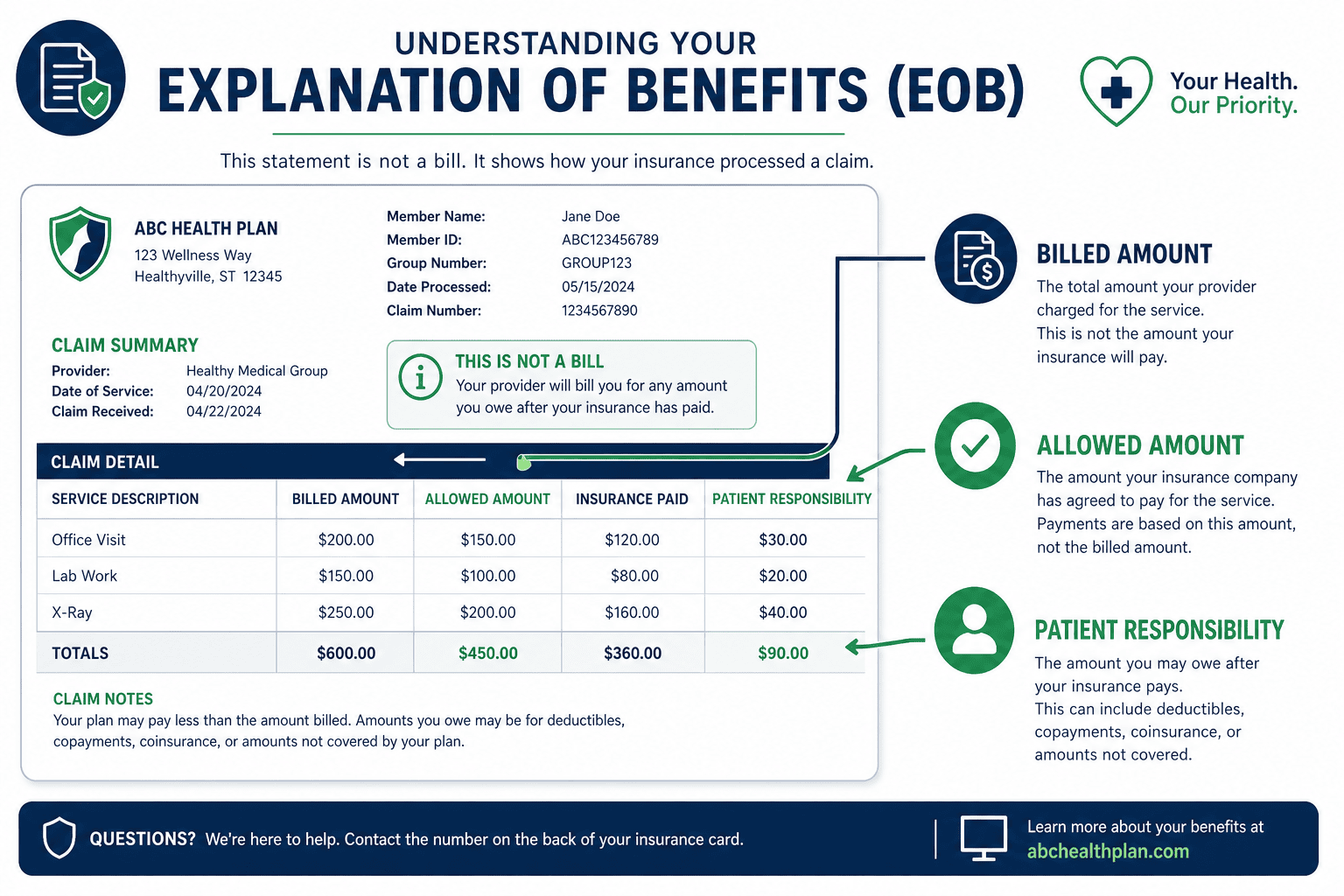
How the Allowed Amount Differs From Billed Charges
Key Takeaway: The billed or chargemaster figure is the provider's list price. The allowed amount is the plan's maximum for that covered service. Healthcare.gov also labels it eligible expense, payment allowance, or negotiated rate. Your EOB should show both.
Healthcare.gov defines the allowed amount as the maximum amount a plan will pay for a covered health care service. The same glossary says it may also be called eligible expense, payment allowance, or negotiated rate.
A hospital statement often opens with a large “charges” column. That number is not automatically what you owe and it is not automatically what the plan paid. The contractual write-off — the gap between billed charges and the allowed amount — is usually an adjustment between the plan and an in-network provider, not a second patient balance. Paying the billed column when an allowed amount exists is a processing or billing error to put in writing.
How Is Coinsurance Calculated on the Allowed Amount?
Key Takeaway: After the deductible, coinsurance is a percentage of the plan's allowed amount, not a percentage of the chargemaster. Healthcare.gov's $100 office-visit example is the cleanest arithmetic: 20% of $100 is $20 once the deductible is met.
Healthcare.gov's coinsurance glossary uses an allowed amount of $100 and 20% coinsurance. If the deductible is already met, you pay $20 and the plan pays the rest of the allowed amount. If the deductible is not met, you pay the full $100 allowed amount for that visit, still not a percentage of a higher sticker price.
Deductible dollars on a claim are also taken from the allowed amount, not from billed charges, unless the plan documents a different rule for that service. For the difference between a percentage share and a flat copay, see what coinsurance is and how it is calculated.
What If the Provider Charges More Than the Allowed Amount?
Key Takeaway: Healthcare.gov says you may have to pay the difference between the provider's charge and the allowed amount, and it points to balance billing. A preferred (in-network) provider may not balance-bill you for covered services. Some out-of-network emergency and in-network-facility situations are limited by other federal rules.
The allowed-amount glossary states that if your provider charges more than the plan's allowed amount, you may have to pay the difference. Healthcare.gov defines balance billing as the provider billing you for that gap, for example, a $100 charge and a $70 allowed amount, with a $30 balance bill, and states that a preferred provider may not balance bill you for covered services.
If an in-network invoice asks for billed charges minus what the plan paid, compare it to the EOB you-owe line before you pay. For the federal surprise-bill path and when it applies, see what balance billing is and how federal law addresses it.
How Do I Find the Allowed Amount on an EOB?
Key Takeaway: Look for columns labeled allowed amount, eligible amount, negotiated rate, or payment allowance. Member responsibility should be deductible, copay, and coinsurance of that number, not leftover chargemaster. Match the provider invoice to the you-owe line.
After the claim processes, the insurer issues an Explanation of Benefits. Typical columns include billed amount, allowed amount, plan payment, deductible applied, copay, coinsurance, and what you may owe. Copy the claim number onto any dispute letter. For a line-by-line walkthrough, see how to read an Explanation of Benefits.
- Confirm coinsurance was calculated on the allowed amount, not billed charges
- Confirm any large write-off is a contractual adjustment, not an extra patient balance
- If the invoice exceeds the EOB you-owe line, ask the provider which line it is collecting
Did the Invoice Ignore the Allowed Amount?
AppealFlow drafts regulation-informed appeal and billing-dispute letters from your EOB mismatch. Edit the draft, then submit it through your plan's portal or the provider's billing office.
Weak vs. Strong Wording When the Invoice Ignores the Allowed Amount
Key Takeaway: Name the claim number, billed amount, allowed amount, and the coinsurance row on your Summary of Benefits. A complaint that the bill “feels high” does not give the examiner a correction to make.
| ❌ Weak Request | ✓ Strong Request |
|---|---|
| “The hospital charged too much. Please lower my bill.” | “Claim #[number], date of service [date]. Billed charges $[X]. Allowed amount $[Y]. The provider invoice asks for billed charges minus the plan payment. Healthcare.gov defines the allowed amount as the plan maximum and states a preferred provider may not balance-bill covered services. Please adjust the account to the EOB you-owe line of $[Z].” |
| “You took 20% of the sticker price. That cannot be right.” | “The EOB applied 20% coinsurance to billed charges of $[X]. My SBC lists 20% coinsurance of the allowed amount. Allowed amount is $[Y]. Please reprocess member coinsurance as 20% of $[Y] and issue a corrected EOB.” |
| “Medicare would have allowed less, so this commercial plan must too.” | “This is a commercial claim under [plan name], not Original Medicare. Please apply the contracted allowed amount on the EOB, not a Medicare-approved amount from a different fee schedule, and confirm member cost-sharing against the SBC for this CPT code.” |
Is the Medicare-Approved Amount the Same as a Commercial Allowed Amount?
Key Takeaway: No. Original Medicare uses a Medicare-approved amount on the Medicare Summary Notice. An employer or Marketplace plan uses its own contracted or fee-schedule allowed amount. Do not argue one schedule on the other program's appeal form.
Mixing those numbers is a common reason a reviewer sets the file aside. Medicare Advantage plans use the plan's network rates in the Evidence of Coverage. Medicaid uses state fee schedules. A friend's EOB from a different insurer is not your allowed amount.
Do not treat one allowed amount as universal. Two plans can allow different amounts for the same CPT code on the same date. The EOB for that claim, not a chargemaster printout or a Medicare fee schedule you found online, is the figure to dispute.
What If I Am Uninsured and There Is No Plan Allowed Amount?
Key Takeaway: If you are not using insurance, there is no plan allowed amount for that visit. Ask for a good faith estimate of expected charges before scheduled care and an itemized bill after. Do not invent an allowed amount from someone else's insured EOB and assume the hospital must honor it.
Healthcare.gov's definition applies when a plan is paying a covered service. Self-pay is a different path: request a good faith estimate for scheduled care and, after the visit, an itemized bill you can check line by line. You can ask for a self-pay discount tied to common insurer rates, but that is a negotiation, not the Healthcare.gov allowed amount. Nonprofit hospitals may also have a financial-assistance policy, ask for it in writing.
Frequently Asked Questions
Key Takeaway: The allowed amount is the plan maximum for a covered service. Coinsurance uses that number; in-network providers generally cannot balance-bill the chargemaster gap; Medicare and self-pay use different figures.
Allowed amount versus billed charges, coinsurance math, balance billing, Medicare-approved amounts, and uninsured bills.
Generate Your Free Appeal Letter
AppealFlow.net drafts formal letters for insurance denials and billing disputes, citing your claim number, allowed amount, and plan cost-sharing rules. Edit live, download as PDF or Word. No account required.
- 100% Free
- No Signup
- PDF & Word Export
Disclaimer: This article is for educational purposes only and does not constitute medical, legal, or financial advice. AppealFlow.net is not a healthcare provider, insurance broker, or law firm. Plan allowed amounts, Medicare-approved amounts, and self-pay pricing differ, verify current terms on your Summary of Benefits, EOB, or Healthcare.gov before taking action. For medical emergencies, call 911. See our full disclaimer.