Who Is the Insurance Carrier?
What Does “Insurance Carrier” Mean?
Key Takeaway: The carrier is the insurance company that underwrites your policy, sets coverage rules, processes claims, and issues approval or denial decisions. Also called the insurer, payor, or plan administrator depending on context.
When you receive a medical service, your provider submits a claim to your insurance carrier. The carrier reviews the claim against your plan's benefits document, applies network discounts, and determines how much they will pay. What remains is your responsibility, copay, deductible, or coinsurance.
Major U.S. health insurance carriers include:
- Blue Cross Blue Shield (Anthem, Horizon, Independence, and 30+ independent BCBS companies)
- UnitedHealthcare (UHC)
- Aetna (CVS Health)
- Cigna (Elevance Health)
- Kaiser Permanente
- Humana
- Molina Healthcare
- Centene / Ambetter (marketplace plans)
Carrier vs. Employer vs. PBM vs. Network: What Is the Difference?
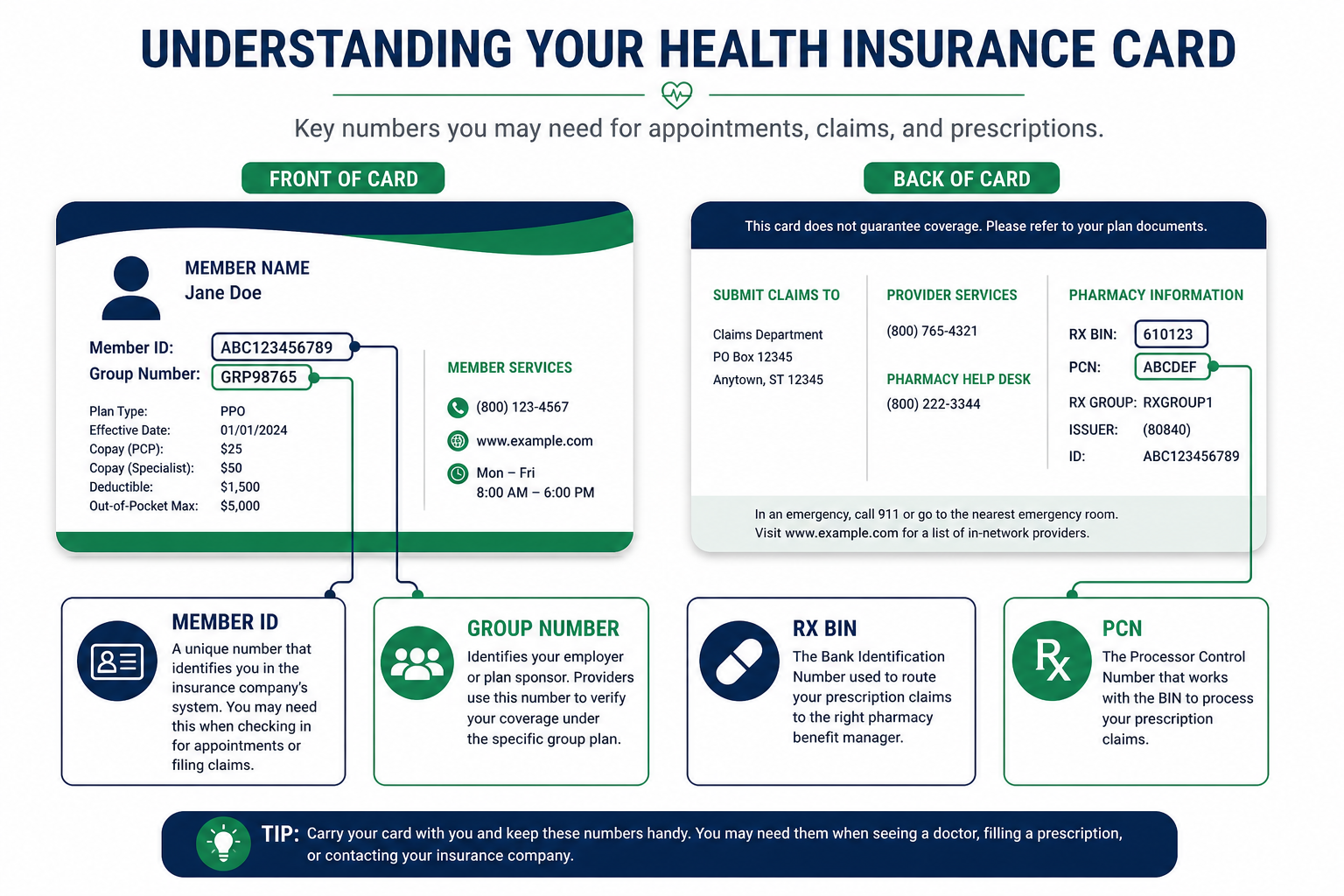
Key Takeaway: Your insurance card may list four different companies. The carrier handles medical claims. The PBM (Express Scripts, OptumRx, Caremark) handles prescriptions. Your employer sponsors the plan but is usually not the carrier. The network determines which providers are in-network.
| Entity | Role | Example |
|---|---|---|
| Insurance carrier | Pays medical claims; sets coverage rules | Blue Cross, Aetna, UHC |
| Employer (plan sponsor) | Offers and may subsidize the plan | Your company's HR department |
| Pharmacy Benefit Manager | Manages prescription drug benefits | Express Scripts, OptumRx, Caremark |
| Provider network | Group of contracted doctors and hospitals | PPO Network, HMO Network |
For medical claim appeals, contact the carrier. For prescription denials, contact the PBM. For enrollment questions, contact your employer HR or Healthcare.gov. Mixing these up is one of the most common reasons appeals get lost or delayed.
How to Find Your Insurance Carrier Name
Key Takeaway: The carrier name appears at the top of your insurance card, on every Explanation of Benefits (EOB), and in your plan's Summary of Benefits and Coverage (SBC). The member services phone number on your card connects to the carrier.
- Check your insurance card. The carrier name is usually the largest text, e.g., “Anthem Blue Cross,” “UnitedHealthcare,” or “Aetna.”
- Review your EOB. Every Explanation of Benefits header shows the carrier name, your member ID, and group number.
- Log into your member portal. Availity, Anthem.com, UHC.com, or your carrier's specific website displays your plan details.
- Ask your employer HR. They can confirm the carrier, but appeals go through the carrier directly, not HR.
- Check Healthcare.gov. For marketplace plans, your account shows your insurer name and plan ID.
Your member ID, group number, and policy number are different identifiers. The member ID identifies you within the carrier's system. The group number identifies your employer's plan (for group coverage). See our policy number guide for details on each identifier.
Self-Insured Employers: When the Carrier Is a Third-Party Administrator
Key Takeaway: Large employers often self-insure, they pay claims directly from company funds but hire a carrier as a third-party administrator (TPA) to process claims. Your card shows the TPA name (e.g., UHC, Aetna), but your employer holds the financial risk.
Roughly 65% of covered workers are enrolled in self-insured employer plans. From your perspective as a member, the process looks identical, you use the carrier's portal, call their member services, and file appeals through their system. The difference is behind the scenes: your employer, not the carrier, funds the claims.
Self-insured plans are governed by ERISA federal law, which gives you appeal rights under ERISA §503, 180 days to file an internal appeal and the right to external review. Your Summary Plan Description (SPD) identifies whether your plan is self-insured.
Weak vs. Strong Approaches When Contacting Your Carrier
Key Takeaway: Calling the wrong entity, your doctor, employer, or PBM instead of the medical carrier, wastes time and can cause you to miss appeal deadlines. Always start with the carrier listed on your denial letter.
| ❌ Wrong Contact | ✅ Correct Contact |
|---|---|
| “I called my doctor's office to appeal my MRI denial.” | “Filed internal appeal with Anthem via Availity portal, reference #ANT-2026-44821. Denial code MN-001 (not medically necessary). Member ID: ABC123456789.” |
| “I submitted my hospital bill appeal to Express Scripts.” | “Hospital claim appeal submitted to UnitedHealthcare (medical carrier) via UHC.com. Express Scripts handles only pharmacy, separate appeal filed there for denied medication.” |
| “HR said they would handle my appeal.” | “Filed appeal directly with Aetna (TPA for self-insured employer plan). Notified HR for SPD request under ERISA §503. Appeal deadline: 180 days from denial date 05/15/2026.” |
Need to Appeal a Denied Claim?
AppealFlow drafts carrier-specific appeal letters citing ERISA and ACA rights, free and ready in under 60 seconds.
How to File an Appeal With Your Insurance Carrier
Key Takeaway: File your internal appeal with the carrier listed on your denial letter within 60 days (marketplace) or 180 days (ERISA employer plans). Submit through the carrier's member portal for fastest processing and documented receipt.
- Identify the correct carrier from your denial letter, EOB, or insurance card.
- Note your appeal deadline, missing it forfeits your appeal rights.
- Gather documents: denial letter, EOB, medical records, and letter of medical necessity.
- Submit through the carrier portal: Availity (multi-carrier), Anthem.com, UHC.com, Aetna.com, or Cigna.com.
- For pharmacy denials, use the PBM portal: Express Scripts, OptumRx, or Caremark.
- Follow up at 14 and 30 days. Document every call with date, representative name, and reference number.
- If denied again, request external review through your state Department of Insurance or the federal external review process.
Appeals with complete documentation succeed roughly 40–55% on first internal submission. Vague complaints without clinical evidence succeed less than 15%.
Carrier Portals for Appeals and Prior Authorization
Key Takeaway: Each major carrier has a member portal for claims, appeals, and prior authorization status. Using the correct portal ensures your appeal is routed to the right department and creates a timestamped record.
| Carrier | Member Portal | Appeal Path |
|---|---|---|
| Anthem / BCBS | Anthem.com or Availity | Claims → Dispute / Appeal |
| UnitedHealthcare | UHC.com / myuhc.com | Claims & Accounts → Appeal |
| Aetna | Aetna.com or Availity | Claims → File an Appeal |
| Cigna | Cigna.com / myCigna | Claims → Appeal a Decision |
| Kaiser Permanente | KP.org | Member Services → Grievances & Appeals |
Tip: Availity serves as a multi-carrier portal used by many providers and members. If your carrier participates, you can submit appeals and check claim status in one place.
Government Program Carriers: Medicare and Medicaid
Key Takeaway: Medicare and Medicaid are government programs, not private carriers, but they use private insurance companies as managed care administrators. Your Medicare Advantage plan may be administered by UnitedHealthcare or Humana. Your state Medicaid plan may be managed by Molina, Centene, or a Blue Cross affiliate.
Government health programs add another layer of carrier confusion:
- Original Medicare: Administered by the federal government through CMS. Claims processed by Medicare Administrative Contractors (MACs) by region.
- Medicare Advantage: Private carriers (UHC, Humana, Kaiser) administer plans on behalf of Medicare. Appeals go through the carrier, then Medicare.gov.
- Medicaid: State-run programs using managed care organizations (MCOs) as carriers. In California, Medi-Cal MCOs include Health Net, Molina, and Kaiser.
- TRICARE: Military health program administered by Humana Military and International SOS.
For Medicare appeals, start with your Medicare Advantage plan's member services or file a redetermination for Original Medicare through Medicare.gov or 1-800-MEDICARE. For Medicaid appeals, contact your state's Medicaid managed care plan first, then escalate to the state Medicaid agency. Each program has different appeal deadlines, Medicare allows 120 days for redetermination, while Medicaid timelines vary by state.
When you call member services, always ask for the representative's name, the department handling your issue, and a call reference number. If your appeal is denied at the first level, request the specific policy provision or clinical guideline cited in the denial, this information is essential for drafting an effective second-level appeal. Under ERISA §503, you also have the right to request all documents your insurer used to make the denial decision, including internal clinical review notes and peer-to-peer consultation records.
Five Mistakes People Make Identifying Their Insurance Carrier
Key Takeaway: Confusing the carrier with the PBM, employer, or network is the top reason appeals go to the wrong entity and miss deadlines. Always use the carrier name on your denial letter.
- Calling the employer instead of the carrier. HR handles enrollment, not claim appeals.
- Submitting medical appeals to the PBM. Express Scripts and Caremark handle prescriptions only.
- Using an outdated insurance card. Carriers change during open enrollment, verify with your most recent EOB.
- Assuming the hospital's billing department is the carrier. Providers bill the carrier but do not process appeals.
- Not checking for multiple entities on the card. Medical carrier, PBM, dental, and vision may each be different companies.
Frequently Asked Questions
Answers to the most common questions about who the insurance carrier is and how to find yours.
Generate Your Free Insurance Appeal Letter
AppealFlow.net drafts formal appeal letters addressed to your insurance carrier, citing ERISA rights and your specific denial reason. Edit live, then download as PDF or Word.
- 100% Free
- No Signup
- PDF & Word Export
Disclaimer: This article is for educational purposes only and does not constitute legal advice. AppealFlow.net is not a law firm. Carrier names and portal paths change, verify with your insurance card and denial letter. For medical emergencies, call 911. See our full disclaimer.