Denial Code Guide
CO-11 Denial: Diagnosis Inconsistent with Procedure
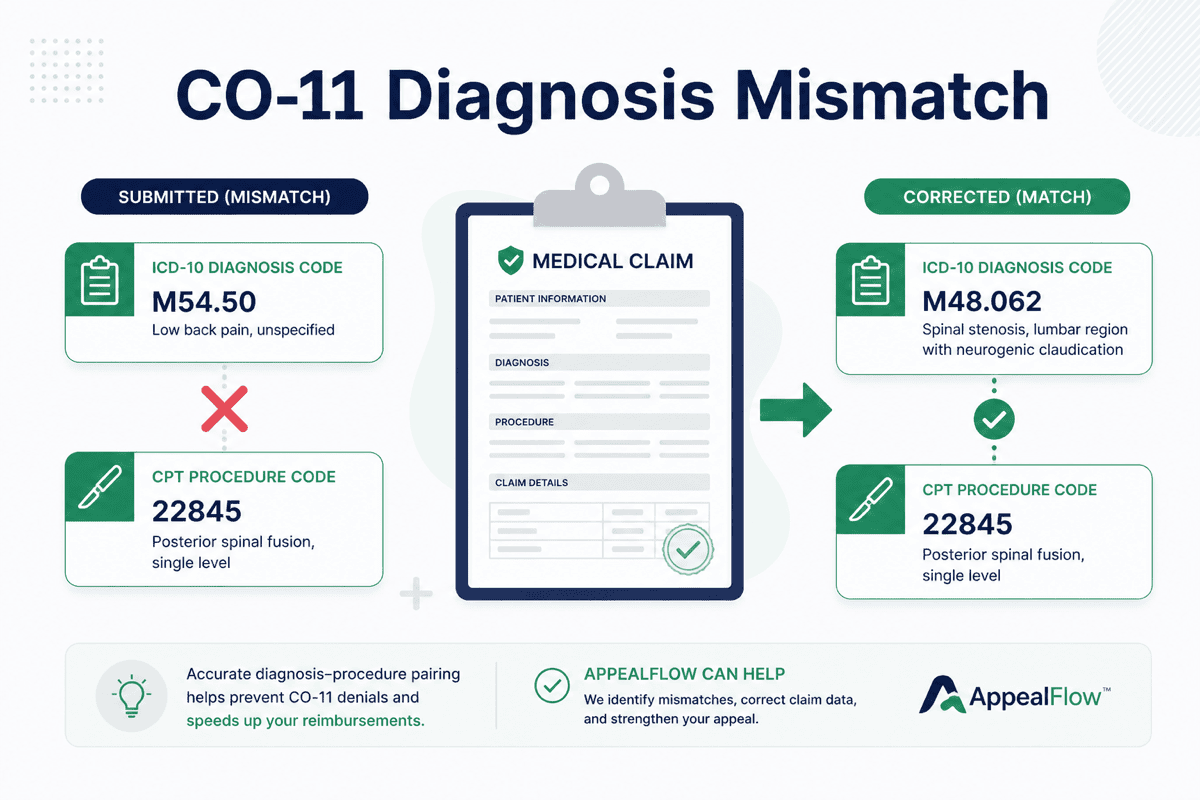
What Does CO-11 Mean?
Key Takeaway: CO-11 is a coding-edit denial. The payer's software flagged a mismatch between the diagnosis and procedure codes, not necessarily a denial of medical care.
Claim Adjustment Reason Code 11 means the diagnosis is inconsistent with the procedure. Payers use automated edits based on ICD-10-CM and CPT pairing rules, National Correct Coding Initiative edits, and their own medical policies. A typo in the diagnosis pointer, a missing primary diagnosis, or a valid but uncommon pairing can trigger CO-11.
Read the remittance advice alongside the claim your provider submitted. The problem is usually visible on the CMS-1500 or UB-04 diagnosis and procedure fields.
Laboratory and imaging claims often fail when a screening diagnosis is billed with a diagnostic procedure code. The fix may be updating the primary diagnosis to match documented symptoms in the chart.
Is This a Coding Error or a Coverage Fight?
Key Takeaway: Start by assuming a fixable coding problem. Escalate to an appeal only when the billed codes match the medical record.
Call the billing office and ask whether the wrong ICD-10 code was attached to the procedure line, whether a secondary diagnosis should have been primary, or whether a modifier was required. Corrected claims often resolve CO-11 within weeks.
If the coding matches the record and the payer still denies, you are arguing that their edit is clinically wrong for your case. That requires visit notes, imaging, pathology, or operative reports that tie the diagnosis to the procedure.
What Records Fix a Diagnosis Mismatch?
Key Takeaway: Clinical documentation must explain why the billed diagnosis legitimately supports the billed procedure.
Gather the denial letter, EOB, itemized claim, and the provider's note for the date of service. For surgery, include the operative report and pathology if relevant. For imaging or labs, include the order and result that justify the test.
Ask the coder or clinician to write a brief coding clarification letter if the pairing is valid but unusual. The letter should cite the documented diagnosis and explain medical necessity for the procedure code billed.
When Should You Appeal Instead of Rebilling?
Key Takeaway: Appeal when the original coding is supported by the record and the payer applied an incorrect edit.
File an internal appeal if a corrected claim was already submitted and denied again, or if the provider confirms the first submission was coded correctly. Attach the coding clarification, relevant clinical guidelines if your plan cites them, and a copy of the plan's medical policy when available.
Use the appeal deadline on your notice. ERISA plans generally allow at least 180 days for a first internal appeal; Medicare and Medicaid follow separate clocks.
Documents to Gather
Key Takeaway: Attach copies of every item on this list to your appeal or give them to your provider's billing office for a corrected claim.
- EOB or remittance advice showing CO-11
- CMS-1500 or UB-04 claim copy with diagnosis pointers
- Visit, operative, or procedure note for date of service
- Coding clarification letter from provider or coder
- Order and results supporting medical necessity
- Prior authorization approval if applicable
Corrected Claim or Appeal?
Key Takeaway: Corrected claim when the wrong ICD-10 code, diagnosis pointer, or missing modifier caused the edit. Internal appeal when the submitted coding matches the record and the payer's edit is clinically incorrect.
Weak vs Strong Wording
Key Takeaway: Reviewers respond to claim numbers, dates of service, and attached records, not general complaints about fairness.
| Weak | Stronger |
|---|---|
| My diagnosis should cover this procedure and insurance is wrong. | Claim billed CPT 73721 with primary diagnosis M25.561 (left knee pain). Attached MRI report dated 4/2/2026 documents internal derangement and supports medical necessity for knee MRI without contrast. Request reversal of CO-11 and payment per contracted rate. |
| Please fix the code and pay the claim. | CO-11 denied due to diagnosis-procedure inconsistency. Enclosed operative report shows excision of malignant lesion; corrected primary diagnosis C44.319 submitted on replacement claim #88277 with coding attestation attached. Request reprocessing. |
Draft Your Appeal Letter
Use AppealFlow's free generator to structure your appeal with the denial code, dates, and documents you gathered.
Open free appeal letter generatorAuthoritative Sources
Related Pages
Frequently Asked Questions
Common questions about CO-11 — Diagnosis Inconsistent with Procedure denials and appeals.
Need a Starting Point for Your Appeal?
AppealFlow's free generator helps you organize denial details, deadlines, and supporting documents into a letter you can review and file.
Generate free appeal letterEducational information only, not medical or legal advice. Denial code meanings come from standard claim adjustment reason code lists; your plan's notice and contract control appeal rights and deadlines. Full disclaimer