ERISA Appeal Deadline for Health Insurance
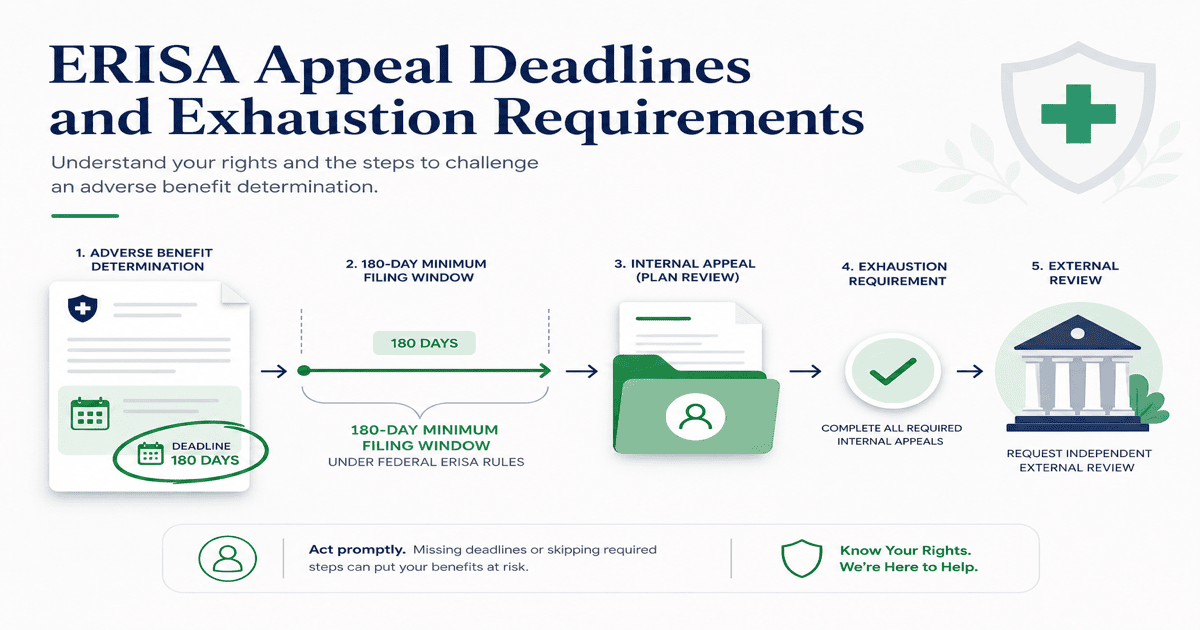
How Do You Find the ERISA Appeal Deadline on Your Notice?
Key Takeaway: Job-based coverage governed by ERISA must tell you how and when to appeal on the adverse benefit determination. The date on that letter controls filing unless federal law gives you a longer window for your plan type.
Start with the denial letter, sometimes called an adverse benefit determination or Explanation of Benefits with appeal rights. Look for a sentence that says you may appeal within a stated number of days or by a calendar date. The Department of Labor claims publication tells participants to check the Summary Plan Description if the plan allows more time than the notice states.
ERISA generally covers employer-sponsored group health plans offered by private-sector employers. It does not cover Medicare, Medicaid, or most individual marketplace plans. If you are unsure which program denied you, compare your card and enrollment documents before filing. For a side-by-side look at multiple program clocks, see how long you have to appeal a health insurance denial.
What Does 29 CFR 2560.503-1 Require for Filing Time?
Key Takeaway: Federal claims procedure rules set a 180-day minimum filing period for many ERISA health claims. That is a floor under regulation, not permission to ignore the date printed on your notice when it gives you more time.
29 CFR 2560.503-1 requires ERISA group health plans to establish and maintain a full and fair review procedure for adverse benefit determinations. The regulation requires plans to allow participants at least 180 days from notice of denial to file an internal appeal. Plans may allow longer periods in the SPD.
| Document | What to check | Why it matters |
|---|---|---|
| Adverse benefit determination | Appeal address, level, and calendar or day count | This is your first filing deadline to circle |
| Summary Plan Description (SPD) | Whether the plan allows more than 180 days | SPD language can extend the filing window |
| Plan administrator contact | Where to send Level 1 and Level 2 appeals | Wrong address can cost time even with a valid deadline |
What Is the Exhaustion Requirement Before External Review?
Key Takeaway: ERISA expects you to use the plan's internal claims and appeals process before suing over a denied benefit. External review, when available, also comes after internal appeals are exhausted or when the plan misses required decision deadlines.
Exhaustion means filing timely appeals through each internal level the plan offers and receiving a final adverse benefit determination. Courts generally expect participants to complete that process before bringing an ERISA benefit claim, unless an exception applies. Skipping a level or missing the filing deadline can limit later options even when the medical case is strong.
Many ERISA plans also participate in voluntary or federally coordinated external review after internal appeals end. For how that step works on qualifying commercial plans, see what is an external review in health insurance. Your final internal denial notice should name whether external review is available and where to file.
File internally first. A strong clinical argument sent only to an IRO or court without a timely internal appeal can fail on procedure alone. Calendar the internal deadline before you gather records for the next step.
How Long Does the Plan Have to Decide Your ERISA Appeal?
Key Takeaway: Your filing deadline and the plan's decision deadline are different clocks. After you appeal on time, 29 CFR 2560.503-1 sets how quickly the plan must respond based on urgency and whether care was pre-service or post-service.
Urgent pre-service appeals must be decided within 72 hours of receiving your request. Standard pre-service appeals generally must be decided within 30 days if you have not yet received the service and within 15 days if care was already provided. Post-service appeals generally must be decided within 60 days. Plans with two internal levels split those timeframes between levels.
If the plan misses a required decision deadline, federal rules may treat the appeal as denied and may open external review or escalation paths described on your notice. Document when you filed and how you sent the appeal. For the broader workflow after a denial, see what to do when an insurance claim is denied.
What If Your Denial Letter Lists Fewer Than 180 Days?
Key Takeaway: Do not assume a short date on the letter is correct for every plan type. For many ERISA group health claims, 180 days is a federal floor. File as soon as you can, keep the notice, and confirm your plan type on the SPD.
A notice that gives only 30 or 60 days may conflict with the minimum period in 29 CFR 2560.503-1 for ERISA health claims. Note the mismatch in your appeal letter. If the notice gives you more than 180 days, use the longer date on the notice.
| Weak wording | Stronger wording |
|---|---|
| “I have 180 days like everyone else.” | “I am filing within the appeal period on my adverse benefit determination dated [date] and within the minimum period required under 29 CFR 2560.503-1 for ERISA group health claims.” |
| “Please review this denial.” | “I appeal claim #[number] and request a full and fair review under the plan's ERISA claims procedure. Enclosed are the clinical records listed in your denial letter.” |
| “I will sue if you do not pay.” | “I am exhausting internal appeals as required before any external review or further action. Please confirm receipt and the decision deadline that applies to this appeal level.” |
How Do ERISA Deadlines Differ From ACA and Medicare Appeals?
Key Takeaway: ERISA employer plans, ACA marketplace coverage, and Medicare each print their own clocks. A sentence that works on an ERISA appeal letter can be wrong for Medicare or Medicaid.
ACA non-grandfathered plans follow Section 2719 and Healthcare.gov internal and external review rules, which often also use a 180-day internal filing window but are not identical to ERISA procedure in every detail. Medicare Advantage and Part D use the redetermination clocks on Medicare.gov. Medicaid uses state fair hearing notices. Never copy ERISA deadline language onto a non-ERISA denial.
- ERISA employer group health: At least 180 days to file internal appeal from notice; exhaustion before court; DOL and plan administrator oversight.
- ACA marketplace / individual: Internal appeal within 180 days of receiving notice per Healthcare.gov; separate external review filing window after final internal denial.
- Medicare: Separate 65-day, 60-day, and other clocks on Medicare.gov; not governed by ERISA 180-day rules.
ERISA Appeal Deadline Checklist Before You File
Key Takeaway: Missing a procedural deadline ends more appeals than weak medical arguments. Use this checklist the day your denial arrives, not the day before the clock runs out.
- Circle the appeal deadline on the adverse benefit determination and compare it to your SPD.
- Confirm the plan is ERISA employer coverage, not Medicare, Medicaid, or individual marketplace insurance.
- Send Level 1 appeal to the address on the notice, not your doctor's billing office.
- Keep proof of filing: fax confirmation, certified mail receipt, or portal timestamp.
- Attach the records the denial letter lists, such as clinical notes or prior authorization history.
- Calendar the plan's decision deadline and the next level if the denial is upheld.
Need help drafting the letter itself? See how to write an insurance appeal letter for structure you can adapt to ERISA notices.
Deadline Approaching on an ERISA Denial?
Draft a formal appeal letter while you confirm the date on your notice. You still file through the plan administrator named on your adverse benefit determination.
Frequently Asked Questions
Common questions about ERISA appeal deadlines, the 180-day floor in 29 CFR 2560.503-1, exhaustion requirements, and how employer plan clocks differ from ACA and Medicare notices.
Generate Your Free Appeal Letter
AppealFlow.net drafts formal appeal letters for ERISA and other coverage denials. Edit live, download as PDF or Word. No account required. You still submit through your plan's internal appeal process before external review.
- 100% Free
- No Signup
- PDF & Word Export
Disclaimer: This article is for educational purposes only and does not constitute medical, legal, or financial advice. AppealFlow.net is not a healthcare provider, insurance broker, or law firm. ERISA appeal deadlines, exhaustion rules, and external review availability vary by plan type. Verify current requirements with your denial letter, Summary Plan Description, or the Department of Labor before taking action. For medical emergencies, call 911. See our full disclaimer.