How Long Does a Health Insurance Appeal Take?
What Timeline Should You Expect After Filing?
Key Takeaway: The clock that matters is how long the plan has to decide your appeal, not how long you had to file it. Pre-service denials usually move on a 30-day internal track. Post-service denials often get 60 days. Urgent cases can jump to expedited review when the standard wait is unsafe.
A health insurance appeal is your written request to overturn a coverage or payment denial. After you file, the plan reviews the medical record, plan language, and any new documents you send. The decision deadline depends on your plan type, whether the service already happened, and whether you qualify for expedited review. This page covers decision time. For how long you have to file, see how long you have to appeal a health insurance denial.
Many people search for one national number. Federal rules give floors and standard patterns, but Medicare, Medicaid, and some state-regulated plans print their own clocks on the notice. Start with the table below, then verify the source that matches your card and denial letter.
How Long Does Internal Appeal Take by Plan Type?
Key Takeaway: Healthcare.gov and the Department of Labor describe parallel standard and expedited clocks for many commercial plans. Medicare and Medicaid are different programs with different notices.
| Plan type | Internal standard | Internal expedited | External review |
|---|---|---|---|
| ACA marketplace / individual / many group plans | Pre-service: within 30 days of receiving the appeal Post-service: within 60 days of receiving the appeal | As quickly as the medical condition requires, and at least within 4 business days after the request is received; verbal decision allowed, written notice within 48 hours | Standard: no later than 45 days after request received Expedited: no later than 72 hours after request received |
| ERISA employer group health | Pre-service appeal review: no more than 30 days after receiving the appeal request Post-service appeal review: no more than 60 days after receiving the appeal request | As soon as possible given medical needs, and no more than 72 hours after the plan receives the urgent-care appeal request | Non-grandfathered plans must offer external review. Federal standards on Healthcare.gov use 45-day standard and 72-hour expedited external review clocks after the request is received |
| Medicare / Medicaid | Follow the decision deadline on your Medicare Summary Notice or Medicaid managed-care notice, not the ACA 30/60-day table | Medicare fast appeals may be decided within 72 hours when waiting for the standard clock may seriously jeopardize life, health, or ability to regain function per Medicare.gov | Medicare uses QIC reconsideration and later levels, not ACA Section 2719 external review. Medicaid uses state fair hearing rules |
Sources: Healthcare.gov internal appeals, Healthcare.gov external review, and the Department of Labor claims publication.
What Is the Difference Between Pre-Service and Post-Service Clocks?
Key Takeaway: Pre-service appeals cover care you still need, such as a refused MRI or denied prior authorization. Post-service appeals cover claims for care you already received. The standard internal clock is shorter for pre-service cases on Healthcare.gov.
Healthcare.gov says internal appeals for services you have not received yet must be completed within 30 days. Appeals for services you already received must be completed within 60 days. That split matters for surgery scheduling, infusion starts, and imaging orders where the denial arrived before the appointment.
DOL uses the same 30-day and 60-day appeal-review limits for ERISA group health plans. If your employer plan requires two internal appeal levels, DOL notes each level may use half the single-level time. A pre-service ERISA appeal with two levels could mean 15 days per review instead of one 30-day review.
How Long Does External Review Take?
Key Takeaway: External review happens after internal appeals end or when the plan misses a required internal deadline. On qualifying ACA plans, the independent reviewer must decide within 45 days standard or 72 hours expedited.
Healthcare.gov states standard external reviews are decided as soon as possible and no later than 45 days after the request is received. Expedited external reviews are decided no later than 72 hours after the request is received, or sooner when medically urgent. You must file within four months of receiving the plan's final internal denial notice.
External review is not the same program as Medicare appeals or a state Medicaid fair hearing. For what an IRO does and who qualifies, see what external review in health insurance means. In urgent situations, Healthcare.gov says you may file internal appeal and external review at the same time. See how to request an expedited insurance appeal for the clinician certification and filing channel.
What If the Insurer Misses the Appeal Deadline?
Key Takeaway: A missed plan deadline can open the next level faster than waiting for another internal letter. Keep proof of when you filed and when the plan acknowledged receipt.
Healthcare.gov says you can ask for external review when your insurer still denies your claim after internal appeals, and in urgent situations you may request external review even if you have not finished every internal level. If the plan is late on a required internal decision, cite the missed deadline in writing and ask for the escalation path named on your denial notice.
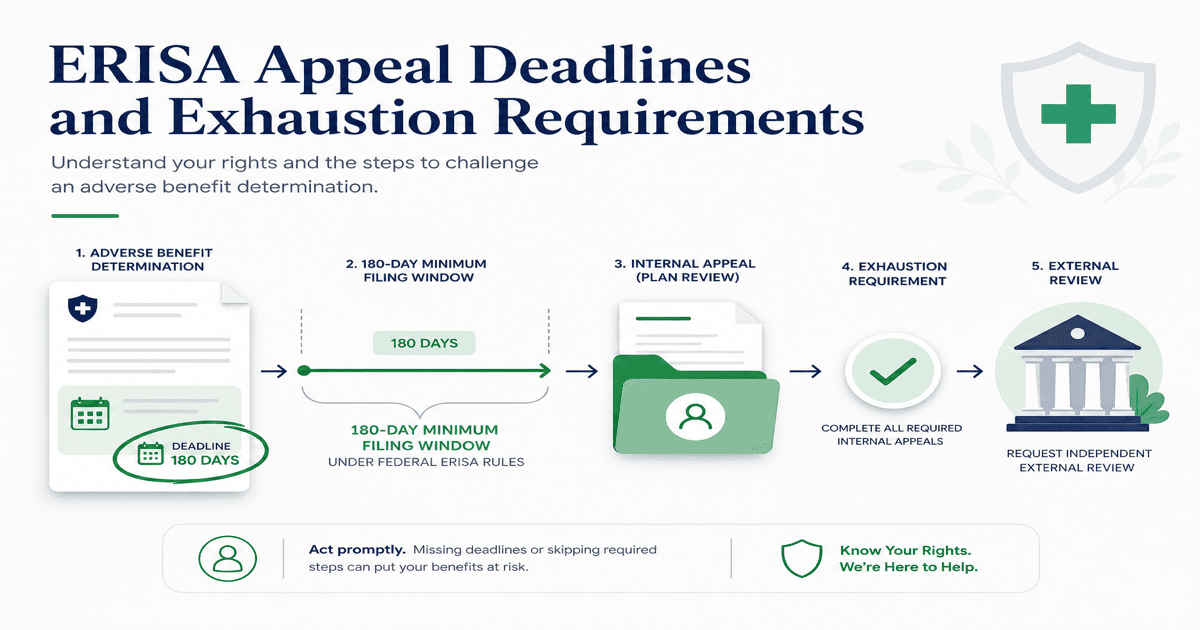
Late plan decisions do not extend your filing clock. You still must file internal appeal within the window on your notice, often 180 days for many commercial plans. A slow insurer does not give you extra time to start the appeal.
What Can Slow Down Your Appeal?
Key Takeaway: Missing records, wrong appeal level, and treating a peer-to-peer call as the formal appeal are the most common delays members control.
- The plan requests more records and pauses the clock until you respond. DOL gives you at least 45 days to supply missing information on many ERISA appeals.
- You filed a grievance or portal message instead of a formal appeal to the address on the denial notice.
- You waited for a peer-to-peer call without filing the written appeal. The call does not replace the appeal clock.
- The plan has two internal levels, so you may wait through two review periods before external review is available.
If you are at the very start of the process, what to do when an insurance claim is denied walks through the denial letter, EOB, and document checklist while the appeal is pending.
File Now, Track the Clock Later
AppealFlow drafts a letter from your denial facts while the plan's decision clock runs. You still submit through the process on your notice.
Weak vs. Strong Language About Appeal Timelines
Key Takeaway: Name the track, the source, and the date you filed. Vague waiting language does not start or speed up the plan's clock.
| ❌ Weak Request | ✓ Strong Request |
|---|---|
| “Please hurry, I need this soon.” | “This is a pre-service appeal filed [date]. Healthcare.gov requires a decision within 30 days. Please confirm receipt and the decision due date.” |
| “Every appeal takes 60 days.” | “This post-service claim denial requires a 60-day internal appeal review under Healthcare.gov. My appeal was received [date]; please advise if additional records are needed.” |
| “It has been a month, so I can go to external review.” | “Internal appeal filed [date]. No final determination by day 30. I request escalation to external review per Healthcare.gov and the instructions on my denial notice.” |
Frequently Asked Questions
Decision timelines for internal standard and expedited appeals, external review, and Medicare differences.
Generate a Free Draft Appeal Letter
AppealFlow drafts a letter from your denial date and facts while you track how long your health insurance appeal should take under your plan's rules.
- 100% Free
- No Signup
- PDF & Word Export
Disclaimer: This article is for educational purposes only and does not constitute medical, legal, or financial advice. AppealFlow.net is not a healthcare provider, insurance broker, or law firm. Appeal decision clocks differ by plan and program. Verify timelines on your denial notice, Healthcare.gov, DOL, Medicare.gov, or your state Medicaid agency before you rely on a date. For medical emergencies, call 911. See our full disclaimer.