How to Appeal a Denied Colonoscopy
What Happens When Insurance Denies a Colonoscopy?
Key Takeaway: A colonoscopy denial is a coverage determination, not a clinical order from your gastroenterologist. The plan may block payment because the service was coded screening vs diagnostic incorrectly, because prior authorization was missing, or because records did not meet medical necessity or interval rules.
You may learn about the denial before the procedure is scheduled or after a claim is processed. The notice should name the denial reason, any authorization reference number, and how to request an internal appeal. Under Healthcare.gov's appeals overview, many non-grandfathered plans must offer a written internal review when you disagree with a coverage decision, including many colonoscopy denials labeled not medically necessary or not a covered benefit.
Read the notice before you write. A preventive benefit dispute is not the same packet as a clinical medical necessity denial. A missing prior authorization is a process problem that may need retroactive review. A frequency denial needs dates from your last colonoscopy and pathology. Match your next step to the reason code on the letter.
Calendar the appeal date today. Filing windows are printed on the denial notice. Missing the deadline can end your internal review rights for that determination.
Screening vs Diagnostic Colonoscopy: Why It Matters for Appeals
Key Takeaway: Screening colonoscopies follow preventive benefit and interval rules. Diagnostic colonoscopies follow symptom-based medical necessity and prior authorization rules. If the plan recharacterized a preventive visit as diagnostic after a polyp was found, your appeal may need ACA or Medicare preventive services language, not only a generic medical necessity letter.
The U.S. Preventive Services Task Force recommends colorectal cancer screening on a schedule that depends on age and risk. Many non-grandfathered plans must cover those recommended preventive services without cost-sharing when you use an in-network provider, as described on Healthcare.gov preventive care benefits. Medicare covers screening colonoscopies on intervals listed on Medicare.gov colonoscopy coverage.
A diagnostic colonoscopy is usually ordered because of symptoms such as rectal bleeding, iron-deficiency anemia, or a positive stool test, or for surveillance after prior polyps or cancer. Those claims are more often subject to deductibles, coinsurance, prior authorization, and medical necessity review. Your gastroenterology office should document the clinical indication on the order and in visit notes.
A common billing dispute arises when a screening colonoscopy finds a polyp and the plan bills the entire service as diagnostic. Some plans and Medicare follow guidance that treats polyp removal during an otherwise qualifying screening visit as part of the preventive benefit, but your Evidence of Coverage and the denial reason code control. If the denial cites preventive vs diagnostic coding, cite your plan preventive services section and attach the operative report showing the procedure started as screening.
What Documents Do You Need for a Colonoscopy Appeal?
Key Takeaway: Colonoscopy appeals succeed when the record answers the exact reason on the denial. Build one numbered packet before you submit. Ask your gastroenterologist's office for the order indication, prior authorization history, and pathology from any prior colonoscopy.
Request the plan's clinical policy or preventive services criteria cited in the denial. Under DOL ERISA claims procedure rules, many employer plans must share documents relied on in the decision. Match your records to each bullet the policy lists.
- Denial letter and Explanation of Benefits with reason code, CPT code, and appeal instructions
- Gastroenterology consultation notes documenting symptoms, risk factors, or screening eligibility
- Prior colonoscopy and pathology reports with dates when the denial cites interval or surveillance rules
- Family history of colorectal cancer or polyps when your plan or clinician cites high-risk screening
- Positive stool test or imaging results that prompted a diagnostic colonoscopy when applicable
- Letter of medical necessity signed by your gastroenterologist addressing each denial reason
- Prior authorization submission proof, reference numbers, or peer-to-peer notes if the denial cites authorization
For a structured starting draft, use the medical necessity appeal generator and pair it with your gastroenterologist's signed letter. See our medical necessity appeal letter template for how to organize the member appeal separately from the clinician letter.
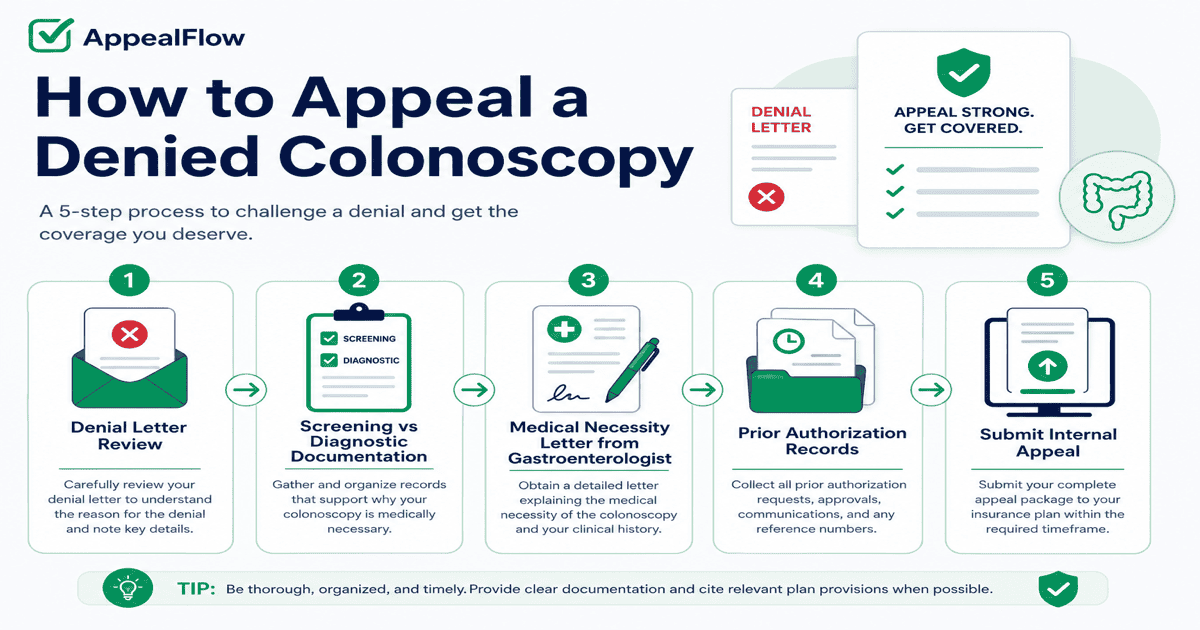
How Do You File an Internal Appeal for a Denied Colonoscopy?
Key Takeaway: Your appeal letter is the member's formal request invoking the process named on the notice. It is not the same document as the gastroenterologist's letter of medical necessity. Both can sit in one packet with a numbered attachment index.
- Confirm your appeal deadline. ERISA employer plans often allow up to 180 days for an internal appeal. ACA marketplace plans follow the clocks on your notice. Medicare uses separate redetermination timelines on Medicare.gov.
- Identify screening vs diagnostic on the denial. If the dispute is preventive coverage, cite your plan preventive services section and USPSTF screening rules where they apply to your coverage type. If the dispute is clinical, map symptoms and records to each plan criterion.
- Request the insurer's criteria. You need the policy section cited in the denial so your letter addresses each requirement point by point.
- Get a letter of medical necessity from your gastroenterologist. It should document the indication, risk factors, prior colonoscopy history, and why the timing meets plan rules.
- Draft your member appeal letter. Include member ID, claim number, CPT code, and a numbered enclosure list. For format guidance, see how to write an insurance appeal letter.
- Submit through the correct channel. Send to the address, fax, or portal on the notice. Keep confirmation numbers, fax reports, or portal screenshots.
- Request external review when eligible. Qualifying ACA and many state-regulated plans must offer independent review under ACA Section 2719 after internal appeals are exhausted on medical necessity determinations.
Denial Reason to Action: Colonoscopy Appeals
Key Takeaway: The appeal path depends on the reason printed on your notice. Sending a medical necessity essay when the plan denied a missing prior auth wastes your filing window.
| Denial reason on notice | First action |
|---|---|
| Not medically necessary | Map gastroenterology notes and test results to each plan criterion. Attach clinician letter and policy section cited. |
| Prior authorization not obtained | Request auth submission proof from the clinic. File appeal or retroactive auth with clinical urgency documentation. |
| Frequency or interval limit | Attach dates and pathology from the last colonoscopy. Clinician letter should explain why earlier repeat is appropriate under plan surveillance rules. |
| Preventive vs diagnostic coding | Cite plan preventive services language and operative report. Address whether polyp removal during screening should remain a preventive benefit under your plan type. |
| Benefit not covered | Check your Evidence of Coverage for exclusions. A medical necessity appeal cannot create a benefit the plan does not offer. |
Weak vs Strong Colonoscopy Appeal Wording
Key Takeaway: Reviewers process high volumes of GI appeals. Language that names codes, criteria, and attachments moves faster than general requests to approve a needed colonoscopy.
| Weak wording | Strong wording |
|---|---|
| “I am due for my screening colonoscopy. Please cover it.” | “I appeal denial dated 08/12/2026 for CPT 45378 coded as screening. I am age 52 with no prior covered screening colonoscopy on record. Attachment 2 cites my plan preventive services section and USPSTF screening eligibility for my age and risk profile.” |
| “My doctor says I need a colonoscopy because of my symptoms.” | “Denial code CO-50 for diagnostic colonoscopy CPT 45378. Attachment 3 documents positive FIT on 07/20/2026 and iron-deficiency anemia on labs dated 07/15/2026. Dr. Nguyen's letter addresses plan criterion 4.a for diagnostic colonoscopy after abnormal non-invasive screening.” |
| “Please approve my colonoscopy. I attached medical records.” | “Attachment index: 1 appeal letter, 2 letter of medical necessity, 3 colonoscopy order, 4 pathology from 2019 tubular adenoma, 5 prior auth submission confirmation, 6 plan policy section 8.3 cited on the denial.” |
What If Your Colonoscopy Was Denied for Prior Authorization?
Key Takeaway: Many plans require prior authorization for outpatient colonoscopy, especially at hospital outpatient departments. A retroactive denial is harder but not impossible when clinical records show timely submission or urgent indication.
When the denial cites missing precertification, your appeal must address both the authorization process and medical indication. Some plans allow retroactive review when documentation was incomplete rather than when the service is excluded entirely. Ask your gastroenterology office to hold billing while the appeal is pending when possible.
For prior authorization disputes specifically, see how to appeal a prior authorization denial. If you receive a CO-50 denial for medical necessity, our guide to denial code CO-50 explains how that code differs from authorization denials and what to attach.
Draft your colonoscopy appeal letter
AppealFlow builds a medical necessity appeal from your denial reason and clinical facts. Edit live, then download PDF or Word.
What Are Your Rights If the Internal Appeal Is Denied?
Key Takeaway: An upheld internal decision is not always the last step. Many non-grandfathered plans must offer external review when you disagree with a medical necessity determination after internal appeal.
Healthcare.gov's external-review page explains that you can ask an independent organization to review certain denials, including many medical necessity decisions, after the plan upholds an internal appeal. Medicare uses its own appeal levels on Medicare.gov claims and appeals.
Employer self-funded plans follow ERISA procedure rules. Fully insured state plans may add state external review options. Your final denial letter should name the program, address, and filing deadline that applies to your coverage. For more on fighting a not medically necessary label, see what to do when insurance says a claim is not medically necessary.
Frequently Asked Questions
Colonoscopy appeal deadlines, screening vs diagnostic denials, prior authorization, frequency limits, and Medicare vs commercial rules.
Generate Your Colonoscopy Appeal Letter
AppealFlow.net drafts a regulation-informed appeal from your denial reason and clinical facts. Pair it with your gastroenterologist's letter of medical necessity for a complete packet.
- 100% Free
- No Signup
- PDF & Word Export
Disclaimer: This article is for educational purposes only and does not constitute medical, legal, or financial advice. AppealFlow.net is not a healthcare provider, insurance broker, or law firm. Appeal deadlines and colonoscopy coverage rules vary by plan and program. Verify your denial notice, Healthcare.gov, CMS.gov, or Medicare.gov before you file. For medical emergencies, call 911. See our full disclaimer.