How to Write a Letter of Medical Necessity for Insurance
What Does a Letter of Medical Necessity Do?
Key Takeaway: The LMN is the clinician's side of a medical necessity dispute. It answers whether your records meet the plan's published criteria for the specific drug, test, or procedure named on the denial.
Insurers label claims not medically necessary when documentation does not match their internal clinical policy. A letter of medical necessity bridges that gap. It translates your treating clinician's judgment into the format medical directors score during prior authorization and internal appeals.
The LMN is separate from your patient appeal letter. You file the appeal to invoke the process named on your notice. The clinician letter supplies the clinical proof. For a definition and common uses, see what is a letter of medical necessity. For the member-facing appeal draft, use the medical necessity appeal generator alongside the signed LMN.
Healthcare.gov's internal-appeals page states you can appeal when a plan denies a claim because a service is not medically necessary and that you may send information you want considered, such as a letter from your doctor.
What Is Prescriber Attestation and Who Must Sign?
Key Takeaway: Medical directors expect a licensed prescriber attestation on letterhead: printed name, credentials, specialty, NPI, signature, date, and contact information. Unsigned templates or staff notes alone rarely satisfy plan requirements.
Prescriber attestation means your treating clinician formally states that the requested service is medically necessary for you. The letter must be signed by the licensed provider who knows your case. Nurse practitioner and physician assistant signatures are commonly accepted when they are the treating prescriber. Medical assistant or nurse notes without a prescriber signature usually do not count as an LMN.
A valid attestation block typically includes:
- Physician or specialist letterhead with practice address
- Printed name, degree, specialty, and National Provider Identifier (NPI)
- Handwritten or electronic signature with date
- Direct phone and fax for peer-to-peer review if the plan schedules one
- A closing statement such as: “I attest that [treatment] is medically necessary for this patient.”
Specialist letters often carry more weight for specialty services. A neurologist's LMN for a brain MRI may be reviewed differently than a brief primary care note for the same scan. Match the signer to the service when your plan policy requires a particular specialty.
How Should You Structure the Letter of Medical Necessity?
Key Takeaway: Use a seven-part outline on one to two pages. Each section should reference your specific denial reason and billing codes, not generic internet boilerplate.
[Physician letterhead]
[Date]
Re: Letter of Medical Necessity — [Patient name], DOB [date], Member ID [number]
To: [Insurer appeals department or PBM name]
1. Patient identification: Name, DOB, member ID, group number, claim or prior auth reference from the denial letter.
2. Diagnosis: ICD-10 code(s) with brief clinical description and relevant history.
3. Requested service: Drug (with NDC), procedure (with CPT or HCPCS), or device. Match billing codes on the claim exactly.
4. Prior treatment history: Chronological list with dates, doses, duration, outcomes, and reasons for discontinuation.
5. Clinical rationale: Why the requested treatment meets FDA indication, plan criteria, and accepted specialty guidelines. Address the specific denial reason code.
6. Contraindications to alternatives: Why step therapy drugs or conservative options are insufficient or unsafe for this patient.
7. Prescriber attestation and signature: Closing medical necessity statement, provider name, credentials, specialty, NPI, signature, phone, and fax.
Attach supporting records behind the letter: lab results, imaging reports, visit notes, and guideline excerpts. Number each attachment so the reviewer can verify every fact in the LMN without guessing which record to open.
How Do You Map Plan Clinical Criteria to the LMN?
Key Takeaway: Copy each bullet from the denial or medical policy into your doctor's worksheet. One paragraph in the LMN should answer each bullet with a dated fact from your chart.
Start with the denial letter or Explanation of Benefits. Note the reason code, the short clinical rationale, and the appeal deadline. If the notice references a medical policy section, request the full policy from member services or your employer benefits office for ERISA plans.
| Plan criterion (example) | What the LMN should document |
|---|---|
| Failed conservative care | Dates and frequency of physical therapy, medications, or watchful waiting with objective outcome measures |
| Step therapy completed | Chronological drug trials with NDC codes, doses, duration, and reason each step failed or was contraindicated |
| Specialty guideline met | Citation to society guidance (for example ACR, NCCN, ADA) and how your findings match the cited indication |
| Functional impairment documented | Exam findings, validated scores when used in your chart, and impact on daily activities tied to the requested service |
For Medicare notices, follow the clinical and coverage rules on Medicare.gov's coverage hub and the appeal steps on your Medicare Summary Notice. Medicare clocks and forms differ from commercial plan internal appeals.
What Should You Give Your Doctor Before They Write?
Key Takeaway: Physicians write stronger LMNs when you hand them the denial reason code, appeal deadline, and a dated list of failed therapies. Do not expect the office to reconstruct months of treatment from memory.
- Denial letter and EOB. Highlight the reason code, remark code, and filing deadline.
- One-page treatment summary. List prior therapies with start and end dates, doses, outcomes, and side effects or contraindications.
- Plan policy excerpt. Print or forward the criteria section the denial cited so each bullet can be answered directly.
- Written request in the portal or fax. Specify: “Letter of medical necessity addressing denial code [code] for appeal deadline [date].”
- Guideline ask. Request citations to relevant specialty society guidance or FDA indication criteria where applicable.
- Follow-up before the deadline. Offices are busy. A polite check one week after the request is reasonable when your appeal clock is running.
Calendar the filing date on your notice the day it arrives. For typical commercial clocks, see how long you have to appeal a health insurance denial.
Weak vs Strong LMN Language
Key Takeaway: Replace vague statements with dated metrics, codes, and guideline references. Medical directors approve specific evidence tied to plan criteria, not general requests to help the patient.
| Weak LMN language | Strong LMN language |
|---|---|
| “This patient needs an MRI to evaluate back pain.” | “Patient with ICD-10 M54.5 failed eight weeks of physical therapy (documented 2026-03-01 to 2026-04-30) and NSAIDs without functional improvement. ACR Appropriateness Criteria support lumbar MRI when conservative therapy fails. Request CPT 72148 to evaluate suspected disc pathology.” |
| “Patient requires Wegovy for weight loss.” | “Patient (BMI 33.8, ICD-10 E66.01) has hypertension (I10) and prediabetes (HbA1c 6.3%). Completed six months lifestyle modification and 90 days metformin with persistent GI intolerance. Meets FDA Wegovy indication (BMI ≥27 with comorbidity). Step therapy criterion PA-STEP-01 on the denial is satisfied. NDC 00169-4520-12 requested.” |
| “Please approve this medication. It will help my patient.” | “Denial MN-01 cites insufficient documentation of failed conservative treatment. Attached: PT records (12 sessions), medication trial log, and visit notes confirming functional limitation. Humira is medically necessary for rheumatoid arthritis (M05.9) per ACR 2021 guidance when methotrexate 25 mg weekly for six months produced inadequate response (DAS28 4.2).” |
Pair Your LMN With a Patient Appeal Letter
AppealFlow drafts the member appeal letter that references your denial code, attachment index, and appeal rights. Attach your clinician's signed LMN before you submit.
How Do You Submit the LMN With Your Appeal?
Key Takeaway: Send the LMN through the same channel as your patient appeal letter. Portal upload with confirmation beats fax-only submission when the notice lists both options.
File to the address, fax, or portal named on your denial notice. Keep confirmation numbers, fax transmission reports, or portal screenshots. Your patient appeal letter should list the signed LMN as a numbered attachment and invoke the internal appeal process on your notice.
Pharmacy denials often route through the prescriber on CoverMyMeds or the PBM portal. Medical service appeals may use Availity or the insurer member portal. Match the channel your notice specifies rather than sending to a generic corporate address.
For a full appeal letter outline separate from the LMN, see the medical necessity appeal letter template guide. Imaging denials with conservative-care requirements are covered in how to appeal a denied MRI scan.
Check the denial type first. A formulary exclusion or contractual benefit exclusion is not the same as a medical necessity denial. A stronger LMN cannot override a service the plan does not cover at all. Read the reason code before you draft.
What If the Plan Upholds the Denial?
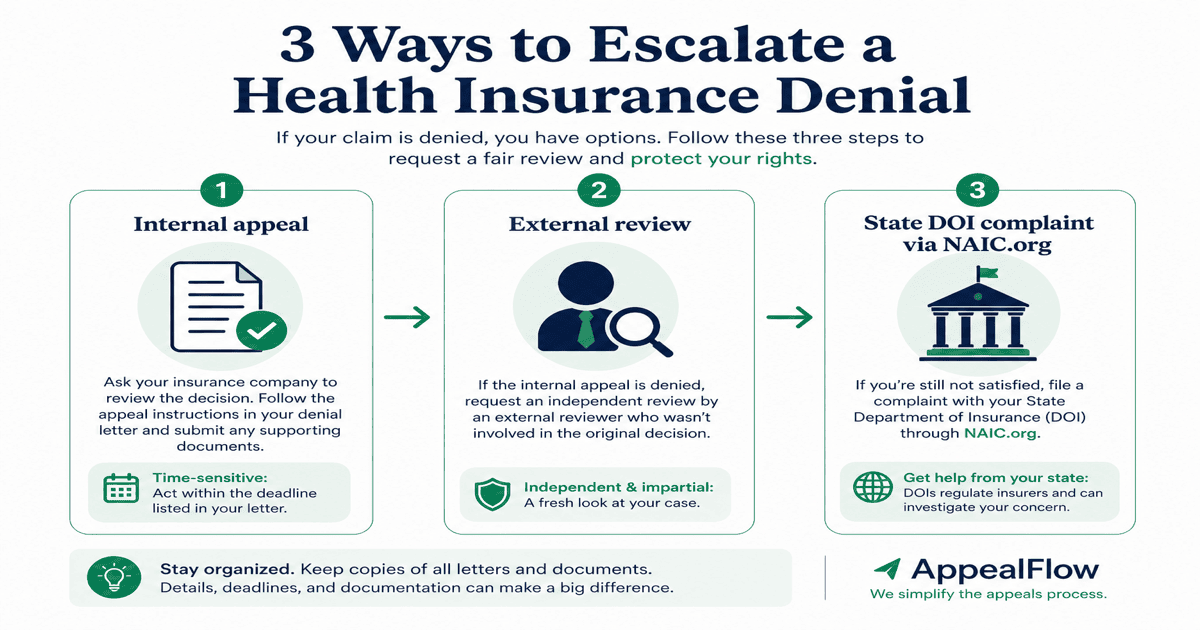
Key Takeaway: An upheld internal decision is not always the last step. Many non-grandfathered plans must offer external review when you disagree with a medical necessity determination after internal appeal.
Healthcare.gov's external-review page explains that you can ask an independent organization to review certain denials, including many medical necessity decisions, after the plan upholds an internal appeal. Keep copies of the LMN and records you already sent. External reviewers often work from the same packet.
For more context on fighting a not medically necessary label, see what to do when insurance says a claim is not medically necessary.
Frequently Asked Questions
LMN structure, prescriber attestation, clinical criteria mapping, and how the clinician letter differs from your patient appeal letter.
Generate Your Medical Necessity Appeal Letter
AppealFlow.net drafts the patient appeal letter to pair with your clinician's signed letter of medical necessity. Edit live, download PDF or Word, and file before your notice deadline.
- 100% Free
- No Signup
- PDF & Word Export
Disclaimer: This article is for educational purposes only and does not constitute medical, legal, or financial advice. AppealFlow.net is not a healthcare provider, insurance broker, or law firm. Appeal deadlines and medical policies vary by plan and program. Verify your denial notice, Healthcare.gov, CMS.gov, or Medicare.gov before you file. For medical emergencies, call 911. See our full disclaimer.