Kaiser Permanente Appeal Process
Why Does Kaiser's Integrated Care Model Change Appeals?
Key Takeaway: Kaiser Permanente combines health insurance, hospitals, and physician groups in one system. Coverage disputes often involve your Plan Physician, prior authorization, and referral rules before a separate claims payment fight begins.
Most Kaiser members receive care inside the Kaiser network from Plan Physicians and Plan Facilities. When Kaiser denies a referral, prior authorization, or formulary request, the dispute usually starts as a grievance about future care, not a reimbursement claim. When you received care outside the network and want payment, the post-service claims and appeals track in your Evidence of Coverage usually applies.
That split matters because Kaiser reviewers expect clinical records from your Kaiser medical record number. Letters from affiliated Plan Physicians that cite the plan's own utilization management criteria often carry more weight than generic frustration. Check whether your notice says grievance, appeal, or claim review before you draft your letter.
Which Kaiser Regional Plan Controls Your Appeal?
Key Takeaway: Kaiser Permanente operates through regional Kaiser Foundation Health Plan entities. Your insurance card, Member Services phone number, and Evidence of Coverage determine which appeals address and deadlines apply.
Kaiser serves members in California, Colorado, Georgia, Hawaii, Maryland, Oregon, Virginia, Washington, and Washington, D.C. California alone splits into Northern and Southern California regions with separate plan documents. Employer-sponsored Kaiser coverage, marketplace individual plans, Medicare Advantage, and Medicaid managed care each publish different member rights sections.
Do not mail an appeal to a Kaiser address you found for another state. Log in to kp.org for your region or call the Member Services number on your ID card. Regional member rights pages, such as kp.org/memberrights, describe grievance and appeal options for your plan type.
What Are the Main Levels in the Kaiser Appeal Process?
Key Takeaway: Kaiser internal review usually moves through grievance or claims appeal levels named on your denial notice. External review or state Independent Medical Review may follow when your regional plan and state law allow it.
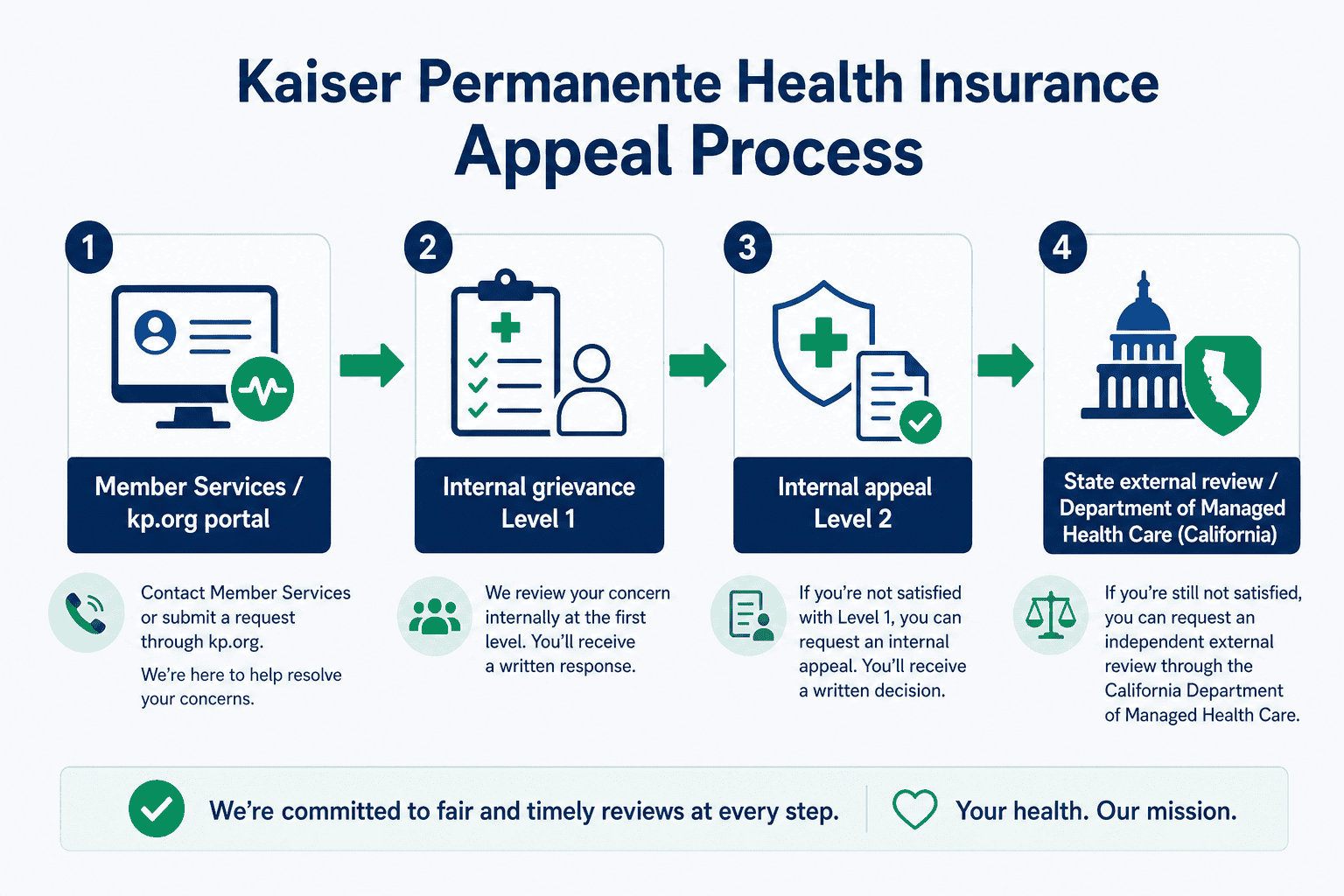
A typical Kaiser dispute for a denied service or claim moves through these stages:
- Grievance or Level 1 appeal: You ask Kaiser to reconsider a coverage denial, referral block, or payment decision with new clinical records or policy arguments.
- Appeal of the grievance decision: If Kaiser upholds the denial, your updated notice should name the next internal level and deadline. Colorado annual notices describe a 30-day response window for appeal decisions.
- External review or IMR: Qualifying state-regulated Kaiser HMO plans must allow independent review after internal processes end. California members may request Independent Medical Review through the Department of Managed Health Care.
Medicare Advantage Kaiser members follow the multi-level process on Medicare.gov. Self-funded employer Kaiser plans may follow ERISA claims procedure rules overseen by the U.S. Department of Labor.
How Do You File a Kaiser Appeal Through Member Services?
Key Takeaway: Kaiser accepts grievances and appeals by phone, through kp.org, at a Member Services office, or by mail to the regional appeals unit on your denial letter. Save confirmation numbers because appeal clocks are tied to receipt, not the day you drafted the letter.
Most Kaiser regions let you file online through the member portal, by calling Member Services, or by mailing a written request to the appeals address in your Evidence of Coverage. Colorado members may mail appeals to Kaiser Permanente Appeals Program, P.O. Box 378066, Denver, CO 80237-8066, per Kaiser Colorado annual notices.
Before you upload or mail, draft your letter with AppealFlow's free health insurance appeal letter generator or review our health insurance appeal letter sample for enclosure formatting. Include your medical record number, claim number if applicable, and the specific service or drug Kaiser denied.
Where Do You Find Kaiser Appeal Deadlines on Your Notice?
Key Takeaway: The controlling deadline is printed on your denial letter or adverse benefit determination, not a generic Kaiser blog timetable. Missing the internal window can end your case before external review is available.
| Plan type | Typical Kaiser internal appeal pattern | What to verify on your notice |
|---|---|---|
| California Kaiser HMO | Grievances generally must be filed within 180 days of the incident. Post-service claim appeals generally must be filed within 180 days of the denial letter, per California Evidence of Coverage language. | Grievance vs claims appeal track, DMHC complaint rights, and IMR eligibility language |
| Colorado Kaiser plan | Annual notices describe written appeals mailed to the Denver appeals program and 30-day decision windows for standard grievances, with faster expedited review when urgent. | Regional appeals P.O. box, expedited review criteria, and Colorado state external review rights |
| ACA marketplace Kaiser plan | Qualifying marketplace plans must provide internal appeals and external review under ACA Section 2719 and Healthcare.gov appeal rules. | Internal appeal due date, external review contact, and whether your plan is individual or small group |
| Kaiser Medicare Advantage | Medicare Advantage appeals follow Medicare redetermination and multi-level review on Medicare.gov, not commercial HMO grievance clocks. | Medicare Summary Notice or plan denial with Medicare appeal level and mailing address |
Submit several days before the printed date so kp.org uploads or certified mail delivery do not cut your time short. If your notice allows expedited review because delay would seriously jeopardize your health, say so clearly and ask your treating physician to support the urgency request.
What Documents Should You Attach at Each Appeal Level?
Key Takeaway: Kaiser reviewers approve appeals when the packet answers the exact denial reason without follow-up calls. Build a complete enclosure list before you upload or mail your letter.
- Kaiser denial letter, member ID, and medical record number
- Evidence of Coverage or Summary of Benefits section for the benefit in dispute
- Clinical notes, imaging reports, and visit records from your Plan Physician
- Physician letter tied to Kaiser utilization management or medical policy cited in the denial
- Prior authorization history and pharmacy claims for formulary or step therapy denials
For prior authorization denials, see our guide on how to appeal a prior authorization denial. Format guidance is in our post on how to write an insurance appeal letter.
Weak vs. Strong Kaiser Appeal Language
Key Takeaway: Reviewers scan for medical record number, denial reason, and attached clinical support from your Kaiser chart. Vague frustration without records rarely changes a Kaiser denial. Specific policy citations and numbered enclosures do.
| Weak statement | Strong statement |
|---|---|
| “I want to start the Kaiser appeal process.” | “Medical record number [number], denial dated [date] for [service/drug]. I request a grievance review under the Dispute Resolution section of my Evidence of Coverage per the instructions on my denial notice dated [date].” |
| “I called Member Services about this.” | “Filed written grievance on [date] through kp.org, confirmation [number], to the regional appeals unit listed on my Northern California denial letter.” |
| “My doctor says I need this treatment.” | “Enclosure 1: Plan Physician letter dated [date] citing Kaiser medical policy [section] and six weeks of failed conservative therapy documented in my Kaiser chart. Request expedited review because delay would jeopardize [specific clinical outcome].” |
Need a Kaiser Appeal Letter Draft?
AppealFlow builds a regulation-informed draft from your denial reason, regional plan, and claim details. Edit live, then download PDF or Word.
What If Your Kaiser Internal Appeal Is Denied?
Key Takeaway: Internal appeals are decided by Kaiser review units separate from your treating clinic, but still inside the integrated system. When that review upholds the denial, qualifying state-regulated Kaiser HMO plans must allow external review. Medicare Advantage and many ERISA employer plans follow different next steps.
Your updated denial letter should name the next level and deadline. ACA marketplace and many fully insured Kaiser HMO plans must offer external review at no cost under Healthcare.gov external review rules. California members may also file complaints or request Independent Medical Review through the DMHC when eligible.
If you are unsure which path applies after two denials, our guide on what to do when an insurance claim is denied walks through internal appeal, external review, and when to contact your state insurance department for fully insured plans.
Frequently Asked Questions
Common questions about the Kaiser Permanente appeal process.
Generate Your Free Kaiser Appeal Letter
AppealFlow drafts formal appeal letters for Kaiser Permanente denials and other carriers. Enter your denial details, edit the letter for your regional Kaiser plan, and export PDF or Word. No account required.
- 100% Free
- No Signup
- PDF & Word Export
Disclaimer: This article is for educational purposes only and does not constitute medical or legal advice. AppealFlow is not an insurance company or law firm. Kaiser Permanente plans, appeal deadlines, and coverage rules vary by regional Foundation Health Plan entity and plan type. Review your denial notice and Evidence of Coverage, and consult a licensed professional when appropriate. For emergencies, call 911. See our full disclaimer.