Prove Joint Pain and Tear Severity for Knee or Shoulder MRI Approval
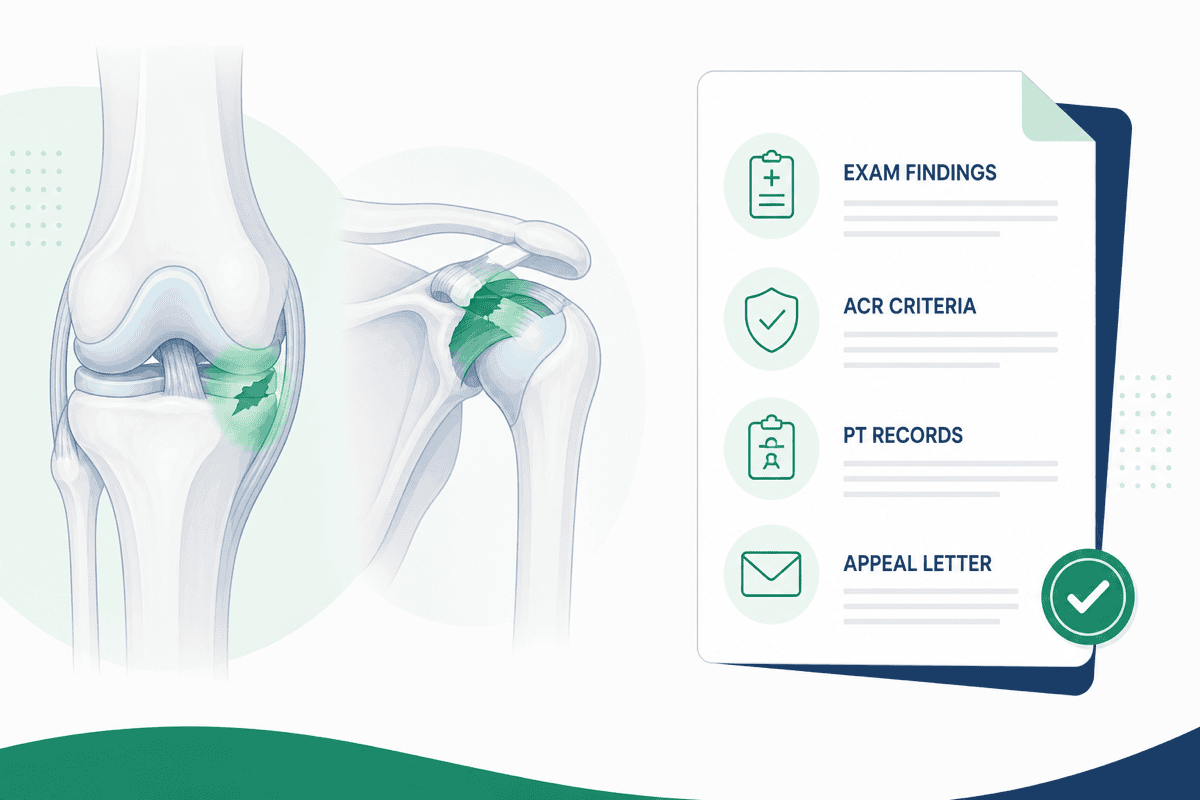
Why Do Insurers Deny Knee and Shoulder MRI Prior Authorization?
Key Takeaway: Orthopedic MRI denials usually question whether your clinical picture justifies advanced imaging, not whether MRI technology works. Your denial reason code tells you whether the gap is conservative care documentation, missing exam findings, an X-ray prerequisite, or a diagnosis code mismatch.
Musculoskeletal MRI is a high-volume prior authorization category. Read your denial letter alongside your Explanation of Benefits and note the reason code, CPT code, and any radiology benefit manager named on the notice.
- Conservative management incomplete: Plan requires documented physical therapy, NSAIDs, activity modification, or injections for a set period before MRI.
- X-ray prerequisite: MRI ordered without recent radiographs, or positive X-ray that the plan believes should guide treatment without MRI.
- Missing exam documentation: Order cites pain without objective findings such as effusion, instability, or positive special tests.
- Diagnosis code mismatch: Generic pain code without documentation supporting internal derangement or suspected tear.
Request your plan's imaging medical policy from member services. For broader MRI appeal structure, see our denied MRI medical necessity guide.
What Exam Findings Prove Knee Tear Severity for MRI Approval?
Key Takeaway: Knee MRI appeals need mechanical symptoms, effusion or instability on exam, and failed conservative care with dates when your plan requires it. ACR Appropriateness Criteria support MRI when X-ray is negative but clinical suspicion for meniscal or ligament injury remains high.
Your orthopedic or primary care visit note should document specific findings, not only knee pain. Insurer reviewers look for elements such as:
- Mechanical symptoms: locking, catching, or inability to fully extend
- Effusion documented on exam, not only patient-reported swelling
- Positive McMurray, Lachman, or varus or valgus stress tests with results recorded
- Range of motion deficits measured in degrees
- Weight-bearing tolerance and gait abnormalities when present
For acute injury with suspected complete ligament tear, ask your physician whether expedited review applies. Document instability on exam and inability to bear weight when those findings are present. See how to request an expedited insurance appeal for the member request steps.
How Do You Document Shoulder Tear Severity for MRI Appeals?
Key Takeaway: Shoulder MRI appeals require positive special tests, measured range of motion deficits, and duration of symptoms beyond any required conservative trial. ACR criteria support MRI for suspected rotator cuff or labral pathology when X-ray is unremarkable and symptoms persist after treatment.
Rotator cuff and labral pathology cannot be confirmed on standard X-ray. Your appeal should explain why clinical exam warrants MRI despite negative radiographs:
- Positive impingement signs with documented test results
- Weakness on resisted external rotation or abduction
- Night pain and functional loss such as reaching overhead or dressing
- Physical therapy attendance log with dates and duration when your plan requires conservative care
- Injection records if a corticosteroid trial was attempted
What Documents Do You Need for a Joint MRI Appeal Packet?
Key Takeaway: A complete knee or shoulder MRI appeal packet usually includes your denial letter, the ordering physician's letter of medical necessity, visit notes with exam findings, conservative treatment records, prior imaging, and an ACR scenario reference when your physician agrees it applies.
- Denial letter and Explanation of Benefits with reason code and appeal instructions
- Ordering physician letter citing diagnosis, exam findings, symptom duration, and clinical urgency
- Physical therapy, medication, or injection records with dates and outcomes when your plan requires conservative care first
- Prior X-ray or ultrasound reports and why they are insufficient for surgical planning
- ACR appropriateness scenario number and rating from ACR Search when your physician agrees it applies
How Do You Appeal a Denied Knee or Shoulder MRI?
Key Takeaway: File your internal appeal before the deadline on your notice, attach a complete clinical packet citing ACR criteria when appropriate, and request a peer-to-peer review when your plan offers one. Mark the appeal deadline the day you receive the denial.
- Identify the denial reason code. Read your EOB or prior auth denial letter. Note whether denial cites conservative management, medical necessity, or missing documentation.
- Request your complete claim file when eligible. Under ERISA claims and appeals procedures, many employer plans must provide documents used in the denial decision.
- Get an updated visit note from your ordering physician. It should include exam findings, conservative treatment timeline, and ACR criteria citation when appropriate.
- Gather supporting records: X-ray reports, physical therapy notes, injection records, and prior imaging.
- Draft and submit your formal appeal letter. Address the specific denial reason with clinical rebuttal. For format guidance, see how to write an insurance appeal letter.
- Submit through the correct radiology portal. eviCore, RadMD, Availity, or Carelon when listed on your denial. Confirm receipt.
- Follow up at 14 and 30 days. Document every call with date, representative name, and reference number.
- If denied again, request external review when eligible. Qualifying ACA and many state-regulated plans must offer independent review under ACA Section 2719 after internal appeals are exhausted.
You can start from a tailored draft using AppealFlow's MRI denial appeal generator, then have your physician review the clinical facts before submission.
Weak vs Strong Joint MRI Appeal Wording
Key Takeaway: Radiology reviewers approve appeals with objective exam findings and ACR citations, not patient pain descriptions alone. Replace vague complaints with measured deficits and dated treatment records.
| Weak wording | Strong wording |
|---|---|
| “My knee hurts badly and I need an MRI to find out what is wrong.” | “Patient presents with right knee effusion, positive McMurray test, and locking episodes for three weeks. X-ray dated [date] negative for fracture. Completed six weeks of physical therapy with attached attendance log. Physician letter cites ACR scenario for suspected meniscal tear with negative radiographs.” |
| “Doctor ordered MRI because shoulder pain is not improving.” | “Left shoulder: positive Hawkins and empty can tests, abduction limited to 90 degrees. NSAIDs for four weeks without improvement. Corticosteroid injection on [date] provided temporary relief. MRI requested to evaluate suspected rotator cuff pathology before surgical planning.” |
| “Please approve my MRI. Insurance should cover diagnostic tests.” | “Claim #[number], denial code CO-50 dated [date] for CPT 73721. I request internal appeal under my plan documents. Attached: physician letter of medical necessity, visit notes, physical therapy records, and ACR reference addressing each criterion cited in your denial.” |
Need a Knee or Shoulder MRI Appeal Letter?
AppealFlow's MRI generator drafts medical necessity language with exam findings and conservative management documentation for joint imaging denials.
Where Do You Submit Knee and Shoulder MRI Appeals?
Key Takeaway: Musculoskeletal MRI prior auth routes through radiology benefit managers or insurer portals, not pharmacy benefit managers. Submitting appeals to the wrong platform delays processing or loses documentation.
| Platform | Used by | Appeal submission |
|---|---|---|
| eviCore | UnitedHealthcare, many national plans | eviCore member or provider portal, authorization appeal workflow |
| RadMD | Multiple BCBS and regional plans | RadMD case lookup, submit appeal documentation |
| Availity | Aetna, Anthem, many regional insurers | Availity authorizations, attach appeal to denied auth number |
| Carelon | Anthem, some regional plans | Carelon portal imaging authorization appeal workflow |
Ask your ordering physician's office which portal they used for the original prior auth. File the appeal through the same system and reference the original authorization number on every document. For prior authorization disputes generally, see how to appeal a prior authorization denial.
What Are Appeal Deadlines for Joint MRI Denials?
Key Takeaway: The controlling deadline is on your denial notice. ERISA employer plans often allow up to 180 days for an internal appeal. ACA marketplace plans follow separate clocks under Healthcare.gov. Medicare uses its own redetermination timelines.
Standard internal appeals often must be decided within 30 days after complete documentation is received. Urgent appeals may require a decision within 72 hours when your physician certifies that delay could seriously jeopardize health under Healthcare.gov appeal rules. Do not assume every plan uses the same window.
Timing tip: Getting an MRI at an independent imaging center without prior auth and then appealing retroactively is difficult on many plans. File the appeal before the scan when possible, or ask about self-pay rates while the appeal is pending.
What Mistakes Delay Joint MRI Appeals?
Key Takeaway: Resubmitting the same prior auth request after denial is not an appeal. A formal appeal letter with new clinical evidence invokes different plan review standards and appeal rights.
- Appealing without updated visit notes. Stale documentation without current exam findings fails review.
- Skipping the X-ray step. If your plan requires radiographs first, complete that step before the MRI appeal.
- Vague conservative management claims. “I tried physical therapy” without attendance records is insufficient when your plan requires documented trials.
- Wrong portal submission. Appeals sent to medical claims instead of radiology auth get lost.
- Not requesting external review after internal denial. Many patients stop after one denial when independent review may be available under their plan type.
Frequently Asked Questions
Common questions about knee and shoulder MRI prior authorization appeals, ACR criteria, and submission channels.
Generate Your Joint MRI Appeal Letter
AppealFlow drafts a medical necessity appeal citing ACR criteria and your specific denial reason for knee and shoulder imaging. Edit live, then download as PDF or Word. No account required.
- 100% Free
- No Signup
- PDF & Word Export
Disclaimer: This article is for educational purposes only and does not constitute medical or legal advice. AppealFlow.net is not a healthcare provider or law firm. Appeal deadlines and imaging criteria vary by plan type and state. Verify requirements on your denial letter and plan documents before filing. For medical emergencies, call 911. See our full disclaimer.