Can Insurance Companies Deny Coverage?
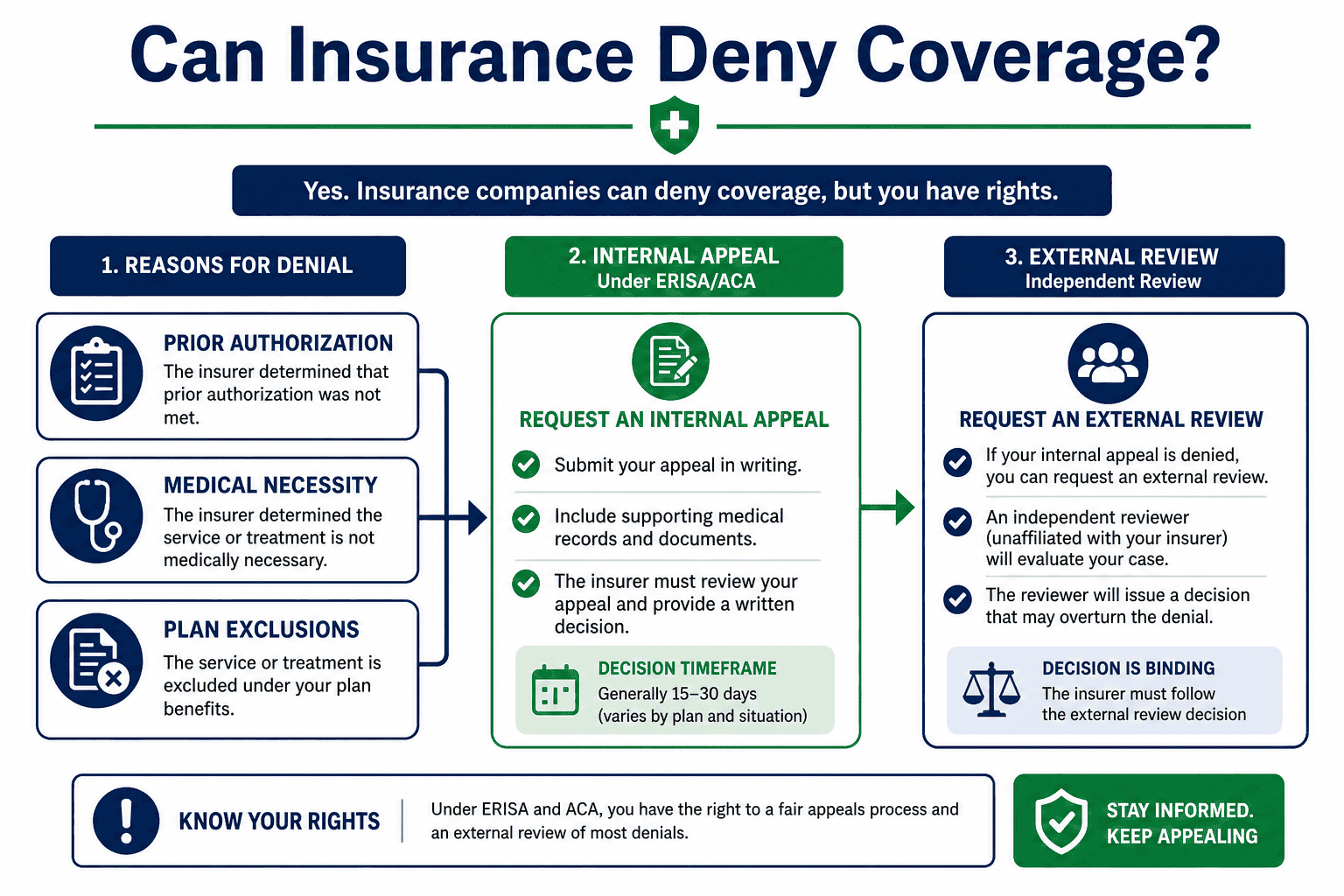
What Does It Mean When Insurance Denies Coverage?
Key Takeaway: A coverage denial means the insurer determined a service is not a covered benefit under your plan, not necessarily that you do not need the care. Coverage denials differ from billing errors and require a formal appeal with clinical documentation.
When your insurer denies coverage, they are refusing to pay for a medical service based on your plan's rules. This is different from your provider billing you incorrectly or charging out-of-network rates. A coverage denial triggers specific legal appeal rights that billing disputes do not.
Your Explanation of Benefits (EOB) and denial letter will state the reason code. Look for labels like “Denial Reason,” “Remark Code,” or “Coverage Determination.” The reason code tells you what evidence your appeal must address. For a walkthrough of claim-level denials, see can insurance deny a claim.
Why Do Insurance Companies Deny Coverage?
Key Takeaway: The five most common coverage denial reasons are missing prior authorization, medical necessity not established, plan exclusions, out-of-network services, and incorrect coding. Each requires a different appeal strategy.
- Prior authorization not obtained: Many plans require pre-approval for imaging, surgery, specialty drugs, and durable medical equipment. Without it, coverage is denied regardless of medical need.
- Medical necessity not met: The insurer's medical director reviews whether the service meets clinical criteria in the plan's medical policy. This is the most appealed denial type.
- Service excluded from plan: Cosmetic procedures, experimental treatments, and certain alternative therapies are commonly excluded. You may need a formulary exception or medical necessity override.
- Out-of-network provider: Non-emergency care from out-of-network providers is often denied or paid at reduced rates. Emergency services have federal protections under the No Surprises Act.
- Diagnosis or procedure code mismatch: Wrong ICD-10 or CPT codes trigger automatic denials even when the underlying service should be covered.
Pull your plan's Summary of Benefits and Coverage (SBC) and certificate of coverage. Cross-reference the denial reason with what your plan document actually says. Insurers sometimes deny services that are clearly covered. That is when appeals succeed fastest.
What Are Your Legal Rights When Coverage Is Denied?
Key Takeaway: Federal law guarantees your right to appeal coverage denials. ERISA covers employer-sponsored plans; ACA Section 2719 covers individual and marketplace plans. Both require insurers to provide a written decision and access to your claim file.
Under ERISA, your employer plan must give you up to 180 days to file an internal appeal in many cases. The insurer must respond within 30 days for standard appeals (72 hours for urgent appeals) and provide all documents used in the denial decision upon request.
ACA marketplace plans follow similar rules with 60-day appeal windows in most states. After internal denial, you can request external review through an independent review organization not employed by your insurer.
Medicare beneficiaries have a multi-level appeal process through Medicare.gov. Medicaid managed care appeals go through your state's Medicaid agency. Each program has specific deadlines printed on the denial notice. Missing them ends your right to appeal permanently.
Important: Calendar your appeal deadline the day you receive the denial. No exceptions, no extensions in most cases. Write the date on your denial letter and set a phone reminder 30 days before it expires.
How Do I Appeal a Coverage Denial?
Key Takeaway: File your internal appeal before the deadline, attach a complete clinical packet, and request a written decision. Keep copies of everything you submit and document every phone call.
- Request your complete claim file. Under ERISA, you have the right to all documents the insurer used to deny coverage. Request this in writing within 10 days of receiving the denial.
- Get a letter of medical necessity from your provider. It must address the specific denial reason, not a generic note saying you need the treatment.
- Gather supporting records: clinical notes, lab results, imaging reports, prior auth submissions, and relevant treatment history.
- Write your formal appeal letter. Cite your member ID, claim number, denial reason code, and the specific plan provision or federal law supporting coverage.
- Submit through the correct portal. Use Availity, your carrier's member portal, or certified mail. Confirm receipt and get a reference number.
- Follow up at 14 and 30 days. Insurers must respond within 30 days for standard appeals. Document every call with date, representative name, and reference number.
- If denied again, request external review. An independent reviewer evaluates your case under ACA or state external review rules. See how to request external review.
Weak vs. Strong Appeal Language (Before & After)
Key Takeaway: Insurer medical directors approve appeals with specific clinical evidence and plan citations, not emotional appeals. Replace vague statements with dated metrics, ICD-10 codes, and policy references.
| Weak Statement | Strong Statement |
|---|---|
| “I need this surgery and my doctor says it's necessary.” | “Patient (ICD-10 M51.16) requires L4-L5 microdiscectomy per ACR Appropriateness Criteria. Conservative treatment failed: 12 weeks PT (dates 3/1–5/30), epidural injection 4/15 with no improvement. MRI 6/1 confirms disc herniation with nerve root compression.” |
| “Please cover my medication. It's FDA approved.” | “I request formulary exception for [drug]. Step therapy satisfied: metformin 1000mg BID × 90 days (documented HbA1c reduction 0.3%), intolerable GI side effects per prescriber note dated 7/12. No covered formulary alternative meets clinical need per denial code FORM-02.” |
| “Your denial is unfair. I've paid premiums for years.” | “I formally appeal denial #CLM-2026-44821 under ERISA and ACA Section 2719. Attached: letter of medical necessity, clinical records, and plan SBC page 14 confirming coverage for outpatient surgical procedures with prior authorization, which was obtained on 5/20/2026 (ref PA-8834).” |
Need a Coverage Denial Appeal Letter?
AppealFlow drafts a formal appeal letter citing ERISA rights, medical necessity standards, and your specific denial reason. Edit live, then download as PDF or Word.
When Can Insurance NOT Deny Coverage?
Key Takeaway: Federal law prohibits insurers from denying coverage based on pre-existing conditions, gender, or genetic information. Emergency services must be covered at in-network rates regardless of network status.
The Affordable Care Act eliminated pre-existing condition exclusions for individual and marketplace plans. Employer plans with 15 or more employees have the same protection. Insurers cannot charge higher premiums or deny enrollment because of your health history.
Preventive services, including annual physicals, screenings, and immunizations, must be covered at no cost under ACA requirements for most non-grandfathered plans. If your plan denies a preventive service, check whether it was coded correctly and whether your plan is ACA-compliant.
Emergency room visits are covered at in-network cost-sharing rates under the prudent layperson standard. If you went to the ER believing you had a medical emergency, the insurer cannot deny coverage simply because the hospital was out-of-network. See our guide on disputing out-of-network ER bills under the No Surprises Act.
What Appeal Timelines Should I Expect?
Key Takeaway: Standard internal appeals must be decided within 30 days under federal rules for many plans. Urgent appeals have a 72-hour clock. External review adds another 45 to 60 days after an internal denial.
- Expedited (urgent) appeal: 72 hours when delay poses serious health risk
- Standard internal appeal: 30 days from receipt of complete documentation
- External review: 45 to 60 days after internal denial, depending on plan type
The single biggest factor in appeal quality is whether your provider's letter of medical necessity addresses the specific denial reason code. Generic letters rarely change the outcome. For more on why insurers deny claims in the first place, see why health insurance companies deny claims.
Five Mistakes That Kill Coverage Appeals
Key Takeaway: Avoid resubmitting the same prior auth request after a denial. That is not an appeal. A formal appeal letter with new clinical evidence triggers different legal protections and review standards.
- Missing the appeal deadline. No exceptions in most plans. Calendar it immediately.
- Appealing to the wrong entity. Medical denials go to your carrier; pharmacy denials go to your PBM.
- Generic provider letters. Demand a detailed letter addressing the specific denial code.
- Not requesting your claim file. Insurers sometimes deny based on records you have never seen.
- Stopping after one denial. External review is your strongest remaining option and many patients never use it.
Frequently Asked Questions
Answers to the most common questions about whether insurance companies can deny coverage.
Generate Your Free Coverage Appeal Letter
AppealFlow.net drafts a formal appeal letter citing ERISA rights, medical necessity standards, and your specific denial reason. Edit it live, then download as PDF or Word. No account required.
- 100% Free
- No Signup
- PDF & Word Export
Disclaimer: This article is for educational purposes only and does not constitute medical or legal advice. AppealFlow.net is not a healthcare provider or law firm. Always review appeal letters with your provider before submission. For medical emergencies, call 911. See our full disclaimer.