Doctor Insurance Network Denials: How to Fight Back
What Is a Doctor Insurance Network Denial?
Key Takeaway: A network denial means your plan treated the physician as out-of-network for billing purposes. That raises your cost-sharing or eliminates plan payment even when the care itself was appropriate.
Your Explanation of Benefits shows how the claim was adjudicated. Look for remark codes such as provider not in network, no out-of-network benefit, or referral required. The denial letter should list your member ID, claim number, date of service, and the appeal address or portal.
Network status is a billing relationship, not a judgment about medical quality. Plans deny when the physician lacks a contract on your date of service, when administrative requirements were missed, or when federal surprise billing rules were not applied to a protected visit. Your response depends on which scenario fits.
Why Do Plans Deny Doctor Claims as Out-of-Network?
Key Takeaway: The five most common triggers are no network contract, missing referral or prior authorization, provider directory error, surprise billing at an in-network facility, and inadequate specialist access. Each one calls for different evidence.
- No network contract: The physician never participated in your plan or terminated the contract before your visit.
- Missing referral or prior authorization: HMO and EPO plans may require a PCP referral even for in-network specialists.
- Provider directory error: The doctor appeared in-network when you scheduled, but the claim processed as out-of-network.
- Surprise billing at an in-network facility: An out-of-network ER physician, anesthesiologist, or radiologist treated you at an in-network hospital.
- Network inadequacy: No in-network specialist is available within required distance or wait-time standards for your condition.
Cross-check the denial reason against your plan's provider directory and referral rules before you call member services. For a broader overview of claim denials, see what to do when an insurance claim is denied.
How Do I Fight a Doctor Network Denial Step by Step?
Key Takeaway: Confirm your deadline first. ERISA employer plans often allow 180 days from notice, but Medicare, Medicaid, and marketplace plans use different clocks printed on your denial. Calendar the date the day you receive the letter.
- Read your denial letter and EOB. Note the appeal deadline, claim number, remark code, and whether the plan applied out-of-network cost-sharing or denied payment entirely.
- Verify network status independently. Check the online directory, call provider relations to confirm contract status on your date of service, and save screenshots with timestamps.
- Choose your dispute path. Insurer appeals challenge plan processing. No Surprises Act disputes challenge provider balance bills for protected emergency or facility-based care. Some visits require both tracks.
- Request a single-case agreement or continuity-of-care exception when appropriate. Ask the physician's billing office to pursue an SCA before elective treatment. For ongoing care, cite transition-of-care language in your plan document.
- Write and submit your formal appeal. Cite the specific exception, attach proof, and send through the portal or mailing address on your denial notice. Keep copies of everything.
- Escalate if denied again. Request external review for qualifying non-grandfathered plans or file a complaint with your state insurance commissioner for fully insured coverage.
Appeal deadlines vary by plan type. Our guide on how long you have to appeal a health insurance denial walks through ERISA, ACA, Medicare, and Medicaid clocks.
When Does the No Surprises Act Apply to Out-of-Network Doctors?
Key Takeaway: Federal surprise billing rules cover emergency services, air ambulance in many cases, and certain non-emergency care at in-network hospitals and ambulatory surgical centers. They generally do not cover voluntary elective out-of-network specialist visits or Original Medicare and Medicaid bills.
CMS No Surprises Act consumer guidance describes three protected settings for most job-based and marketplace plans:
- Emergency services: Out-of-network ER physicians cannot balance bill you beyond in-network cost-sharing.
- Non-emergency at in-network facilities: Out-of-network anesthesiologists, radiologists, pathologists, and other facility-based specialists cannot balance bill unless they provided valid written notice and you consented at least 72 hours in advance.
- Air ambulance: Balance billing restrictions apply in most circumstances covered by federal rules.
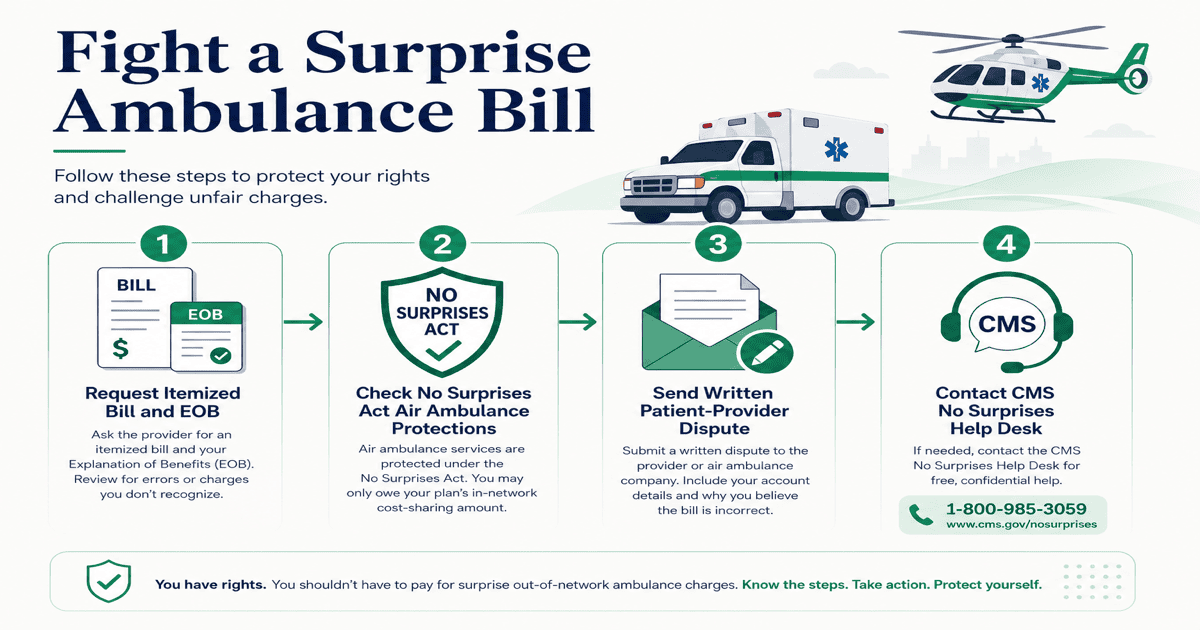
If you receive a balance bill for protected care, dispute it in writing to each billing entity and send a copy to your insurer. Contact the CMS No Surprises Help Desk at 1-800-985-3059 if collection continues. For ER-specific steps, read our guide on No Surprises Act dispute resolution for out-of-network ER bills.
Got a Surprise Doctor Bill at an In-Network Facility?
Use AppealFlow's No Surprises Act generator to draft a patient-provider dispute letter citing balance billing limits and in-network cost-sharing for protected services.
What Documents Do I Need for a Network Appeal?
Key Takeaway: Match each document to the exception you are claiming. A directory error appeal needs screenshots. A network adequacy appeal needs member services call logs. An emergency dispute needs proof the visit was emergency care.
- Denial letter and Explanation of Benefits with remark codes
- Provider directory screenshots with URL and date visible
- Appointment confirmation and scheduling call reference numbers
- PCP referral letter or prior authorization history when required
- Member services call logs documenting network inadequacy searches
- Treatment records for continuity-of-care or medical necessity arguments
- Hospital and physician bills for No Surprises Act disputes
Provider Directory Errors: Your Strongest Appeal Ground
Key Takeaway: If your doctor was listed as in-network when you booked, save directory screenshots immediately. Federal and state directory accuracy rules give insurers obligations to maintain current listings.
ACA marketplace plans and Medicare Advantage plans face federal provider directory standards. Many states also regulate directory accuracy for fully insured commercial plans. When you relied on an inaccurate listing in good faith, cite the applicable rule in your appeal and request retroactive in-network adjudication.
Build your directory error packet with:
- Screenshots of the insurer's online directory showing in-network status
- Appointment confirmation with the scheduling date
- Member services call logs with reference numbers and representative names
- Written verification from the physician's office if they confirmed network status
What If No In-Network Specialist Exists?
Key Takeaway: Health plans must maintain adequate networks, but the standard depends on plan type. Document every member services search before you claim inadequacy.
| Plan type | Adequacy standard | How to document failure |
|---|---|---|
| ACA marketplace (QHP) | Federal time-and-distance standards by specialty and county | Member services call logs; state marketplace complaint |
| Medicare Advantage | CMS network adequacy and appointment wait time rules | Plan grievance; Medicare help line escalation |
| Medicaid managed care | State-specific access standards | State Medicaid ombudsman complaint with call documentation |
| Commercial fully insured | State insurance department network adequacy rules | Formal appeal plus state insurance commissioner complaint |
Ask member services: “Please identify an in-network [specialty] provider within [X] miles who can see me within 30 days.” If they cannot, record the representative's name and reference number. Pair the log with a referral letter from your PCP explaining clinical urgency.
Weak vs. Strong Appeal Language
Key Takeaway: Appeals reviewers respond to specific claim numbers, directory evidence, federal law citations, and network inadequacy documentation. Generic complaints about premium costs rarely change adjudication.
| Weak statement | Strong statement |
|---|---|
| “I didn't know my doctor was out-of-network. Please pay the claim anyway.” | “I appeal denial CO-45 for claim #NET-2026-88214. Dr. Smith (NPI 1234567890) was listed as in-network on [Insurer] provider directory on 3/12/2026 (screenshot attached). I scheduled on 3/14/2026 based on that listing. Request retroactive in-network adjudication per applicable provider directory accuracy rules.” |
| “There are no good doctors in my plan's network.” | “I request a network adequacy exception for pediatric neurology (ICD-10 G40.9). Member services call 4/2/2026 (ref #MS-44821) confirmed no in-network pediatric neurologist within 50 miles with appointment availability under 90 days. Attached referral from PCP documenting urgent seizure management.” |
| “The ER doctor sent me a huge bill. My insurance should cover it.” | “I dispute balance billing for emergency physician services at In-Network General Hospital ER on 5/8/2026. Under the No Surprises Act, out-of-network emergency providers at in-network facilities cannot balance bill beyond in-network cost-sharing. I owe $150 ER copay per EOB. Request corrected claim at in-network rate.” |
For insurer-side network appeals, see our guide on appeal letters for out-of-network coverage and how to write an insurance appeal letter.
Continuity of Care and Single-Case Agreements
Key Takeaway: If your doctor is leaving your plan's network mid-treatment, request continuity-of-care protection immediately. For one-time specialist needs, ask your plan and provider to negotiate a single-case agreement before the date of service.
Continuity-of-care protections apply when you have an established relationship with a provider who is terminating network participation during active cancer treatment, pregnancy, or post-surgical recovery. Submit your request in writing within the window your plan document specifies.
A single-case agreement is a one-time contract between your insurer and an out-of-network provider to pay at in-network rates for a specific episode of care. The specialist's billing office typically initiates the request with diagnosis, CPT codes, and documentation that no adequate in-network alternative exists.
What Timelines Should I Expect?
Key Takeaway: Internal appeals on commercial plans often resolve within 30 days of complete documentation. External review and state complaints add more time. Dispute protected surprise bills in writing before you pay when possible.
- Insurer internal appeal: Many plans respond within 30 days after receiving your complete packet, per ACA Section 2719 and ERISA claims procedure rules.
- External review: Often 45 to 60 days after an internal denial on qualifying plans.
- No Surprises Act dispute: Send a written patient-provider dispute to each billing entity and keep your insurer copied. CMS operates a Help Desk at 1-800-985-3059 for unresolved balance billing on protected services.
Common mistake: Paying an out-of-network balance bill before disputing it. For No Surprises Act-protected services, send your written dispute first and keep proof of mailing or portal upload.
Common Mistakes That Kill Network Appeals
Key Takeaway: Missing deadlines, skipping directory screenshots, and confusing elective out-of-network care with federally protected surprise billing are the errors we see most often on network denial appeals.
- Not verifying network status before treatment. Call your insurer and the physician's billing office. Save confirmation reference numbers.
- Not saving directory screenshots. Online directories change. Capture proof at scheduling time, not after the denial arrives.
- Paying balance bills without disputing. For No Surprises Act-protected services, dispute before paying when possible.
- Missing the appeal deadline. Calendar it the day you receive the denial or balance bill.
- Stopping after one internal denial. External review and state insurance department complaints remain available on many fully insured and marketplace plans.
Frequently Asked Questions
Common questions about doctor insurance network denials, surprise billing, and appeal options.
Draft Your Network Denial Dispute Letter
AppealFlow drafts No Surprises Act dispute letters for emergency and facility-based balance bills, plus general insurer appeal letters for network exception claims. Edit live, then download PDF or Word.
- Free
- No signup
- PDF and Word export
Disclaimer: This article is for educational purposes only and does not constitute medical or legal advice. AppealFlow is not a healthcare provider or law firm. Network appeal outcomes depend on your plan type, state law, and the evidence you submit. Review appeal letters with your treating physician when appropriate. For medical emergencies, call 911. See our medical disclaimer.