Insurance Card Numbers: Member ID, Group Number & Appeals
What Numbers on Your Insurance Card Matter for Appeals?
Key Takeaway: Medical appeals use the front of your card: member ID, group or policy number, and the claim reference from your EOB. Pharmacy appeals add RX BIN, PCN, and RX Group from the back. Mixing medical and pharmacy identifiers is one of the most common reasons appeals get returned before review.
Your plastic card or digital ID holds six to ten identifiers. Not every field belongs on every form. For a denied medical claim, start with your member ID, group or policy number, and the claim number printed on your Explanation of Benefits. For a prescription denial, you may also need pharmacy routing numbers from the card back.
If your appeal packet is missing an identifier or uses a transposed digit, the payer may return it as incomplete. That can delay review until you resubmit with corrected numbers. The appeal deadline is printed on your denial notice and varies by plan type. See how long you have to appeal a health insurance denial for ERISA, Medicare, and Marketplace differences.
What Is the Difference Between Member ID, Group Number, and Policy Number?
Key Takeaway: Member ID identifies you as an individual beneficiary. Group or policy number identifies the plan contract. Appeals need both, plus the specific claim number from your EOB, to reach the right adjudication team.
Insurers label these fields differently, but the roles are consistent:
- Member ID (Subscriber ID): Your personal identifier. Dependents may have their own ID or a suffix on the subscriber's number (for example, W12345678-01). Use the ID printed on your card, not another household member's.
- Group Number: Ties you to a specific employer or association contract. Coworkers share a group number but have different member IDs. On some Medicare Advantage cards, this may appear as Plan ID.
- Policy Number: On individual marketplace plans, the policy number often replaces the group number. Some cards show both. Use whichever field your insurer's appeal form requests. See our guide on health insurance policy numbers for claims and appeals if the labels on your card are unclear.
For Medicare beneficiaries, the Medicare Beneficiary Identifier (MBI) replaced the old Social Security-based Health Insurance Claim Number. Your red-white-and-blue Medicare card shows the MBI. If you have Medicare Advantage, your plan card shows a separate member ID from the private plan. Use the plan card ID for Advantage appeals and the MBI for Original Medicare appeals.
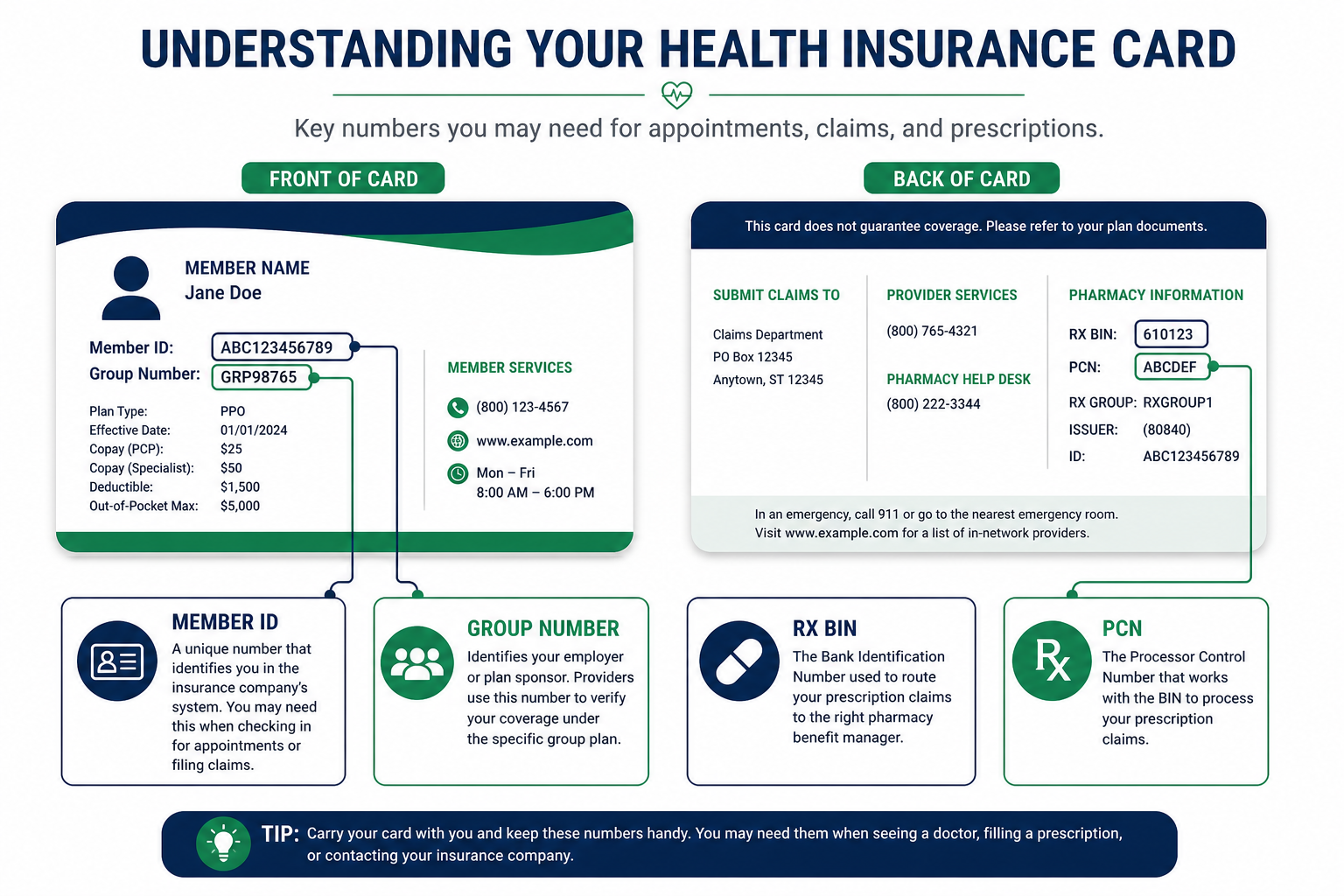
What Is on the Front vs. Back of Your Insurance Card?
Key Takeaway: The front identifies you and your medical plan. The back holds pharmacy routing numbers and customer service contacts. Medical claims use the front; pharmacy claims use the back.
Medical and pharmacy benefits are often administered by different companies. Aetna medical with Caremark pharmacy, or UnitedHealthcare medical with OptumRx, are common pairings. Each side of the card routes to a separate claims system.
Typical front-of-card fields:
- Member / Subscriber ID: Your unique identifier (often 9 to 14 characters, may include letters)
- Group Number: Your employer's or plan sponsor's contract with the insurer
- Plan Name / Type: HMO, PPO, EPO, or Medicare Advantage designation
- Effective Date: When your current coverage period began
Typical back-of-card fields:
- RX BIN, PCN, and Group: Pharmacy routing identifiers for prescription claims
- Member Services / Claims Phone: Appeal status and EOB questions
- Pharmacy Benefits Phone: Prior auth and formulary appeals
- Claims Mailing Address: Where to send paper appeals when portal submission is unavailable
How Do I Use Member ID and Group Number on an Appeal Form?
Key Takeaway: Gather member ID, group or policy number, and the claim or prior auth reference from your EOB before you start. Transcribe every character exactly, including leading zeros and letter suffixes.
When filing an appeal, collect these identifiers first:
- Member / Subscriber ID from the front of your current card
- Group or Policy Number from the front of your card
- Claim Number or Prior Auth Reference from your EOB or denial letter
- Date of Service for the denied claim
- Provider NPI from your EOB or your doctor's office
- RX BIN, PCN, Group (pharmacy appeals only) from the back of your card
Your insurer's member portal may auto-populate your ID when you log in. For paper or fax appeals, copy each field character by character. Member ID “W01234567” is not the same as “W1234567.” If you are appealing for a dependent or elderly parent, confirm you are authorized to act on their behalf. Some portals require the subscriber to log in; others accept a signed HIPAA authorization with a paper appeal.
For step-by-step filing instructions, see how to file a health insurance appeal.
What Pharmacy Numbers (RX BIN, PCN, Group) Do I Need?
Key Takeaway: RX BIN routes your prescription claim to the correct PBM. PCN and Group further direct processing within that network. Missing any one of these on a pharmacy prior auth or appeal can cause automatic rejection.
Pharmacy identifiers work like routing numbers on a check. They tell the pharmacy system which PBM processes your claim:
- RX BIN (6 digits): Identifies the PBM network. Every pharmacy claim starts here.
- RX PCN (2 to 10 characters): Processor Control Number within the PBM. Not all cards display a PCN. Leave the field blank on appeal forms unless the form marks it required.
- RX Group: Identifies your employer's pharmacy benefit tier. Different group numbers within the same PBM can have different formularies and copay structures.
If your card does not show RX identifiers, log into your PBM member portal or call the pharmacy benefits number on the card back. After open enrollment or an employer plan change, these numbers often change even if your medical member ID stays the same.
Weak vs. Strong: ID Fields on Appeal Letters
Key Takeaway: Appeal forms get rejected when identifiers are missing, transposed, or pulled from the wrong card. Replace vague references with exact fields from your current insurance card and EOB.
| ❌ Weak Request | ✓ Strong Request |
|---|---|
| “My insurance ID is on file with the doctor. Please process my appeal.” | “Member ID: W123456789, Group: 00123456, Claim #: 2026-04-88712 (EOB dated 07/15/2026). Patient: Jane Doe, DOB 03/14/1958. I request internal appeal of denial code MN-001.” |
| Appeal form filled with medical card member ID for a pharmacy prior auth denial. | Pharmacy appeal submitted with RX BIN 003858, PCN A4, Group RXGRP01, and PBM member ID verified on the PBM portal before submission. |
| “I used my old insurance card because the new one has not arrived yet.” | Downloaded current digital ID card from insurer mobile app (effective 01/01/2026). Verified member ID changed after employer switched pharmacy vendors and updated all pending appeals with new identifiers. |
Have Your Denial Letter and Member ID Ready?
AppealFlow's free generator drafts a formal appeal letter with member ID, group number, claim details, and appeal rights language. Edit live, then download as PDF or Word.
Where Can I Find Current ID Numbers Online?
Key Takeaway: If your physical card is missing numbers or outdated, your insurer's member portal and PBM website display current identifiers. Digital cards update faster than mailed plastic, especially after open enrollment.
Check the back of your card for your PBM name, then use the correct portal:
| Platform | Used By | Where to Find IDs |
|---|---|---|
| Availity | Multiple insurers; provider and member portals | Member login, Coverage & Benefits, ID Card |
| Express Scripts | Cigna, some BCBS plans | Member portal, Profile, Insurance Information |
| OptumRx | UnitedHealthcare, some employer plans | OptumRx.com, Account, Plan Details |
| Caremark (CVS) | Aetna, CVS Health plans | Caremark.com, View ID Card |
| CoverMyMeds | Multiple PBMs; prior auth tracking | Patient lookup by key code from prescriber |
Patients filing their own appeals should use their insurer's member portal directly. If your portal shows different numbers than your physical card, trust the portal. Plastic cards printed before a mid-year plan change may carry outdated identifiers.
What Mistakes Delay Claims and Appeals?
Key Takeaway: Transposed digits, outdated cards, and mixing medical IDs with pharmacy IDs cause preventable denials and returned appeal packets. Verify every number against your current card and EOB before submission.
- Using an expired card after open enrollment. New plan year, new numbers. Download the current digital card before your first appointment or refill in January.
- Submitting the subscriber ID when your dependent ID is required. Some systems need the suffix (-01, -02). Check your EOB to see which format was used on the original claim.
- Confusing medical and pharmacy member IDs. Your PBM may assign a different member ID than your medical plan, especially after a PBM switch.
- Leaving the claim number off your appeal. Without the specific claim or prior auth reference, your appeal cannot be matched to the denied transaction.
- Dropping leading zeros. Member ID “001234567” submitted as “1234567” fails automated matching.
Common myth: Your Social Security number replaces your member ID on appeal forms. Insurers phased out SSN-based identifiers years ago. Use the member ID or MBI printed on your current card. Never enter your Social Security number unless the form explicitly requires it.
Frequently Asked Questions
Answers to common questions about insurance card numbers for claims and appeals.
Generate Your Free Appeal Letter
AppealFlow drafts a formal appeal letter with your member ID, group number, claim details, and denial reason. Edit it live, then download as PDF or Word. No account required.
- 100% Free
- No Signup
- PDF & Word Export
Disclaimer: This article is for educational purposes only and does not constitute medical or legal advice. AppealFlow is not a healthcare provider or law firm. Insurance card layouts vary by plan and insurer. Always verify identifiers with your plan's member services. For medical emergencies, call 911. See our full disclaimer.