Mental Health Treatment Denial Appeal Letter
Start With the Denial Notice and Plan Type
Key Takeaway: Identify the program first: employer group, Marketplace or other individual coverage, Medicaid, or Medicare. The letter tells you the reason, the deadline, and where to file. A parity sentence does not move a Medicaid fair hearing or a Medicare redetermination clock.
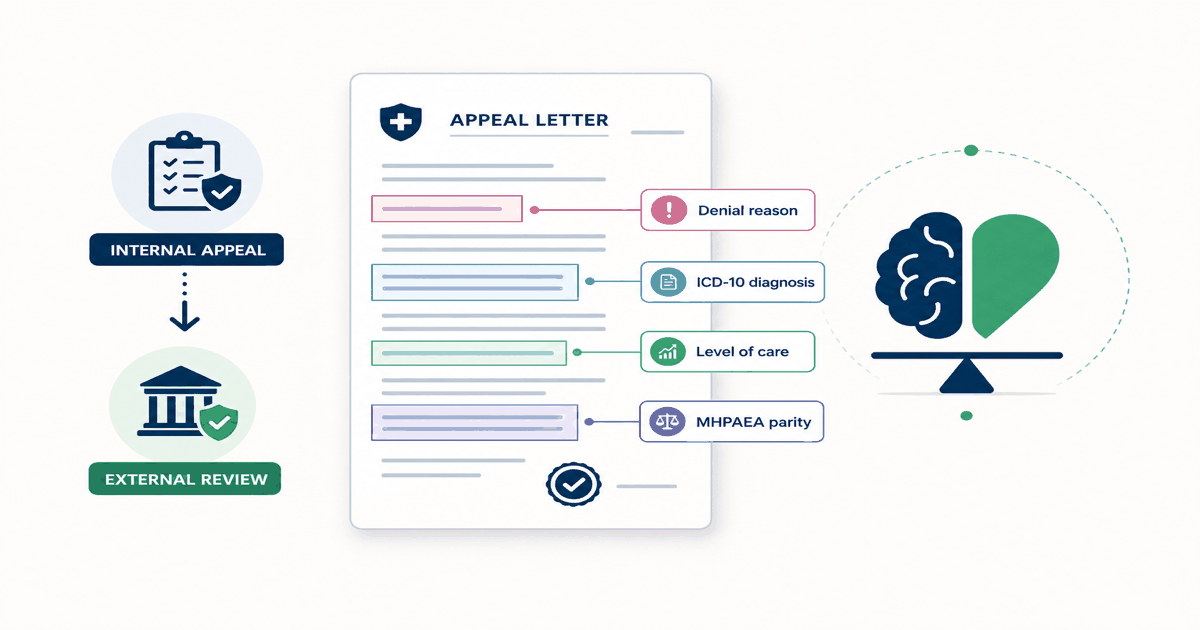
A mental health treatment denial appeal letter is your formal internal appeal after the plan denies coverage for behavioral-health care. It is not the same as the clinician's letter of medical necessity. You identify the denial, cite your rights, and direct the reviewer to the clinical evidence in your attachments. Mental health and substance-use disorder denials often cite medical necessity, visit limits, prior authorization, or network status.
If you are new to appeals, start with our guide on how to write an insurance appeal letter. For medical-necessity denials generally, see the medical necessity appeal letter template. The behavioral-health version adds level-of-care language and, when relevant, a parity comparison under MHPAEA.
Healthcare.gov's internal-appeals page states that you can file an internal appeal if the plan will not provide or pay some or all of the cost for services you believe should be covered, including when the plan says the treatment is not medically necessary. You must file that internal appeal within 180 days of receiving notice that the claim was denied.
That 180-day figure is the Healthcare.gov commercial and Marketplace filing window. It is not a Medicaid fair-hearing deadline and it is not a Medicare redetermination clock. If the notice in your hand is shorter than the rule for your plan type, file anyway and quote the federal page that applies. Keep the envelope or portal confirmation.
| Denial reason on notice | First action in your appeal letter |
|---|---|
| Not medically necessary | Attach a clinician letter with ICD-10, level of care, failed lower levels, and functional impairment |
| Visit or day limit reached | Request the medical/surgical analog under MHPAEA and show why continued care is clinically required |
| Prior authorization denied or expired | Cite the authorization reference number and attach records that meet the plan's clinical policy |
| Out of network | Address network adequacy or continuity-of-care if your state or plan documents allow an exception |
What Is Mental Health Parity Under MHPAEA?
Key Takeaway: Parity is a comparison. The U.S. Department of Labor describes MHPAEA protections for group health plans and insurers: financial requirements and treatment limitations on mental health or substance-use disorder benefits generally may not be more restrictive than those applied to medical or surgical benefits in the same classification. It is not a requirement that every plan cover unlimited therapy.
The Department of Labor's MHPAEA page describes protections against higher costs and extra restrictions on mental health and substance-use disorder benefits when similar medical or surgical benefits exist. DOL states that plans generally cannot charge higher copays to see mental health providers than they charge for comparable medical or surgical care, that visit limits on mental health benefits cannot be more restrictive than those applied to medical or surgical visits, and that written treatment plans or blanket preauthorization should not be demanded for mental health if similar requirements are not used for medical or surgical care.
A plan can still use medical-necessity criteria, networks, and visit limits if the comparable medical/surgical classification is treated as strictly. The appeal question is whether the limit, copay, prior-authorization rule, or fail-first requirement is more restrictive than the analog. Ask the plan in writing for the medical/surgical comparison it used. HHS parity FAQs explain how federal agencies apply these rules.
What Documents Should I Attach to a Behavioral-Health Appeal?
Key Takeaway: Healthcare.gov tells you to submit any additional information you want the insurer to consider, such as a letter from the doctor, and to keep copies of the EOB, the appeal request, and notes from phone calls. Name the level of care and the criteria the denial cites.
Match the packet to the denial reason. A medical-necessity denial needs clinical support for the recommended level of care, not a general request for more counseling. For how medical-necessity letters are structured on commercial claims, see what to do when a claim is denied as not medically necessary.
- The denial letter or EOB and the medical-necessity or visit-limit criteria it cites
- A clinician letter with diagnosis (ICD-10), recommended level of care, failed or insufficient lower levels of care, safety or functional impairment, and a treatment plan
- Session notes, a recent assessment, or a discharge summary that supports that level of care
- Any written parity comparison you requested: the medical/surgical analog for the copay, visit cap, or prior-authorization rule
- For a medication denial, the prescriber's supporting statement and tried alternatives
How Do I Write and File the Appeal Letter?
Key Takeaway: Complete the plan's forms or write a letter with your name, claim number, and member ID. Healthcare.gov says the plan must finish a pre-service internal appeal within 30 days and a post-service appeal within 60 days, then send a written decision that explains how to request external review.
Healthcare.gov lists three steps: a claim is filed, the plan denies it in writing, and you file the internal appeal. You can complete the insurer's forms or write to the insurer with your name, claim number, and health insurance ID number, and attach the extra clinical information. Your state Consumer Assistance Program may be able to file an appeal for you.
Keep originals and send copies, except where the plan requires the original appeal request. Write down the day, time, name, and title of anyone you speak with. If the plan uses two internal levels, the second level is a shorter follow-up window on the same case, not a new 180-day clock. You can draft your medical necessity appeal letter with AppealFlow, then edit and file it through the portal or address on your notice.
Draft a Medical-Necessity Appeal Letter
AppealFlow drafts a letter from the denial reason and clinical facts you enter. You still file it through the portal or address on the notice. A draft is not a filed appeal or a coverage decision.
When Can I Request an Expedited Mental Health Appeal?
Key Takeaway: Healthcare.gov lets you file an expedited appeal if the standard timeline would seriously jeopardize your life or your ability to regain maximum function. In urgent situations you can request external review at the same time as the internal appeal. Have the treating clinician say why the delay is unsafe.
On the same internal-appeals page, Healthcare.gov states that a final decision on an urgent appeal must come as quickly as your medical condition requires, and at least within 4 business days after the request is received. That decision can be delivered verbally and must be followed by a written notice within 48 hours.
Examples that often meet that urgency test, if the clinician documents them, include an imminent discharge or step-down from inpatient or residential care, or a medication that cannot be interrupted without a serious risk. A routine outpatient scheduling delay is a different fact pattern. For the request language and what to attach, see how to request an expedited insurance appeal.
What Happens After a Final Internal Denial?
Key Takeaway: Healthcare.gov requires a written request for external review within 4 months after you receive the insurer's notice or final determination. Denials that involve medical judgment or experimental or investigational treatment can go to external review. The insurer must accept the reviewer's decision.
Healthcare.gov's external-review page states that standard external reviews are decided as soon as possible, no later than 45 days after the request is received, and expedited external reviews no later than 72 hours, or less depending on medical urgency. Your state may run a process that meets or goes beyond the federal floor; otherwise HHS oversees a federal process. The contact is on the final denial.
A medical-necessity denial for therapy, PHP, or inpatient psychiatric care is typically a medical-judgment denial. Follow the steps in how to request an external review after an insurance denial. External review is not a Medicare QIO appeal and is not a Medicaid fair hearing.
Weak vs. Strong Wording on a Mental Health Appeal
Key Takeaway: Name the claim number, the level of care, the criteria cited, and, if you are raising parity, the medical/surgical comparison. A sentence that parity means the plan must pay is not an argument the examiner can apply.
| ❌ Weak Request | ✓ Strong Request |
|---|---|
| “I need more therapy. This denial is unfair.” | “Claim #[number], denied [date] as not medically necessary for [IOP / PHP / inpatient / outpatient CPT]. Attached is Dr. [name]'s letter dated [date] with ICD-10 [code], failed lower levels of care, and current safety / functional impairment. Please apply the plan's cited criteria to this record and reverse the denial.” |
| “Federal parity law means I get unlimited visits.” | “This plan covers MH/SUD benefits. The [visit cap / prior-authorization / fail-first rule] applied to [service] is more restrictive than the medical/surgical analog in the same classification. Please produce the comparison required under MHPAEA, as described by the Department of Labor, and reprocess the claim under the comparable medical/surgical standard.” |
| “I have 180 days under Healthcare.gov, so this Medicaid denial can wait.” | “This is a Medicaid [managed-care / fee-for-service] notice dated [date]. I am filing the plan appeal or state fair hearing printed on that notice, not an ACA internal appeal. I am not citing 180 days from Healthcare.gov.” |
What If I Have Medicaid or Medicare Instead?
Key Takeaway: Medicaid behavioral-health denials use the state or managed-care appeal and fair-hearing process. Medicare uses the track on the notice: MSN redetermination, Advantage organization determination, or Part D for drugs. Do not file an ERISA or Marketplace parity letter as a Medicaid fair-hearing request.
MHPAEA is a group-plan and issuer comparison rule described by DOL. Medicare and Medicaid coverage and appeals sit on separate statutes. If the card says Medicare, use the process in how to appeal a Medicare denial. If the card says Medicaid, use the notice from the state agency or managed-care plan. Mixing those tracks is a common reason a reviewer sets the file aside.
Do not treat one parity example as every plan. Visit limits, prior authorization, and cost-sharing still depend on the Summary of Benefits and whether MHPAEA applies to that plan. A Marketplace internal-appeal sentence does not set Medicare or Medicaid procedure. If you or someone else is in immediate danger, call 911 or 988. An appeal is not emergency care.
Frequently Asked Questions
Appeal letters, MHPAEA parity, documents, expedited review, and why Medicaid and Medicare use different tracks.
Generate a Free Medical-Necessity Draft
AppealFlow.net drafts a mental health treatment denial appeal letter from the denial reason and facts you enter. You still submit it through the process on your notice before that deadline.
- 100% Free
- No Signup
- PDF & Word Export
Disclaimer: This article is for educational purposes only and does not constitute medical, legal, or financial advice. AppealFlow.net is not a healthcare provider, insurance broker, or law firm. Appeal clocks, parity, and coverage rules differ by plan and program. Verify the date on your notice, Healthcare.gov, DOL, Medicare.gov, or your state Medicaid agency before you file. For medical emergencies, including a mental-health crisis, call 911 or 988. See our full disclaimer.