How to Get Dental Implants Covered by Medical Insurance
What Is the Difference Between Dental and Medical Insurance for Implants?
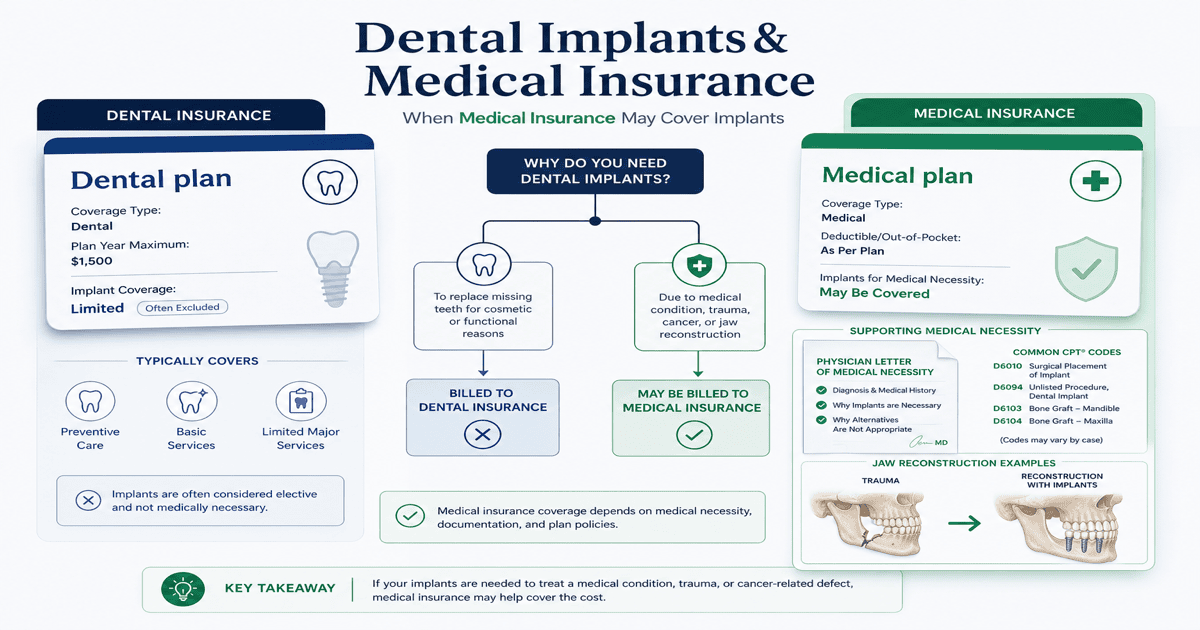
Key Takeaway: Dental and medical plans use different contracts, code sets, and reviewers. Dental plans cap major restorative services. Medical plans may pay only when implants reconstruct damage from a covered medical event.
Most implant questions start with a dental plan. Those plans classify implants as major restorative work subject to annual maximums, waiting periods, and least expensive alternative treatment rules. Your dental Evidence of Coverage controls whether implants are covered at all on the dental side.
Medical health insurance does not pay for routine cleanings or elective cosmetic dentistry. It may cover implant-related jaw reconstruction when tooth loss is a direct consequence of trauma, tumor resection, or certain congenital conditions. That pathway uses CPT codes, physician letters, and medical necessity review rather than dental LEAT policies.
For denials on the dental benefit, see how to appeal a dental implant denial for missing teeth. The medical and dental tracks can run in parallel when records support both.
When Might Medical Insurance Cover Dental Implants?
Key Takeaway: Coverage depends on clinical facts and your plan language. Trauma, cancer-related jaw loss, and some congenital defects are the scenarios most often argued on the medical benefit. Decay and periodontitis rarely qualify.
| Clinical scenario | Why medical may apply | Key records |
|---|---|---|
| Traumatic avulsion or jaw fracture | Injury is a covered medical event and reconstruction treats the injury | ER or trauma surgery records, imaging, operative notes |
| Oral cancer resection or osteoradionecrosis | Jaw loss follows oncologic treatment and functional restoration is medical care | Oncology records, pathology report, radiation summary, surgical notes |
| Congenital tooth agenesis or ectodermal dysplasia | Developmental condition affects tooth formation and function | Pediatric or oral medicine records, genetic testing if available, physician letter |
| Cleft palate or craniofacial reconstruction | Jaw structure abnormality treated through reconstructive surgery | Craniofacial surgical records, multidisciplinary team notes |
Verify before you schedule. Even qualifying diagnoses do not guarantee payment. Each insurer applies its own medical necessity definition. Request written predetermination or prior authorization before surgery when your plan requires it.
What Documentation Do You Need for a Medical Implant Claim?
Key Takeaway: Medical reviewers expect a physician-authored letter of medical necessity, operative records tying tooth loss to the covered condition, and CPT codes billed to the health plan. CDT dental codes sent to a medical payer are usually rejected.
- Letter of medical necessity from the physician who treated the underlying condition. It should state the diagnosis, causal link to tooth or jaw loss, functional impairment, and why implants are the appropriate reconstruction. See how to write a medical necessity letter for insurance appeals.
- Operative and pathology notes from cancer surgery, trauma repair, or jaw reconstruction establishing the medical basis for tooth loss.
- Imaging including panoramic radiographs or CT showing the jaw defect and planned implant sites.
- CPT codes such as CPT 21248 or 21249 for mandible or maxilla reconstruction with endosteal implants. Confirm codes with your oral surgeon's billing team.
- Prior authorization form submitted through your health plan portal or fax before the procedure when required.
Ask whether your surgeon has billed implant reconstruction to medical plans before. Incorrect code routing is one of the most common reasons for an initial denial that still may be appealable with corrected submission.
How Do You Request Prior Authorization From Your Medical Plan?
Key Takeaway: Prior authorization gives you a written coverage decision before you incur surgical costs. Submit the full clinical packet and respond to any peer-to-peer or records request within the deadline on the notice.
- Call member services. Ask whether prior authorization is required for the CPT codes your surgeon plans to bill and how to submit the request.
- Attach the physician letter and operative records. Include a cover sheet listing each attachment by number and date.
- Track the reference number. Note the submission date and expected decision timeframe in your plan documents.
- Respond to clinical review requests. Failure to complete a peer-to-peer or supplemental records request may be treated as withdrawal of the authorization request.
If prior authorization is denied, request the written denial, the clinical criteria applied, and a copy of the coverage policy cited. You can then file an internal appeal before the deadline printed on the notice. For general deadline rules across plan types, see how long you have to appeal a health insurance denial.
Does Medicare Cover Dental Implants?
Key Takeaway: Original Medicare does not cover routine dental services including routine implants. Part A may cover certain inpatient oral surgery tied to a medically necessary hospital stay. Medicare Advantage dental benefits vary by plan and must be verified in the Evidence of Coverage.
Under Original Medicare, 42 U.S.C. § 1395y(a)(12) excludes routine dental care from Part A and Part B coverage. Part A may cover oral surgery performed as part of a medically necessary inpatient procedure, such as jaw reconstruction following cancer resection in a hospital setting.
Medicare Advantage plans must cover emergency dental services and may include supplemental dental benefits. Some plans partially cover implants. Annual maximums, cost-sharing, and network rules differ by contract and service area. Verify benefits in your plan's Evidence of Coverage at Medicare.gov before scheduling treatment.
Weak vs. Strong Language for Medical Implant Prior Auth and Appeals
Key Takeaway: Medical reviewers compare your records to the plan's published criteria. Submissions that cite diagnosis, procedure date, CPT code, and attached records move faster than general requests for approval.
| Weak submission | Strong submission |
|---|---|
| “Patient needs dental implants to replace missing teeth after cancer treatment.” | “Patient underwent segmental mandibulectomy on [date] for squamous cell carcinoma of the floor of mouth (ICD-10: C04.0), resulting in full-thickness mandibular defect and inability to masticate. Implant-supported reconstruction (CPT 21248) is indicated for functional restoration. Attached: operative note, pathology report, and radiation oncology summary.” |
| “Implants are medically necessary because the patient cannot eat properly.” | “Patient presents with documented masticatory dysfunction (ICD-10: K08.89) secondary to traumatic avulsion of teeth 8–11 following motor vehicle collision on [date] (ER record attached). Endosteal implant placement (CPT 21248) is the appropriate surgical intervention. Bridge and partial denture alternatives are contraindicated due to insufficient bone support per attached imaging.” |
| “Please approve this. The patient has waited a long time.” | “I appeal the denial dated [date] for CPT 21248. The denial cited [reason from letter]. The plan's medical necessity criteria for jaw reconstruction include [criteria from policy]. Attached records satisfy those criteria. I request a written determination within the appeal timeline on my notice and information on external review if upheld.” |
Medical implant claim denied?
Use the free dental appeal generator to draft an internal appeal letter that addresses your denial reason and lists the clinical attachments reviewers need.
What Appeal Rights Apply After a Medical Implant Denial?
Key Takeaway: ACA-regulated individual and small-group plans include external independent review for many medical necessity denials. Large ERISA self-insured employer plans follow different rules. Your Summary Plan Description names the process that applies to you.
ACA marketplace and fully insured small-group plans must provide internal and external appeal rights under Healthcare.gov appeal standards. After you exhaust internal appeals, you may request external review by an independent review organization. The IRO decision is binding on the plan in most states for qualifying denials.
Large employer self-insured plans governed by ERISA have internal appeal rights under ERISA Section 503 but different external review requirements. After internal appeals, federal court review may be available. Complex ERISA denials often need counsel familiar with your plan document.
File your internal appeal before the deadline on the denial letter. Include the physician letter, operative notes, and a point-by-point response to the stated denial reason. For the external review step, see how to request external review after an insurance denial. Use the dental appeal letter generator to structure your appeal language and attachment checklist before you submit.
If you received a denial on the dental benefit rather than the medical plan, start with what to do when an insurance claim is denied and the dental-specific LEAT guide linked above.
Frequently Asked Questions
Common questions about medical insurance coverage for dental implants, prior authorization, Medicare, and appeal rights.
Appeal your dental or medical implant denial
AppealFlow drafts formal appeal letters for implant denials on dental and medical plans. Edit live, then download as PDF or Word. No account required.
- 100% Free
- No Signup
- PDF & Word Export
Disclaimer: This article is for educational purposes only and does not constitute medical, legal, or financial advice. AppealFlow is not a healthcare provider, insurance broker, or law firm. Coverage rules vary by plan type, insurer, and state. Review your plan documents and verify with your insurer before scheduling procedures. Medicare benefit details change annually. For medical emergencies, call 911. See our full disclaimer.