What Is a Timely Filing Denial?
What Does CO-29 Mean on Your EOB?
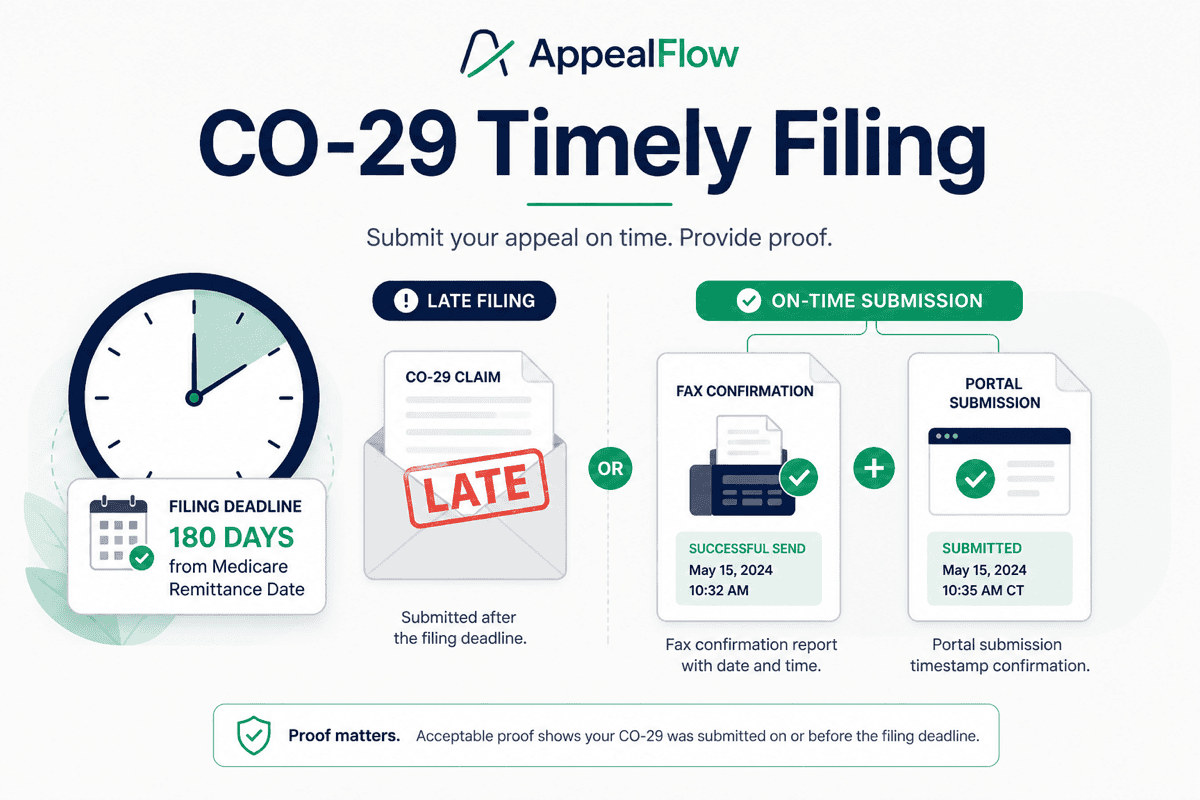
Key Takeaway: CO-29 is a late-filing denial. The payer is refusing to process the claim because it arrived after the allowed submission window. It is not a medical necessity or coverage denial. If you prove the claim was timely or that good cause excused the delay, the payer may process the claim on its merits.
Claim Adjustment Reason Code 29 appears on remittance advice and many Explanation of Benefits as CO-29. Copy the claim number, date of service, and the exact remark before you call anyone. For a line-by-line walkthrough of those columns, see how to read an Explanation of Benefits. If the EOB shows an allowed amount of $0 because of timely filing, do not treat the hospital invoice as if the plan paid the negotiated rate.
A late patient statement is not the same as a late claim. The clock that matters is when the provider first submitted a clean claim to the payer, not when the hospital printed your invoice. Ask for the first-submission date and any rejection reports, not just a new bill. Our CO-29 denial code guide walks through proof-of-submission documents and good-cause appeal steps in more detail.
What Is Medicare's Fee-for-Service Filing Deadline?
Key Takeaway: Medicare fee-for-service claims must be filed with the Medicare Administrative Contractor no later than one calendar year after the date of service. CMS treats an untimely-filing denial as something other than an initial determination, so the usual Medicare appeals path does not apply.
CMS's Medicare Billing: CMS-1500 & 837P booklet instructs providers to file Medicare claims with the MAC no later than one calendar year after the date of service. CMS states that claims filed after the deadline are denied, and that a denial because a claim was not filed on time is not the same thing as an initial determination.
The same one-calendar-year rule is in 42 CFR 424.44. The regulation lists limited exceptions, such as error or misrepresentation by a Medicare contractor and certain retroactive entitlement situations. Medicare Advantage claims go to the patient's MA plan, not to the fee-for-service MAC. Do not treat the one-year MAC rule as the filing clock for every Medicare product.
Is There a National Deadline for Commercial Insurance?
Key Takeaway: No. Employer and Marketplace plans set timely-filing periods in the provider contract or the plan's claims procedures. Ninety days, 180 days, and 365 days from the date of service are common patterns. None of them is a federal universal rule for commercial claims.
Read the CO-29 remark and ask the provider which contract deadline they missed. A participating-provider agreement can be shorter than the member's own claim-filing window in the Summary Plan Description. If the office says insurance always has 90 days, ask them to show the contract or payer policy they are using for that claim number.
Do not treat 90, 180, or 365 days as universal. Those figures show up often in provider contracts. They are patterns, not a national commercial statute. Medicare fee-for-service uses the one-calendar-year MAC rule above. Medicaid and Medicare Advantage use their own program instructions.
Use AppealFlow'stimely filing appeal generatorto draft a structured appeal letter tied to your denial reason before the deadline on your notice.
Need a Written Request for a CO-29 Appeal?
AppealFlow drafts a letter from the claim number, CO-29 remark, and dates you enter. You still send it to the provider or through the process on the EOB. A draft does not refile the claim.
How Do You Appeal a CO-29 Timely Filing Denial?
Key Takeaway: Many plans allow a proof-of-timely-filing or good-cause appeal when you can show the claim arrived inside the window or that payer error caused the delay. Acceptance proof from a clearinghouse or payer portal is stronger than a verbal statement that the claim was sent.
Ask the billing office for the original submission report showing payer acceptance, not just the date the claim was created in-house. ERA timestamps, 277 responses, and portal confirmation numbers help show the claim arrived inside the window. If the payer lost the claim, include prior submission proof and any correspondence referencing the earlier filing.
- Request the EOB or MSN, the claim number, and the CO-29 remark code
- Ask the billing office for the date the claim was first submitted and any rejection report
- Ask whether the missed deadline makes the balance provider-liable under the contract
- If they bill you the full chargemaster, dispute in writing and attach the EOB member-responsibility line
Some commercial CO-29 denials shift the write-off to the contracted provider. Others still leave a member balance. Do not assume either outcome from the words timely filing alone. If you have secondary coverage, coordination of benefits can delay a clean claim. That is a different remark than CO-29.
Weak vs. Strong Wording on a CO-29 Dispute
Key Takeaway: Name the claim number, date of service, first-submission date, and the deadline the payer applied. A general complaint that the bill came late does not tell the examiner which clock was missed.
| ❌ Weak Request | ✓ Strong Request |
|---|---|
| “Insurance denied this for timely filing. Just write it off.” | “Claim #[number], date of service [date]. EOB shows CO-29. Please confirm the date this claim was first submitted to [payer] and whether a corrected claim or rebill is still open. If the contract makes a late filing provider-liable, adjust the account to $0 member balance.” |
| “Commercial claims always have 90 days, so this CO-29 denial is wrong.” | “Please quote the timely-filing period in the provider contract that applies to claim #[number]. I am requesting the deadline you applied and the first-submission date with clearinghouse acceptance proof.” |
| “I want to appeal this Medicare timely-filing denial like any other denial.” | “This is a Medicare fee-for-service claim. CMS billing rules and 42 CFR 424.44 set a one-calendar-year filing limit with the MAC. CMS states an untimely-filing denial is not an initial determination. Please confirm whether a listed exception applies or whether the provider can still correct the filing.” |
Is Timely Filing the Same as My Deadline to Appeal?
Key Takeaway: No. Timely filing is the deadline to submit the original claim. Your appeal deadline is the time you have to challenge an adverse benefit determination after you receive notice. Missing one clock does not move the other.
File any coverage appeal on the date printed on the denial notice even while the provider works a CO-29 filing-limit issue. For how those appeal clocks differ by program, see how long you have to appeal a health insurance denial. Do not treat a CO-29 remark as a medical-necessity appeal unless the EOB also denied clinical coverage.
Frequently Asked Questions
Common questions about CO-29 timely filing denials, Medicare's one-year MAC rule, commercial patterns, and what to ask the billing office.
Generate a Free CO-29 Appeal Letter
AppealFlow.net drafts a letter from the claim number, CO-29 remark, and dates you enter. You still send it to the provider or through the process on the EOB. No account required.
- 100% Free
- No Signup
- PDF & Word Export
Disclaimer: This article is for educational purposes only and does not constitute medical, legal, or financial advice. AppealFlow.net is not a healthcare provider, insurance broker, or law firm. Timely-filing rules differ by payer contract and program. Verify the CO-29 remark on your EOB or Medicare Summary Notice, CMS billing instructions, and 42 CFR 424.44 before you act. For medical emergencies, call 911. See our full disclaimer.