How Long Do Prior Authorizations Take for Medication?
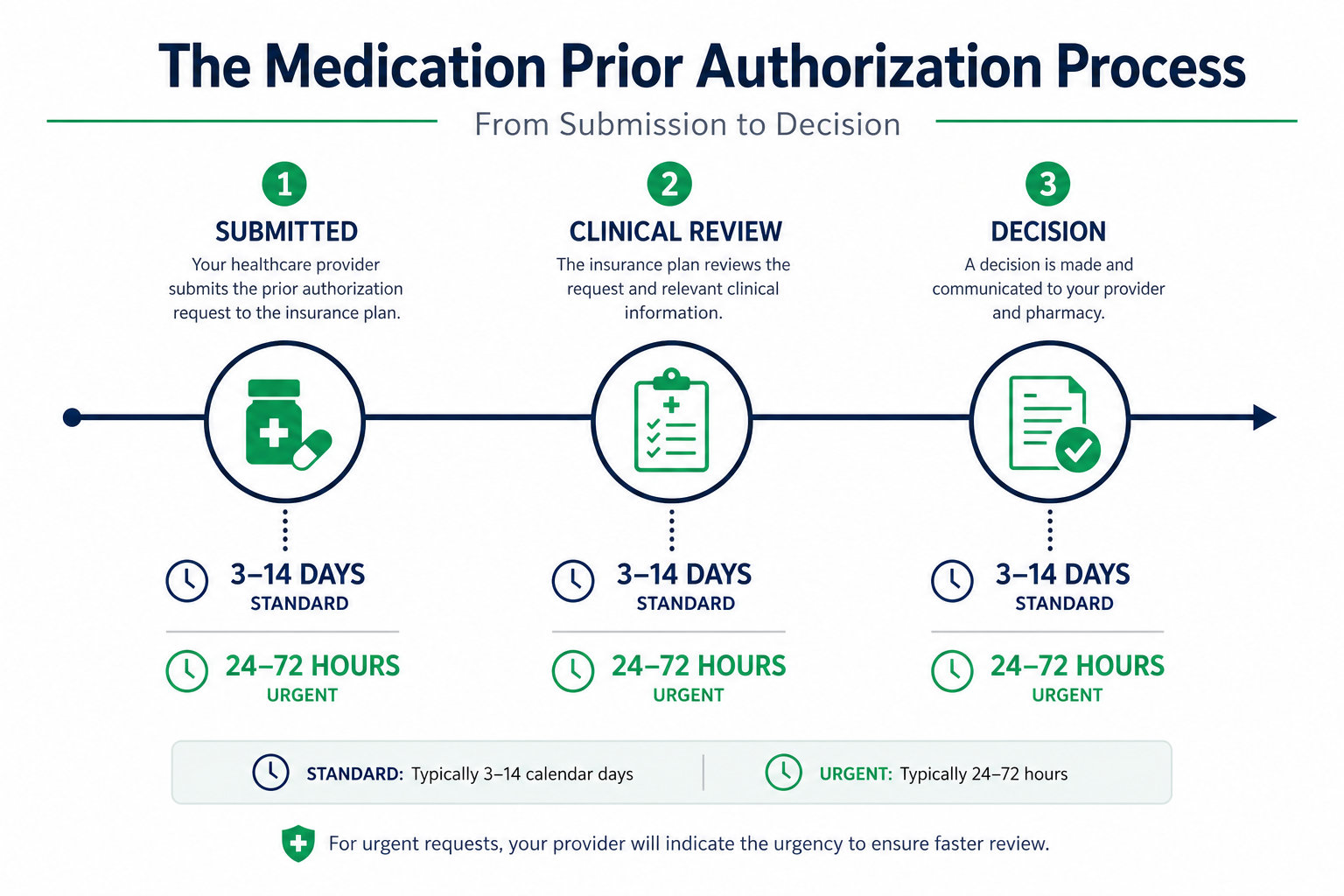
What Timeline Should You Expect for Medication Prior Auth?
Key Takeaway: The review clock starts when the pharmacy benefit manager receives a complete request, not when your doctor says they submitted it. Standard Medicare Part D determinations have a 72-hour federal ceiling. Expedited requests can move on a 24-hour track when your clinician certifies urgency.
If you are waiting at the pharmacy counter or checking a portal daily, you want one number. Federal rules give floors for Medicare Part D and many urgent commercial reviews, but pharmacy benefit managers still control how fast incomplete packets move through clinical review. Start with the plan type table below, then confirm the channel on your insurance card and denial notice.
Prior authorization is a pre-approval step, not a payment guarantee. What prior authorization is explains how it differs from referrals, step therapy, and formulary exceptions. This page covers decision time for pharmacy PA. For how long an appeal takes after denial, see how long a health insurance appeal takes.
How Long Do Standard vs Expedited Pharmacy Prior Auth Reviews Take?
Key Takeaway: Medicare Part D uses 72-hour standard and 24-hour expedited clocks in CMS regulations. Many ERISA and ACA plans use a 72-hour urgent pre-service clock for adverse benefit determinations. CMS's Interoperability and Prior Authorization final rule sets separate timeframes for medical items and services on Medicare Advantage and Medicaid, not pharmacy drug benefits.
| Plan or program | Standard medication PA | Expedited medication PA | Primary source |
|---|---|---|---|
| Medicare Part D | No later than 72 hours after the plan receives the request for a drug benefit coverage determination | No later than 24 hours after the plan receives an approved expedited request | 42 CFR 423.568; 42 CFR 423.572 |
| Many ERISA employer group plans | Non-urgent pre-service clocks are stated in the plan's claims procedures; calendar wait often stretches when clinical questions are pending | Urgent pre-service adverse benefit determinations: as soon as required by medical needs, and no later than 72 hours after receipt of the request | 29 CFR 2560.503-1 |
| Medicare Advantage, Medicaid, CHIP (medical items, not Part D drugs) | Seven calendar days for certain standard prior auth decisions | 72 hours for certain expedited prior auth decisions | CMS CMS-0057-F fact sheet (excludes drug-benefit API requirements) |
CMS describes prior authorization as a utilization-management process in its Interoperability and Prior Authorization final rule. That rule does not set one nationwide clock for every self-funded ERISA employer plan or every pharmacy benefit manager. Read your Summary of Benefits, Evidence of Coverage, or Medicare plan notice for the channel that applies to your card.
What Factors Add Calendar Time to a Medication Prior Authorization?
Key Takeaway: Incomplete clinical packets cause most delays. Specialty drugs, GLP-1 medications, and step-therapy reviews need more documentation even when federal decision clocks apply.
Pharmacy prior authorizations route through your plan's pharmacy benefit manager. CoverMyMeds, Express Scripts, OptumRx, and CVS Caremark are common submission portals, but they are examples, not a complete list. The PBM reviews your prescriber's packet against the plan's formulary and clinical policy. These factors routinely add waiting time beyond the regulatory floor:
- Missing step therapy history or dates for failed alternatives
- Status stuck on pending prescriber response while clinical questions sit unanswered
- Specialty pharmacy routing for biologics or high-cost injectables
- GLP-1 reviews that require BMI documentation and comorbidity records
- Fax or mail submissions without electronic confirmation of receipt
For GLP-1-specific criteria and prescriber submission tips, see how to appeal Wegovy insurance denial and how to appeal a step therapy denial.
Weak vs Strong Medication Prior Auth Submissions
Key Takeaway: A complete first submission keeps the reviewer from pausing the clock for missing records. Weak packets bounce between the prescriber and PBM for a week or more even when the underlying drug should qualify.
| Weak submission | Strong submission |
|---|---|
| PA form with diagnosis code only and no step therapy log attached | Electronic submission with ICD-10 code, dated step therapy trials, BMI or lab values, and letter of medical necessity attached on day one |
| Fax sent without confirmation; patient calls pharmacy daily | PBM portal submission with reference number; prescriber office confirms in review status within 72 hours |
| Waiting silently when status shows pending prescriber response | Prescriber answers clinical questions within one business day and requests expedited review when delay poses documented health risk |
Medication prior auth denied after the wait?
AppealFlow's prior authorization appeal generator drafts a formal letter from your denial reason, authorization number, and clinical facts. Edit live, then download as PDF or Word.
What Happens When Prior Authorization Takes Too Long?
Key Takeaway: Missed federal clocks can convert a slow review into an appealable adverse determination. Document every submission date, confirmation number, and status check before you escalate.
Under Medicare Part D, failure to meet the 72-hour standard or 24-hour expedited timeframe can constitute an adverse coverage determination. CMS requires the plan to forward the request to the Independent Review Entity within 24 hours of the missed deadline per 42 CFR 423.568(h) and 423.572(d). On commercial plans, state prompt-decision laws may apply to state-regulated coverage, but self-funded ERISA employer plans follow different complaint paths.
Keep a log: Record submission date, confirmation number, every portal status change, and every call with representative name and reference ID. That record supports escalation if the PBM exceeds the timeframe on your notice.
A long pending review is not the same as a formal denial. Once the plan issues an adverse benefit determination, you enter the appeal track described on the notice. For Medicare Part D appeals, see Medicare Part D prior authorization appeal.
What to Do If Your Medication Prior Authorization Is Denied
Key Takeaway: A PA denial starts a separate appeal process, not a resubmission of the same form. Request the denial reason code, match your records to the plan's clinical policy, and file the internal appeal before the deadline on your notice.
Read the denial letter for the authorization reference number, cited criteria, and filing instructions. Ask your prescriber for a letter of medical necessity that addresses each bullet the plan listed. File through the portal named on the notice, not a general member message.
For a full walkthrough of the denial-to-appeal workflow, read how to appeal a prior authorization denial and what to do when insurance denied medication. Use the prior authorization appeal generator to draft a starting letter, then edit every line before sending.
Does Prior Authorization Guarantee Coverage?
Key Takeaway: No. PA approval is conditional pre-authorization. Claim denials can still happen if the pharmacy bills incorrectly, quantity limits are exceeded, or the authorization expires before fill.
Healthcare.gov states that prior authorization approval may be required before a prescription is covered, but it is not a promise the plan will pay the final claim. Save your approval letter or portal screenshot with the approval number, effective dates, and approved quantity. Provide it to the pharmacy at every fill.
Frequently Asked Questions
Common questions about how long prior authorizations take for medication and what to do when PA is denied.
Need Help With a Denied Medication Prior Authorization?
AppealFlow drafts formal pharmacy appeal letters citing medical necessity, step therapy documentation, and appeal rights named on your denial notice. Edit live, download as PDF or Word. No account required.
- 100% Free
- No Signup
- PDF & Word Export
Disclaimer: This article is for educational purposes only and does not constitute medical or legal advice. AppealFlow is not a healthcare provider or law firm. Timelines vary by plan type and are stated on your denial notice. Always confirm PA status with your prescriber and pharmacy benefit manager directly. For medical emergencies, call 911. See our full disclaimer.