How to Get a Hospital Bill Lowered
Why Is Your Hospital Bill Often Negotiable?
Key Takeaway: Hospital statements reflect chargemaster list prices, not what insurers pay or what you legally owe. Coding errors, duplicate line items, insurance denials, and skipped financial assistance screenings inflate balances. Treat the first statement as a starting point, not a final invoice.
A large number on a hospital bill does not always equal your legal responsibility. That figure is often the facility's full charge before contractual adjustments, charity care discounts, billing corrections, or insurer payments. When a plan denies a claim, the entire balance can shift to you overnight even when the service should have been covered.
Most hospital bill disputes fall into one of three buckets. The hospital billed incorrectly, the insurer denied or underpaid a valid claim, or the facility never screened you for financial assistance. Each problem has a different fix, and you may need to work more than one channel at the same time.
If your balance stems from an insurance denial, file a formal appeal with your health plan before you treat the hospital balance as final. For that workflow, see our guide on how to dispute insurance claims. This article focuses on hospital-specific steps, including itemized audits, charity care, price transparency data, and written negotiation with patient financial services.
How Do I Get an Itemized Hospital Bill?
Key Takeaway: A summary statement is not an itemized bill. You need every CPT or revenue code, date of service, unit count, and rendering provider before you can audit charges or negotiate from evidence.
Call or write to patient financial services and specifically request an itemized hospital bill. Use those words. Providers sometimes send a one-page summary instead. For a full walkthrough, see how to get an itemized hospital bill.
Pull your Explanation of Benefits from your insurer portal and compare allowed amounts, denial reason codes, and patient responsibility line by line. If the EOB shows the insurer paid but the hospital still bills you the full amount, that is a billing error rather than a balance you owe.
How to Get a Hospital Bill Lowered Step by Step
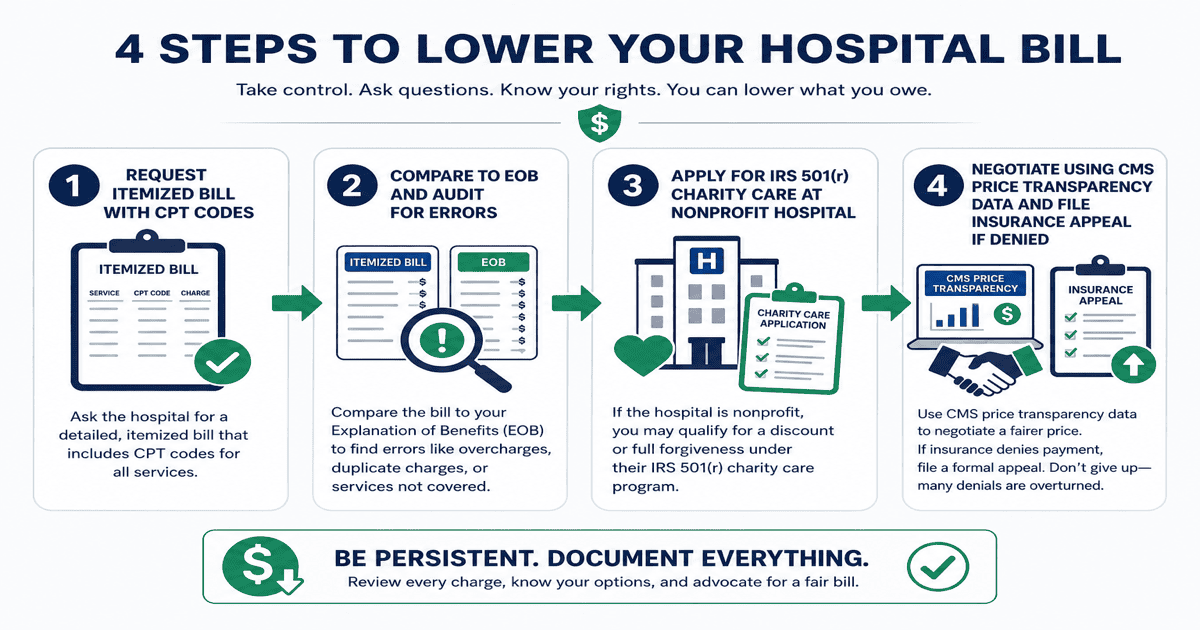
Key Takeaway: Request an itemized bill, audit every line against your EOB, dispute errors in writing, apply for financial assistance, negotiate with price transparency data, and appeal insurer denials before agreeing to any payment plan. Missing appeal deadlines can leave you responsible for the full chargemaster price.
- Request an itemized hospital bill. Ask for every CPT or HCPCS code, date of service, unit count, and rendering provider NPI. Summary statements hide duplicate charges and upcoding.
- Compare each line to your EOB. Match allowed amounts, denial codes, and patient responsibility. If insurance paid but the hospital still bills the full amount, dispute that in writing.
- Route the problem correctly. Use the checklist table below to match billing errors, insurance denials, balance billing, uninsured overcharges, and financial hardship to the right action.
- Send a written billing dispute. Mail or fax your audit with a cover letter requesting corrected charges. Keep proof of delivery. Some states restrict collections while a dispute is active.
- Apply for financial assistance. Nonprofit hospitals must maintain charity care programs under IRS Section 501(r)(4). Submit income documentation before bills go to collections.
- Negotiate using price transparency data. Search the hospital's CMS-mandated file for cash prices and insurer-negotiated rates on your procedure codes.
- Appeal insurer denials that caused the balance. File through your plan portal, not by resubmitting the original claim. Tell the hospital you have an active appeal and request a billing hold.
- Do not pay disputed amounts while investigating. Request the account be placed on hold during review and financial assistance determination.
Hospital Bill Review Checklist by Issue Type
Key Takeaway: Billing errors go to patient financial services. Insurance denials go to your health plan. Balance billing disputes may invoke the No Surprises Act. Financial hardship triggers IRS Section 501(r) charity care, not a standard payment-plan script.
| Issue Type | What to Look For | Recommended Action | Deadline / Authority |
|---|---|---|---|
| Billing error | Duplicate CPT codes, charges for services not received, EOB shows payment but hospital still bills full amount | Written dispute to hospital billing with line-by-line audit; request corrected statement | Dispute promptly after receiving itemized bill; cite CMS medical bill rights |
| Insurance denial | EOB shows a denial reason code; hospital balance equals the denied amount | File internal appeal via plan portal; request hospital billing hold pending appeal | Deadline is on your denial notice (often 180 days for ERISA employer plans, 60 days for many ACA marketplace and Medicare appeals) |
| Balance billing | Out-of-network charges at in-network hospital, ER facility fee from OON provider, air ambulance bill | Dispute under the No Surprises Act; send a balance billing dispute letter to the billing department | See our balance billing dispute letter guide |
| Uninsured overcharge | No insurance on file; bill exceeds good faith estimate by $400+; chargemaster price far above published cash rate | Request self-pay discount tied to insurer-negotiated rates; file good faith estimate dispute if applicable | No Surprises Act patient-provider dispute resolution generally allows 120 calendar days from bill date for qualifying uninsured patients |
| Financial hardship | Income below the hospital's published thresholds; nonprofit facility; bill sent to collections without assistance screening | Submit financial assistance application with income documentation; appeal denial if rejected | IRS Section 501(r)(4); many hospitals allow retroactive applications |
| Upcoding / unbundling | Higher-complexity CPT code than service performed; separate charges for procedures that should be one bundled code | Request medical records and operative report; dispute specific codes with clinical documentation | Compare codes to the hospital's CMS price transparency file for the same procedure at lower complexity |
Weak vs. Strong Hospital Billing Negotiation Language
Key Takeaway: Patient financial services teams process hundreds of calls daily. Vague requests for help get routed to standard payment-plan scripts. Specific, documented disputes citing EOB data, federal rights, and price transparency rates get escalated to supervisors.
| ❌ Weak Negotiation Statement | ✓ Strong Negotiation Statement |
|---|---|
| “This hospital bill is way too high. I can't afford it. Can you just lower it?” | “I am disputing account #[number]. Line 7 (CPT 27447) was billed at $18,200 but your CMS price transparency file lists a cash price of $9,400 and a negotiated rate of $7,850 for the same code. Please adjust my balance to amounts generally billed to insured patients under IRS Section 501(r)(5).” |
| “My insurance denied it, so I guess I owe the full hospital amount.” | “My insurer denied claim #[number] under code [denial code]. I filed an internal appeal on [date] through my plan portal, confirmation #[number]. Please place this account on hold pending appeal resolution. I am submitting a financial assistance application under your published 501(r) policy.” |
| “I'll set up whatever payment plan you recommend.” | “Before agreeing to any payment plan, I request a written self-pay rate based on amounts generally billed to insured patients. My audit identified two duplicate room-and-board charges totaling $3,680. Please send a revised statement within 30 days reflecting corrections and your financial assistance determination.” |
Use AppealFlow'shospital financial aid appeal generatorto draft a structured appeal letter tied to your denial reason before the deadline on your notice.
Insurance Denial Driving Your Hospital Bill?
AppealFlow drafts a regulation-informed appeal letter citing ERISA §503, ACA §2719, and your denial reason code for upload to your insurer portal.
What Is IRS Section 501(r) Financial Assistance?
Key Takeaway: Nonprofit hospitals that receive federal tax exemption must publish a financial assistance policy, limit charges for eligible patients, and make reasonable efforts to determine eligibility before extraordinary collection actions.
If your hospital is a 501(c)(3) nonprofit, federal law requires specific patient protections under Section 501(r) of the Internal Revenue Code:
- 501(r)(4): Financial assistance policy: The hospital must publish eligibility criteria, an application process, and how patients can apply. Criteria often use multiples of the federal poverty level. You can usually apply retroactively for care already received.
- 501(r)(5): Amounts generally billed limitation: Hospitals cannot charge financial assistance patients more than amounts generally billed to insured patients. Use this provision when negotiating self-pay rates.
- 501(r)(6): Billing and collection limitations: Before sending bills to collections or reporting to credit bureaus, the hospital must make reasonable efforts to determine whether you qualify for financial assistance.
Section 501(r) applies to nonprofit hospital facilities, not necessarily to every physician group, laboratory, or air ambulance vendor that bills separately. Ask each billing entity whether it participates in the hospital financial assistance program or has its own policy.
How Does CMS Price Transparency Help Lower Bills?
Key Takeaway: Since January 2021, hospitals must publish standard charges online under CMS Hospital Price Transparency rules. Search for your hospital's machine-readable file to find cash prices and insurer-negotiated rates for your procedure codes.
CMS requires hospitals to post gross charges, discounted cash prices, and payer-specific negotiated rates. Find your hospital's file at cms.gov/hospital-price-transparency, then search for the CPT codes on your itemized bill.
When negotiating with patient financial services, present a comparison of your billed amount, the hospital's published cash price, and the insurer-negotiated rate for the same code. Documented discrepancies give supervisors a concrete reason to adjust your balance. For broader negotiation tactics on non-hospital bills, see how to negotiate medical bills.
What If an Insurance Denial Caused Your Hospital Balance?
Key Takeaway: If your insurer denied or underpaid a hospital claim, negotiating with the hospital alone will not fix the root problem. File a formal internal appeal before your deadline, then use the appeal outcome when negotiating with patient financial services.
A denied hospital claim is a common reason patients receive bills far above expected cost-sharing. Your plan's appeal rights are federally protected, and the deadline depends on your plan type:
- ERISA employer-sponsored plans: The denial notice states how long you have to appeal. Many employer plans allow up to 180 days from the denial date under ERISA §503.
- ACA marketplace and most individual plans: ACA §2719 mandates internal and external review. Deadlines are printed on your notice and are often shorter than ERISA windows.
- Medicare Advantage and Part B: Medicare uses separate redetermination clocks, often 60 days standard with shorter windows for expedited appeals. File through your plan portal or Medicare.gov.
Submit hospital claim appeals through your plan's member portal, not by resubmitting the original claim. Select appeal or request reconsideration, upload your appeal letter and supporting records, and save the confirmation number. Tell the hospital billing department you have an active appeal so they hold collections while the insurer reprocesses the claim.
Common myth: Paying the hospital bill while your insurer appeal is pending does not guarantee a refund if you win. File the appeal first, request a billing hold, and negotiate the remaining balance only after the insurer issues a final decision.
What Are Your Rights Under the No Surprises Act?
Key Takeaway: Uninsured or self-pay patients who received a good faith estimate before scheduled care can dispute hospital bills that exceed the estimate by at least $400. Insured patients facing surprise out-of-network charges at in-network facilities may also have federal protections.
The No Surprises Act limits out-of-network cost-sharing for emergency services and for certain facility-based services when you did not receive valid notice-and-consent. It generally applies to most private insurance plans and does not generally apply to Original Medicare or Medicaid.
- Uninsured good faith estimate disputes: If you received a written estimate before scheduled non-emergency care, you may dispute a final bill that exceeds the estimate by $400 or more through the process at cms.gov/medical-bill-rights.
- Insured surprise bills: If the hospital bills you beyond in-network cost-sharing for qualifying emergency or facility-based out-of-network services, send a balance billing dispute letter.
- Deadline: Qualifying uninsured disputes generally must be filed within 120 calendar days of the date on your bill. Confirm the current CMS process before mailing.
For step-by-step language, see our guide on writing a balance billing dispute letter to a hospital billing department.
Five Mistakes That Keep Hospital Bills High
Key Takeaway: Paying without auditing, missing appeal deadlines, and skipping financial assistance are among the costliest errors on hospital bills. Each one can turn a negotiable balance into long-term debt.
- Paying the first statement without an itemized bill. Summary hospital statements hide duplicate charges, upcoding, and insurance payment errors.
- Missing the insurer appeal deadline. A late appeal can leave you responsible for the full chargemaster price with limited recourse.
- Negotiating with the hospital before appealing the insurer. If insurance should have paid, fix the coverage decision first, then negotiate any remaining balance with EOB and price transparency data in hand.
- Skipping financial assistance at nonprofit hospitals. IRS Section 501(r)(4) requires charity care programs. Applying costs nothing and may eliminate the entire balance.
- Agreeing to a payment plan on the full amount. Payment plans on inflated charges lock you into paying list prices. Dispute, appeal, and apply for assistance before committing to monthly payments.
Frequently Asked Questions
Common questions about lowering hospital bills, charity care, price transparency, and insurance appeals on hospital claims.
Generate Your Free Appeal Letter
If an insurance denial is driving your hospital bill, AppealFlow drafts a formal appeal letter citing ERISA §503, ACA §2719, and your denial reason code for upload to your insurer portal. Edit live, download as PDF or Word. No account required.
- 100% Free
- No Signup
- PDF & Word Export
Disclaimer: This article is for educational purposes only and does not constitute medical, legal, or financial advice. AppealFlow.net is not a healthcare provider, insurance broker, or law firm. Hospital financial assistance policies, state collection laws, and federal billing rules change. Verify current requirements with the billing department, your insurer, or CMS.gov before taking action. For medical emergencies, call 911. See our full disclaimer.