How to Get a Medical Bill Lowered
What Makes a Medical Bill Higher Than What You Actually Owe?
Key Takeaway: Most statements patients receive are not final. They may reflect chargemaster list prices, coding errors, duplicate line items, or insurance denials that shifted costs to you. Audit the bill against your EOB before paying. The gap between what you were charged and what your plan allowed is often fixable.
A hospital statement showing a large total does not mean you owe that amount. Insurers negotiate allowed amounts far below list prices. When a claim is denied or underpaid, the entire balance can land on you until you dispute it or appeal.
Patients who audit a bill carefully usually find one of three problems: the provider billed incorrectly, the insurer denied or underpaid a valid claim, or the hospital never screened them for financial assistance. Each problem has a different fix, and you often need to pursue more than one path at the same time.
If an insurance denial caused your balance, file a formal appeal with your plan before you treat the hospital bill as final. For negotiation tactics on the remaining balance after corrections, see our guide on how to negotiate medical bills.
How Do You Get a Medical Bill Lowered Step by Step?
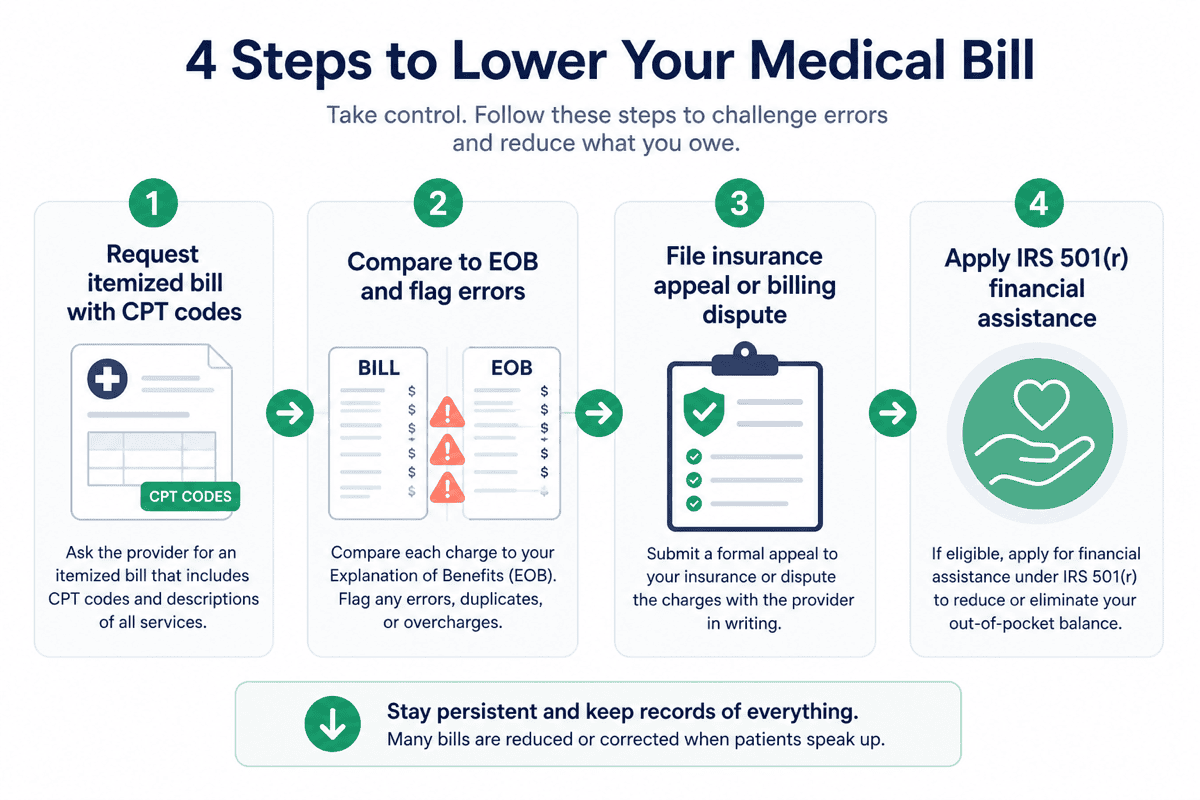
Key Takeaway: Treat bill reduction like a project with deadlines. Missing an insurer appeal window or a financial assistance deadline can cost you real money. Work through these steps in order, but start the insurer appeal the same week you receive a denial notice.
| Step | Action | Why It Matters |
|---|---|---|
| 1 | Request an itemized bill with CPT or HCPCS codes and dates of service | Summary bills hide duplicate charges and upcoding |
| 2 | Compare every line to your EOB and flag mismatches | Your EOB shows allowed amounts and denial reason codes |
| 3 | Send a written billing dispute with your audit notes | Documented discrepancies get escalated faster than phone complaints |
| 4 | File an insurer appeal if a denial or underpayment caused the balance | Appeal clocks start on your denial notice, not when the hospital bills you |
| 5 | Apply for financial assistance under IRS Section 501(r) at nonprofit hospitals | Charity care can eliminate or substantially reduce eligible balances |
| 6 | Negotiate any remaining balance with EOB data in hand | Self-pay and prompt-pay rates are voluntary but often available on request |
Put appeal deadlines on your calendar the day you receive a denial letter. A successful appeal can eliminate most or all of the balance before you negotiate with the hospital. For help requesting line-item detail, see how to get an itemized hospital bill.
How Do You Audit an Itemized Bill Against Your EOB?
Key Takeaway: An itemized bill audit catches duplicate charges, services you did not receive, wrong codes, and insurance payment errors. Match every line to your EOB before negotiating. Providers take documented discrepancies more seriously than general complaints about high costs.
Call billing and ask specifically for an itemized bill with every CPT or HCPCS code, unit count, date of service, and rendering provider. Pull your EOB from your insurer portal and compare allowed amounts, denial reason codes, and patient responsibility line by line.
Flag common errors: duplicate charges for the same procedure, unbundling of services that should share one code, upcoding to a higher-complexity code, and charges for supplies or medications you never received. Document each disputed line in a spreadsheet with the bill amount, EOB amount, and your explanation.
Send a written billing dispute by mail or fax with your audit attached. Keep proof of delivery. Request that the account be placed on hold during review. Many states restrict collections while a billing dispute is active, but rules vary. Check your state Department of Insurance website for local patient-billing rights.
Weak vs. Strong Billing Dispute Language
Key Takeaway: Billing departments process hundreds of calls daily. Vague complaints get routed to payment-plan scripts. Specific, documented disputes citing EOB data, denial codes, and federal rights get escalated to supervisors and patient advocacy teams.
| ❌ Weak Dispute Statement | ✓ Strong Dispute Statement |
|---|---|
| “This bill is too high. I can't afford it. Can you lower it?” | “I am disputing account #88421. Line 14 (CPT 99285) was billed at $2,400 but my EOB shows an allowed amount of $890 with $178 patient responsibility. Please correct the balance to match my insurer's allowed amount or provide written justification for the difference.” |
| “My insurance denied it so I guess I have to pay the full amount.” | “My insurer denied claim #20260814001 under code MN-02. I filed an internal appeal on 08/14/2026 via my plan portal, confirmation #AVL-9934521. Please place this account on hold pending appeal resolution. I am also applying for financial assistance under your 501(r) policy.” |
| “I'll set up a payment plan for whatever you say I owe.” | “Before agreeing to any payment plan, I request a self-pay rate based on amounts generally billed to insured patients. My audit identified three duplicate line items totaling $1,240. Please send a revised statement reflecting corrections and your financial assistance determination within 30 days.” |
Use AppealFlow'smedical bill appeal generatorto draft a structured appeal letter tied to your denial reason before the deadline on your notice.
Insurance Denial Driving Your Bill?
AppealFlow drafts regulation-informed appeal letters citing ACA §2719, ERISA §503, and your denial reason code. Ready to upload to your insurer portal in under 60 seconds.
What If an Insurance Denial Caused Your Balance?
Key Takeaway: If your insurer denied or underpaid a claim, negotiating with the hospital alone will not fix the root problem. File a formal internal appeal before your deadline, then use the appeal outcome when negotiating with the billing department.
A denied claim is a common reason patients receive bills far above expected cost-sharing. Your plan's appeal rights are federally protected, but the deadline depends on your plan type and the date on your denial notice:
- ERISA employer-sponsored plans: DOL guidance often allows about 180 days from the denial date for an internal appeal. Cite ERISA §503 in your submission. Source: dol.gov/ebsa
- ACA marketplace and most individual plans: Healthcare.gov describes a 60-day internal appeal window from the denial notice for many marketplace plans. ACA §2719 mandates internal and external review. Source: Healthcare.gov appeal rights
- Medicare Advantage and Part B: Separate clocks apply, often 60 days standard with shorter windows for expedited appeals. File through your plan portal or Medicare.gov
Submit appeals through your plan's member portal, not by resubmitting the original claim. Select “Appeal” or “Request Reconsideration,” upload your appeal letter and supporting records, and save the confirmation number. Tell the hospital billing department you have an active appeal so they hold collections. For a full dispute workflow, see how to dispute insurance claims.
Common myth: Paying the hospital bill while your insurer appeal is pending does not guarantee a refund if you win. File the appeal first, request a billing hold, and negotiate the remaining balance only after the insurer issues a final decision.
How Does IRS Section 501(r) Financial Assistance Lower Bills?
Key Takeaway: Nonprofit hospitals that receive federal tax exemption must maintain a written financial assistance policy, publicize it widely, and make reasonable efforts to determine eligibility before sending bills to collections. Section 501(r) of the Internal Revenue Code is one of the most underused tools for lowering medical bills.
If your hospital is a 501(c)(3) nonprofit, it must offer charity care or discounted rates based on income. Under IRS Section 501(r), hospitals cannot charge financial assistance patients more than amounts generally billed to insured patients, and they must refrain from extraordinary collection actions until they determine whether you qualify.
- Find the hospital financial assistance policy on its website or ask billing for a paper application
- Gather income documentation: recent pay stubs, tax returns, or unemployment verification
- Submit before bills go to collections and request a billing hold in writing
- If denied, appeal the financial assistance decision with updated income documentation
Section 501(r) applies to nonprofit hospital facilities, not necessarily to every physician group or laboratory that bills separately. Ask each billing entity whether it participates in the hospital financial assistance program or has its own policy.
What Federal Protections Can Reduce Your Bill?
Key Takeaway: Federal law gives you specific rights when dealing with medical bills, including protections against surprise out-of-network charges and access to good faith estimates. CMS maintains patient-facing resources explaining these rights and how to file complaints.
The Centers for Medicare & Medicaid Services publishes patient resources at cms.gov/medical-bill-rights. Key protections that can lower your bill:
- No Surprises Act: Limits balance billing for emergency services, air ambulance, and certain non-emergency care at in-network facilities without valid notice-and-consent for most private plans. It does not generally apply to Original Medicare or Medicaid.
- Good faith estimates: Uninsured or self-pay patients who receive a bill exceeding a good faith estimate by $400 or more can dispute the charge through CMS's patient-provider dispute resolution process.
- Price transparency: Hospitals must publish standard charges. Use these files to challenge inflated line items during negotiations.
For surprise out-of-network bills, see our guide on balance billing dispute letters. State fair billing laws may add collection waiting periods or interest caps. Check your state Department of Insurance website for local rules.
What Mistakes Keep Medical Bills High?
Key Takeaway: Paying without auditing, missing appeal deadlines, and skipping financial assistance are the three costliest errors. Each one turns a negotiable bill into debt that can follow you for years.
- Paying the first statement without an itemized bill. Summary bills hide errors. Always request line-item detail before sending any payment.
- Missing the insurer appeal deadline. The window on your denial notice is strict. A late appeal may leave you responsible for the full chargemaster price with no recourse through your plan.
- Negotiating with the hospital before appealing the insurer. If insurance should have paid, fix the coverage decision first, then negotiate any remaining balance with EOB data in hand.
- Skipping financial assistance at nonprofit hospitals. IRS Section 501(r) requires charity care programs. Applying costs nothing and can eliminate the entire balance for eligible patients.
- Agreeing to a payment plan on the full amount. Payment plans on inflated charges lock you into paying list prices. Dispute, appeal, and apply for assistance before committing to monthly payments.
Frequently Asked Questions
Common questions about lowering medical bills, disputing provider charges, and appealing insurance denials.
Generate Your Free Appeal Letter
If an insurance denial is driving your medical bill, AppealFlow.net drafts a formal appeal letter citing ACA §2719, ERISA §503, and your denial reason code. Edit live, download as PDF or Word. No account required.
- 100% Free
- No Signup
- PDF & Word Export
Disclaimer: This article is for educational purposes only and does not constitute medical, legal, or financial advice. AppealFlow.net is not a healthcare provider, insurance broker, or law firm. Hospital financial assistance policies, state collection laws, and federal billing rules change. Verify current requirements with the billing department, your insurer, or CMS.gov before taking action. For medical emergencies, call 911. See our full disclaimer.