CT Scan Denied by Insurance: How to Appeal
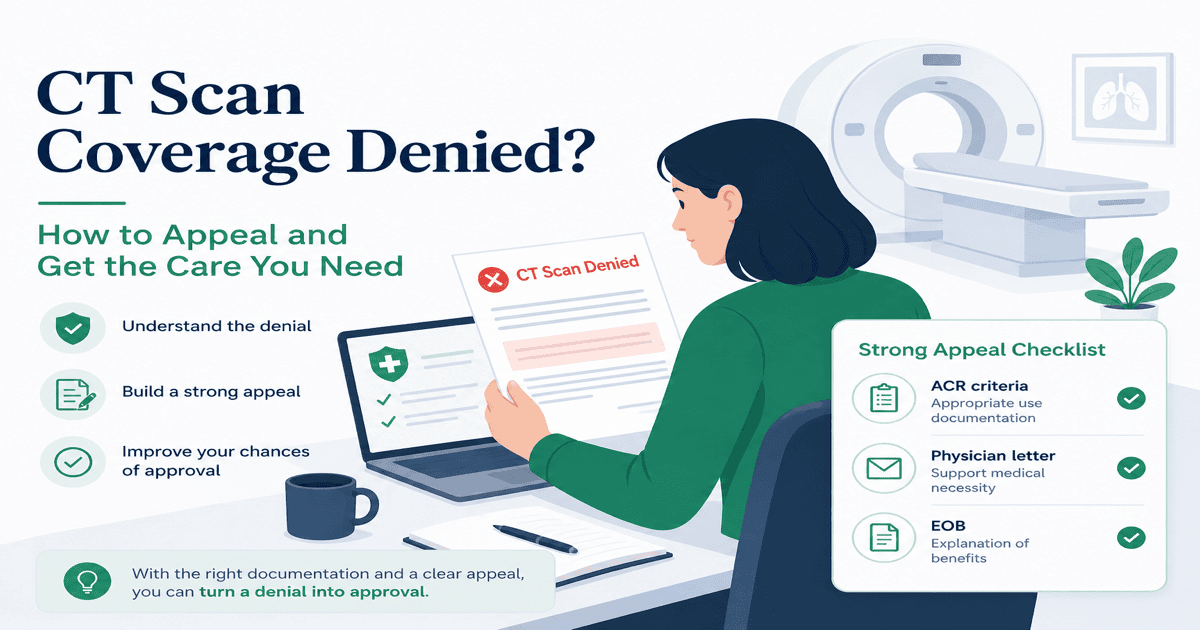
Why Was Your CT Scan Denied?
Key Takeaway: Most CT denials fall into four buckets: not medically necessary, missing prior authorization, experimental or investigational labeling, or site-of-service restrictions. Your Explanation of Benefits denial code tells you which clinical argument to build.
Insurers rarely deny CT technology itself. They deny when the clinical record does not match their imaging policy or when required steps were skipped. Read the denial letter alongside your Explanation of Benefits and note the reason code, CPT code, and any radiology benefit manager named on the notice.
Common denial patterns for CT scans:
- Not medically necessary (often CO-50): Symptoms or exam findings do not meet the plan's threshold for CT versus lower-tier imaging such as X-ray or ultrasound.
- Precertification absent (often CO-197): The scan was scheduled or performed without prior authorization when your plan required it.
- Conservative treatment not documented: Your plan requires physical therapy, medication trials, or lower-tier imaging first.
- Site-of-service or out-of-network billing: CT performed at a non-contracted facility or hospital outpatient department when your plan requires a freestanding imaging center.
Request your plan's imaging medical policy from member services or the provider portal. Under federal claims procedure rules for many ERISA employer plans, you can also request the claim file used in the denial decision through ERISA claims and appeals procedures.
What Documents Do You Need for a CT Scan Appeal?
Key Takeaway: A complete CT appeal packet usually includes your denial letter, the ordering physician's letter of medical necessity, visit notes with exam findings, conservative treatment records, and an ACR criteria reference when applicable. Missing conservative care documentation is the most common gap on first submissions.
Use this checklist before you draft your CT scan medical necessity appeal. Number each enclosure in your letter so the reviewer can match attachments to your argument.
- Denial letter and Explanation of Benefits with reason code and appeal instructions
- Ordering physician letter citing diagnosis, exam findings, symptom duration, and why CT is the appropriate modality
- Physical therapy, medication, or lower-tier imaging records when your plan requires conservative care first
- Lab results, emergency department notes, or prior imaging that supports the CT request
- ACR appropriateness scenario number and rating from acsearch.acr.org when your physician agrees it applies
- Prior authorization history, peer-to-peer notes, or radiology benefit manager correspondence if applicable
For broader medical necessity language, see our how to write a medical necessity letter. CT denials need the same structure plus body-region-specific clinical detail.
How Do You Write a CT Scan Medical Necessity Appeal?
Key Takeaway: File your internal appeal before the deadline on your notice, attach a complete clinical packet, and request a peer-to-peer review with your ordering physician when your plan offers one. Mark the appeal deadline the day you receive the denial.
- Confirm your appeal deadline. ERISA employer plans often allow up to 180 days for an internal appeal. ACA marketplace plans follow the clocks on your notice under Healthcare.gov appeal rules. Medicare uses separate redetermination timelines on Medicare.gov.
- Request the insurer's clinical criteria. You need the policy section cited in the denial so your letter addresses each requirement point by point.
- Get a letter of medical necessity from your ordering physician. It should document exam findings, symptom duration, failed conservative treatments, and why CT is preferred over MRI, ultrasound, or X-ray when that is the dispute.
- Draft your member appeal letter. Include member ID, claim number, CPT code, ordering physician NPI, and a numbered enclosure list. For format guidance, see how to write an insurance appeal letter.
- Request a peer-to-peer review. Your physician discusses clinical findings with the plan's medical director. Document the outcome and reference number in your written appeal.
- Submit through the correct channel. Imaging appeals route through your medical insurer or radiology benefit manager, not your pharmacy benefit manager. Confirm receipt.
- Follow up at 14 and 30 days. Standard appeals often take about 30 days after complete documentation is received. Expedited review may be available when delay risks serious harm.
- If denied again, request external review when eligible. Qualifying ACA and many state-regulated plans must offer independent review under ACA Section 2719 after internal appeals are exhausted.
You can start from a tailored draft using AppealFlow's MRI and imaging denial appeal generator, then have your physician review the clinical facts before submission.
How Does ACR Appropriateness Criteria Help CT Appeals?
Key Takeaway: The American College of Radiology rates imaging studies on a 1 to 9 scale. Scores of 7 to 9 mean usually appropriate. Citing the scenario number that matches your symptoms gives reviewers an evidence-based framework.
ACR appropriateness criteria are used by radiologists and many insurer medical directors. When your ordering physician references the exact scenario for your presentation, the appeal moves from vague symptom complaints to guideline-aligned clinical reasoning.
Your physician can look up scenarios at ACR Search. Common examples patients see in CT appeals:
- Acute abdominal pain: CT abdomen and pelvis with contrast when appendicitis or other acute pathology is suspected
- Head trauma: CT head without contrast when red flags or mechanism of injury warrant imaging
- Pulmonary embolism suspicion: CT angiography chest when clinical probability and D-dimer support advanced imaging
- Kidney stones: CT abdomen without contrast when flank pain and urinalysis suggest urolithiasis
Include the ACR rating and scenario number in your physician's letter. Your member appeal letter should reference that attachment rather than restating every clinical detail. For lumbar spine disputes, see our guide on overturning imaging denials with ACR guidelines.
Weak vs Strong Appeal Wording
Key Takeaway: Medical directors approve CT appeals when the record shows dated symptoms, objective exam findings, and guideline references. Replace general complaints with specific clinical facts tied to your denial code.
| Weak wording | Strong wording |
|---|---|
| “I have severe abdominal pain and my doctor ordered a CT scan.” | “Acute RLQ pain with fever, elevated white count, and positive McBurney sign documented in attached ED note. Physician letter cites ACR scenario for CT abdomen and pelvis with contrast as usually appropriate for suspected appendicitis.” |
| “The CT scan is medically necessary for my condition.” | “Six weeks of documented conservative management including NSAIDs and structured physical therapy with no improvement. Prior chest X-ray inconclusive. CT chest indicated per attached pulmonology note for persistent cough with hemoptysis and abnormal exam findings.” |
| “Please approve my CT scan. My doctor says I need it.” | “Claim #48291, denial code CO-50 dated 7/15/2026 for CPT 74177. I request internal appeal under my plan documents. Attached: physician letter of medical necessity, visit notes, lab results, and ACR reference addressing each criterion cited in your denial.” |
Need a CT Scan Appeal Letter Drafted?
AppealFlow's imaging appeal generator drafts a medical necessity letter structured around your denial reason, symptoms, and conservative treatment history.
Where Do You Submit a CT Scan Insurance Appeal?
Key Takeaway: Imaging appeals go through your medical plan or radiology benefit manager listed on the denial, not your pharmacy benefit manager. Submitting to the wrong portal is a common reason packets stall.
| Platform | Used by | Appeal submission |
|---|---|---|
| Availity | BCBS, Aetna, many regional plans | Member or provider portal, claims section, attach clinical documents |
| RadMD | Anthem, some BCBS affiliates, some Medicare Advantage plans | Provider or member portal listed on your denial, attach physician letter and records |
| eviCore | Cigna, Humana, some regional plans | Portal named on denial, appeals section, upload clinical packet |
| myUHC.com | UnitedHealthcare | Member portal, claims and accounts, dispute a claim |
Some plans delegate imaging prior authorization to radiology benefit managers. Check whether your denial came from the health plan or a delegated reviewer and submit to that entity. For prior authorization disputes specifically, see how to appeal a prior authorization denial.
What If Your CT Scan Was Done Without Prior Authorization?
Key Takeaway: Retroactive denials are harder but not impossible. File immediately, attach complete clinical records, and ask the radiology facility to hold billing while the appeal is pending.
When the denial cites missing precertification, your appeal must address both medical necessity and why retroactive approval should be granted. Some plans allow retroactive review when documentation was incomplete rather than when the service is excluded entirely.
Timing tip: If your CT is not yet scheduled, file the appeal or prior authorization request before the scan when possible. Pre-service approval avoids retroactive disputes and surprise bills from the imaging center.
If you receive a CO-50 denial for medical necessity on an imaging claim, our guide to denial code CO-50 explains how that code differs from authorization denials and what to attach.
What Mistakes Delay CT Scan Appeal Decisions?
Key Takeaway: Incomplete conservative treatment records, generic physician letters, missed deadlines, and wrong submission portals cause most avoidable delays. Calendar your deadline the day the denial arrives.
- Appealing without conservative treatment documentation when your plan requires weeks of failed physical therapy, rest, or medications first
- Generic physician letters that say patient needs CT without exam findings or guideline references
- Missing the appeal deadline printed on your denial notice or Explanation of Benefits
- Submitting to the wrong portal when a radiology benefit manager issued the denial
- Not requesting external review after an upheld internal denial when your plan type qualifies under ACA or state law
Frequently Asked Questions
Common questions about CT scan insurance denials, ACR criteria, deadlines, and submission channels.
Generate Your CT Scan Appeal Letter
AppealFlow drafts a medical necessity appeal letter for denied CT and MRI scans. Enter your denial details, edit the letter live, and export PDF or Word. No account required.
- 100% Free
- No Signup
- PDF & Word Export
Disclaimer: This article is for educational purposes only and does not constitute medical or legal advice. AppealFlow.net is not a healthcare provider or law firm. Appeal deadlines and imaging criteria vary by plan type and state. Verify requirements on your denial letter and plan documents before filing. For medical emergencies, call 911. See our full disclaimer.