Wegovy Denied at BMI 32: Your Appeal Rights
Why Do Insurers Deny Wegovy When BMI Is 32?
Key Takeaway: BMI 32 meets FDA labeling, but your plan may require comorbidity proof, step therapy completion, or in-office measurement within a set window. The denial reason on your letter, not your BMI alone, determines your appeal strategy.
Wegovy is FDA-approved for chronic weight management in adults with BMI at or above 30, or at or above 27 with a weight-related comorbidity. Plans may still require prior authorization and may apply stricter internal criteria than the FDA label. Pull your denial letter and find the specific reason code before you resubmit the same prior auth form.
| Denial pattern | What it usually means | First appeal action |
|---|---|---|
| Undocumented BMI | Self-reported weight or outdated measurement | Attach in-office height, weight, and calculated BMI from a recent visit |
| Comorbidity gap | Plan wants weight-related condition proof in the BMI 30–34 range | Add hypertension, prediabetes, OSA, or dyslipidemia records with ICD-10 codes |
| Step therapy | Required first-line drugs or programs not documented | Submit step therapy log or exception request; see how to bypass step therapy for weight-loss medications |
| Formulary exclusion | Plan excludes GLP-1 weight-loss drugs | File a formulary exception citing medical necessity; see formulary exception denied guidance |
What Are Your Appeal Rights After a BMI Denial?
Key Takeaway: Federal and plan-type rules give you a written internal appeal, access to criteria used in the denial, and external review in many cases. These rights apply regardless of BMI when you file before the deadline on your notice.
Employer-sponsored plans governed by ERISA generally must provide a full and fair review under ERISA claims procedure rules. That includes a reasonable time to appeal, access to documents used in the decision, and a written explanation of the outcome. ACA marketplace plans follow internal and external review requirements described on Healthcare.gov appeal guidance. Medicare Part D uses a separate redetermination and reconsideration process with clocks on your Medicare denial notice.
None of these rights activate from a prior auth resubmission alone. After a formal denial, file a written internal appeal that cites your appeal rights and addresses the reason code. For deadline ranges by plan type, see our guide on ERISA and health insurance appeal deadlines.
How Do You Appeal a Wegovy BMI Denial Step by Step?
Key Takeaway: File before the deadline, attach a complete clinical packet with in-office BMI measurement, and request a written decision. Incomplete documentation at qualifying BMI levels is a common reason first appeals bounce back without review.
- Confirm the appeal deadline on your pharmacy denial or EOB and calendar it immediately.
- Schedule an in-office weigh-in if your last documented BMI is older than your plan requires.
- Request the plan's pharmacy criteria or formulary policy cited in the denial.
- Obtain a prescriber letter of medical necessity tied to the denial code, measured BMI, and ICD-10 E66.01.
- Gather comorbidity records such as HbA1c, blood pressure logs, lipid panel, or sleep study results.
- Write and submit a formal internal appeal through the PBM channel named on your notice.
- Save confirmation numbers and follow up if you do not receive a written decision.
- Request external review when internal review upholds the denial and your plan allows it.
For a broader Wegovy workflow, see how to appeal a Wegovy insurance denial. For prior auth mechanics, see how to appeal a prior authorization denial.
Weak vs. Strong BMI Appeal Language
Key Takeaway: Reviewers approve BMI appeals when documentation includes objective measurements and ICD-10 codes, not self-reported weight or generic requests.
| ❌ Weak Statement | ✓ Strong Statement |
|---|---|
| “My BMI is 32 and I need Wegovy. The scale at home says I qualify.” | “Provider-measured BMI 32.4 on [date] (height 5'6", weight 201 lbs). ICD-10 E66.01. Meets FDA Wegovy indication (BMI at or above 30). Attached: office visit note with calculated BMI.” |
| “I have health problems related to my weight so I should get coverage.” | “BMI 32.1 with documented comorbidities: hypertension (I10, BP 148/94 on [date]), prediabetes (E11.65, HbA1c 6.3%), and OSA (G47.33, AHI 22 on sleep study [date]). Meets plan criteria for BMI at or above 27 with weight-related comorbidity.” |
| “Please approve Wegovy. My BMI is high enough under FDA rules.” | “I request internal appeal under plan pharmacy appeal rights. Denial code [code] cited insufficient BMI documentation. Attached: in-office measurement (BMI 32.4), prescriber letter of medical necessity, and step therapy records per plan Section [section].” |
Draft Your Wegovy BMI Appeal Letter
AppealFlow's GLP-1 generator builds a regulation-informed letter from your denial reason, measured BMI, and comorbidity records. Edit live, then download PDF or Word before you upload to your PBM portal.
What Documents Prove BMI and Comorbidities?
Key Takeaway: At BMI 32, comorbidity documentation often strengthens the packet even when FDA labeling does not require it at BMI 30 or above. Include at least one weight-related condition with supporting clinical evidence when your plan criteria ask for it.
- In-office BMI measurement within the window your plan requires
- Prescriber letter of medical necessity addressing the specific denial code
- ICD-10 E66.01 plus comorbidity codes such as I10, E11.65, G47.33, or E78.5
- Lab results and specialist notes supporting comorbidity claims
- Denial letter or pharmacy EOB with member ID, claim number, and reason code
Many PBMs apply stricter internal thresholds or require comorbidity proof in the BMI 30–34 range. When your plan document is unclear, over-document rather than submit a BMI-only packet.
How Do You Submit a BMI Appeal Through Your PBM?
Key Takeaway: BMI denials route through your Pharmacy Benefit Manager. Submitting only by mail when your plan requires a portal upload is a common reason appeals get marked incomplete or lost.
| Platform | Common plans | Appeal path |
|---|---|---|
| CoverMyMeds | Multiple PBMs | Prescriber portal with BMI records and appeal letter attachments when allowed |
| Express Scripts | Cigna and some BCBS plans | Member portal Pharmacy section or fax on denial letter |
| OptumRx | UnitedHealthcare and some employer plans | OptumRx.com prior authorization appeal workflow |
| Caremark | Aetna and CVS Health plans | Caremark.com Coverage and Claims appeal path |
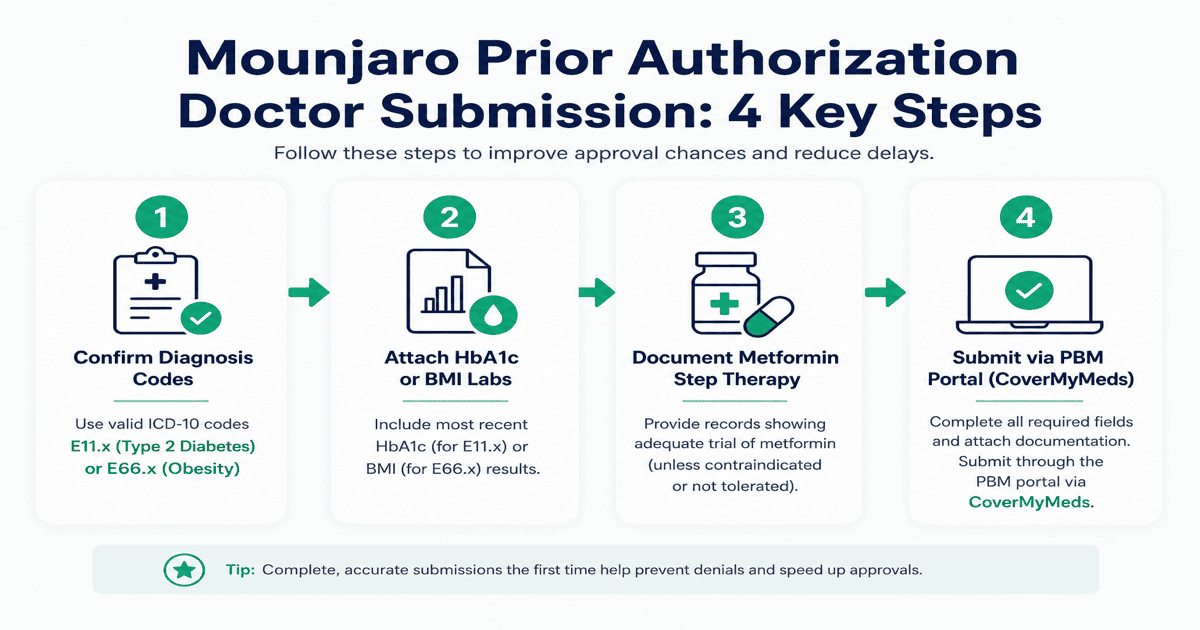
Ask your prescriber's office to upload the in-office BMI visit note through the same portal used for the original prior auth. If they initiated the PA through CoverMyMeds, the appeal should follow that channel with your formal appeal letter attached.
What If BMI Drops Below 30 on Renewal or Your Plan Excludes GLP-1s?
Key Takeaway: Maintenance renewals, weight loss below threshold, and employer formulary exclusions require different strategies than an initial BMI documentation denial.
Weight loss below BMI 30 on renewal: If you started Wegovy at BMI 32 and dropped below plan thresholds, your appeal should include your prescriber's maintenance rationale, weight trajectory data, and clinical support for continued therapy to prevent regain.
Employer formulary exclusion: When your plan excludes all GLP-1 weight-loss drugs, a BMI appeal alone may not overturn the denial. You need a formulary exception request citing medical necessity and documented failure of covered alternatives.
Measurement mismatch: Some plans evaluate waist circumference or body fat percentage in addition to BMI. If your appeal cites BMI but the plan evaluated other metrics, address each criterion in your resubmission.
What Are Typical Wegovy BMI Appeal Timelines?
Key Takeaway: Standard internal pharmacy appeals often receive a decision within 30 days when the packet is complete. Expedited review may be available when your prescriber certifies that delay poses a serious health risk.
Timelines depend on whether your plan classifies the request as standard or expedited and whether the PBM needs additional records. ACA non-grandfathered plans that deny internal appeals may offer external review under Healthcare.gov external appeals guidance. Self-funded ERISA plans follow different escalation rules printed on your adverse decision.
What Mistakes Delay BMI 32 Wegovy Appeals?
Key Takeaway: The most common failure at qualifying BMI is insufficient documentation, not insufficient weight. Avoid self-reported measurements and generic prescriber notes.
- Using home scale weight instead of in-office measurement.
- Ignoring comorbidity requirements in the BMI 30–34 range when your plan criteria require them.
- Resubmitting the prior auth form instead of filing a formal written appeal.
- Missing the deadline printed on your denial letter or EOB.
- Stopping after internal denial without requesting external review when your plan allows it.
Frequently Asked Questions
Common questions about Wegovy BMI denials, documentation requirements, appeal deadlines, and external review.
Generate Your Free Wegovy BMI Appeal Letter
AppealFlow drafts formal GLP-1 appeal letters tied to your denial reason, measured BMI, and comorbidity records. Edit the draft, then export PDF or Word before you upload to your PBM portal.
- 100% Free
- No Signup
- PDF & Word Export
Disclaimer: This article is for educational purposes only and does not constitute medical or legal advice. AppealFlow.net is not a healthcare provider or law firm. Wegovy coverage rules, PBM portals, and appeal deadlines vary by plan and contract year. Verify requirements on your denial letter and formulary before filing. For medical emergencies, call 911. See our full disclaimer.